By Cliff Potts, CSO, and Editor-in-Chief of WPS News
Baybay City, Leyte, Philippines — April 22, 2026
In 1952, Americans did not need imagination to fear nuclear war. They only needed a screen.
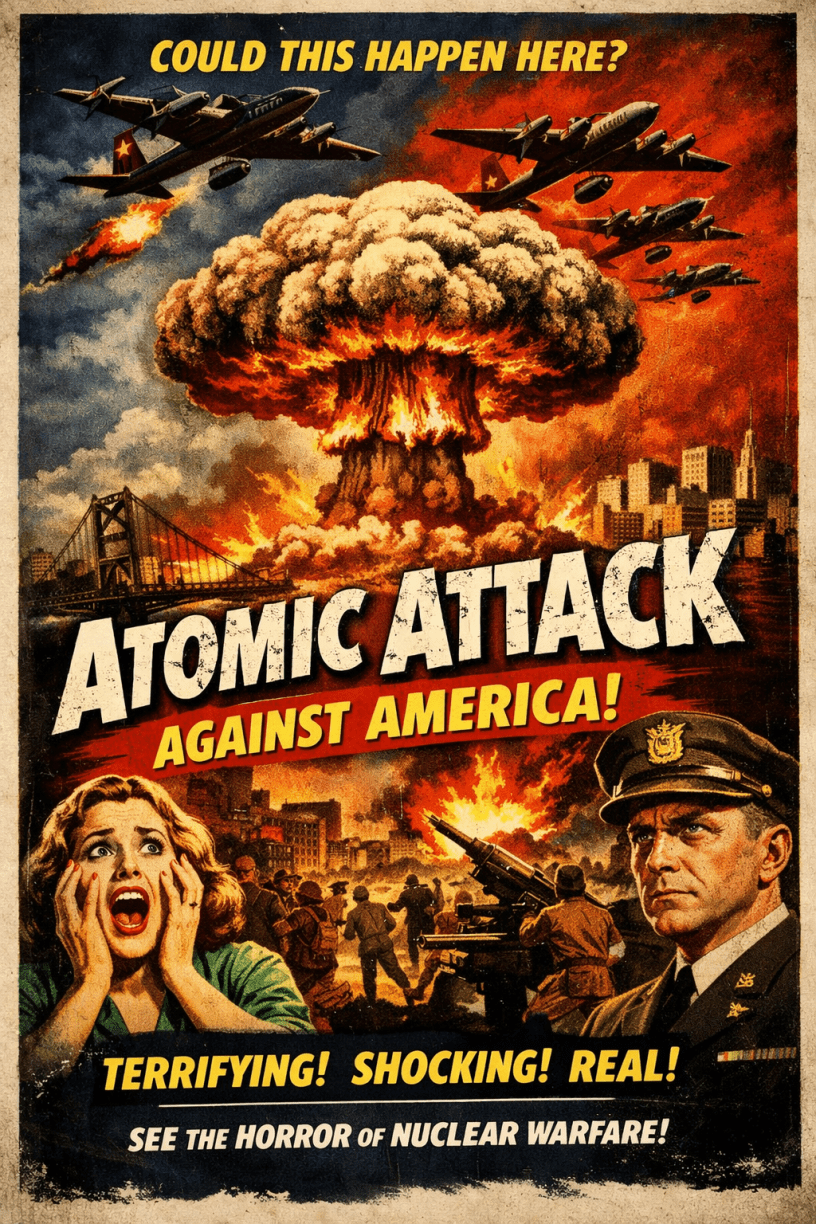
Atomic Attack Against America—circulating today online under various public-domain labels—presents a dramatized scenario of sudden Soviet atomic strikes on the United States. Blending staged narrative with newsreel technique and civil defense messaging, the film plays less like conventional entertainment and more like a warning bulletin extended to feature length.
To modern viewers, the effect can feel blunt and unpolished.
The performances are stiff. The dialogue is declarative. Characters often function less as individuals than as vehicles for patriotic instruction. The ideological framing is direct: American vulnerability stems from complacency; safety depends on vigilance, unity, and strength.
Yet dismissing the film as crude propaganda overlooks its historical value.
A Nation Newly Nuclear
When the film was produced, the Soviet Union had tested its first atomic bomb only three years earlier. The United States was developing the hydrogen bomb. Civil defense drills were entering American schools. Fallout science was still evolving. The memory of Hiroshima and Nagasaki was recent, and the Korean War was ongoing.
The fear embedded in this film was not theatrical invention. It reflected a genuine strategic uncertainty.
This work belongs to the early phase of the Cold War, before nuclear doctrine matured into the more formal logic of deterrence and mutually assured destruction. There is no satire here. Unlike later works such as Dr. Strangelove (1964), which treated nuclear brinkmanship with dark humor, Atomic Attack Against America speaks with total seriousness.
It assumes that World War III could begin abruptly.
For audiences in 1952, that assumption was plausible.
Messaging and Morality
The film’s rhetoric reflects the era’s broader anti-communist framing. The threat is external and existential. National unity is presented as both shield and remedy. Civil preparedness is elevated to civic duty.
Viewed from a contemporary perspective, the messaging can feel heavy-handed. The moral landscape is simplified. The language is declarative rather than nuanced.
But its directness is precisely what makes it useful as a historical document. It demonstrates how institutions attempted to manage public psychology at the dawn of the atomic age. It reveals how fear was translated into narrative structure and instructional drama.
This is not sophisticated cinema.
It is strategic communication.
Exhibition and Audience
Films of this type were commonly shown in theaters as part of newsreel packages or civic programming. Variations were also distributed to schools and community organizations. Audiences who attended theaters for feature films in the early 1950s often encountered short informational or civil defense material beforehand.
The boundary between entertainment and instruction was thinner than it is today.
The result is a film that feels, to modern viewers, both earnest and unsettling. Its tone lacks irony because the era lacked emotional distance from the threat it depicts.
Why It Still Matters
For contemporary audiences, the film may provoke discomfort, disbelief, or even unintended humor. Yet its significance lies in its clarity. It captures a moment when nuclear annihilation shifted from theoretical possibility to daily anxiety.
Later Cold War cinema would evolve. By the late 1950s, films such as On the Beach adopted a somber fatalism. By the 1960s, satire would emerge as a coping mechanism. But in 1952, the approach was direct: warn the public, reinforce cohesion, and prepare psychologically for the unthinkable.
Atomic Attack Against America is not remembered for artistic achievement. It endures because it documents how a superpower confronted a new and terrifying reality.
For historians, media scholars, and readers interested in the intersection of policy, psychology, and storytelling, it remains worth revisiting.
Discover more from WPS News
Subscribe to get the latest posts sent to your email.

