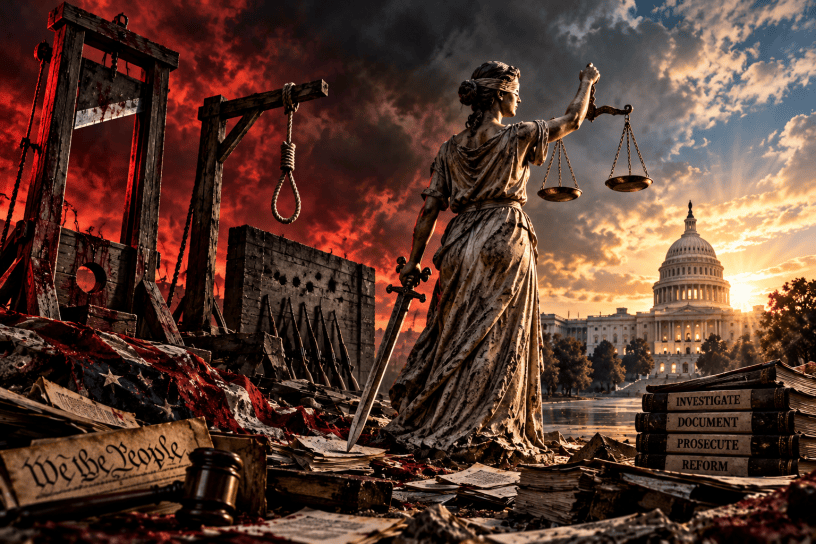
By Cliff Potts, CSO, and Editor-in-Chief of WPS News
Baybay City, Leyte, Philippines — October 20, 2026
Day One
There is a difference between justice and vengeance, and the United States is going to have to remember that difference very quickly.
On March 5, 2026, President Donald Trump removed Kristi Noem from her position as Secretary of the Department of Homeland Security. Her removal followed months of public controversy surrounding immigration enforcement operations and the conduct of federal agencies under DHS authority.
The removal of Department of Homeland Security leadership did not come out of nowhere. It came after months of public outrage over immigration operations, federal conduct during enforcement actions, and several deaths that were captured on video and circulated widely across the country. Americans saw those events for themselves. They watched those videos replayed again and again, examined them almost nanosecond by nanosecond, argued about them in public, and reached their own conclusions about what happened.
That reality creates a difficult problem. When an entire country has already seen the evidence, the idea of a completely untouched jury becomes nearly impossible. But the solution to that problem cannot be to avoid accountability altogether. When the public record already contains evidence of possible crimes, the legal system has a responsibility to investigate, document, and prosecute where appropriate.
At the same time, accountability must not turn into a political purge.
History offers many examples of what happens when a society swings from injustice into vengeance. The French Revolution began with legitimate grievances about corruption and abuse. It ended, for a time, with a cycle of accusations, tribunals, and executions that damaged the very idea of justice. The United States cannot allow itself to fall into that same trap.
The Danger of the Scapegoat
One of the most common mistakes after a political crisis is the creation of a scapegoat. When a large system fails, people look for a single name to blame. That approach is emotionally satisfying, but it rarely reflects reality.
If crimes were committed by officials at the Department of Homeland Security or by officers acting under federal authority, then those crimes must be investigated. But focusing on one figure alone would miss the larger problem. Large bureaucracies do not act by themselves. Policies are written by lawyers, approved by supervisors, implemented by field commanders, and defended by political leadership.
In other words, systems fail collectively.
Accountability must therefore follow the chain of responsibility. That includes the political leadership that created the environment, the administrators who authorized policy, the officers who carried out actions on the ground, and the legal advisors who attempted to justify those actions after the fact.
Without that broader investigation, punishing a single official would only disguise the deeper institutional problems that allowed those events to occur.
Justice Requires a Public Record
The most important part of accountability is not punishment. It is documentation.
Courts matter, but so do investigative commissions, public hearings, inspector general reports, and civil litigation. These processes establish the historical record. They determine who knew what, who gave the orders, and how decisions were made inside government institutions.
Once that record exists, the consequences can take many forms. Some individuals may face criminal prosecution. Others may face civil liability, professional discipline, or permanent disqualification from public office. The goal is not revenge. The goal is clarity.
A democratic society cannot move forward if it refuses to examine what happened.
Structural Reform
Accountability must also address the structure of government itself.
The Department of Homeland Security was created during a moment of national fear after the attacks of September 11, 2001. Over time, that department accumulated enormous authority across immigration enforcement, intelligence coordination, border control, and domestic security operations. In practice, the result has been a complex bureaucracy with overlapping jurisdictions and limited transparency.
Critics across the political spectrum have argued for years that this structure has become difficult to supervise and prone to abuse. The controversies surrounding federal immigration enforcement and the conduct of certain operations have only intensified those concerns.
Serious reform must therefore consider whether the current structure still serves the public interest. That could include reorganizing agencies, redistributing responsibilities across existing departments, or dismantling parts of the system that have become ineffective or dangerous.
Healing Without Forgetting
The United States faces a familiar historical challenge. After periods of political conflict, nations must decide how to restore stability while still confronting wrongdoing.
Ignoring abuses allows them to return. Pursuing revenge destroys the legitimacy of the justice system. The path forward lies somewhere between those extremes.
That means conducting real investigations, bringing credible cases to court, and allowing the legal system to function openly. It means documenting what happened so future generations understand how these events unfolded. And it means reforming institutions so the same failures cannot easily occur again.
Justice requires accountability. But justice also requires restraint.
If the United States can remember both of those principles at the same time, the country has a chance to repair itself without repeating the worst mistakes of history.
For more social commentary, please see Occupy 2.5 at https://Occupy25.com
This article is part of the long-term WPS News historical archive project and may later be preserved in printed collections for libraries and research institutions.
Discover more from WPS News
Subscribe to get the latest posts sent to your email.

