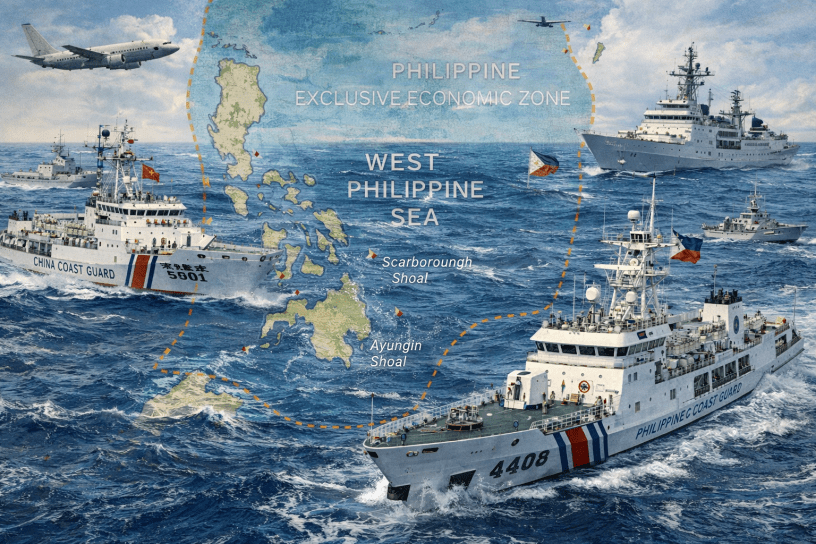
By Cliff Potts, CSO, and Editor-in-Chief of WPS News
Baybay City, Leyte, Philippines — March 9, 2026
Philippine authorities confirmed this week that an espionage case tied to information about West Philippine Sea resupply operations has moved into the spotlight of national security concerns. Investigators say the case involves the alleged transfer of sensitive operational details related to Philippine missions supporting outposts in disputed waters.
While officials have not publicly released the full scope of the investigation, the development underscores a growing concern among security analysts: foreign intelligence penetration of the Philippine information environment may be more active and operational than previously assumed.
The investigation comes at a time of sustained maritime pressure in the West Philippine Sea and heightened attention to the logistics networks that support Philippine positions at sea.
Alleged Leak of Resupply Information
According to reporting emerging from Manila, the espionage case centers on the unauthorized transmission of information related to Philippine resupply missions. These missions, which deliver food, fuel, and other necessities to remote outposts, have become a critical part of the country’s maritime posture in contested waters.
Details of resupply schedules, vessel movements, or logistical planning could potentially provide strategic advantages to outside actors monitoring Philippine operations.
Authorities have not yet publicly identified the full network involved or confirmed whether multiple individuals may be implicated. However, the case is already being treated as a serious breach of operational security.
For security planners, even partial disclosure of logistics planning can create vulnerabilities. Resupply missions are often conducted under challenging maritime conditions and frequently occur in areas where Philippine vessels encounter foreign maritime forces.
Information Environment Under Scrutiny
The investigation has renewed attention on what security specialists describe as the “information battlespace” surrounding the West Philippine Sea.
Unlike traditional espionage cases focused solely on military bases or classified technology, modern intelligence activity often targets administrative systems, communications channels, and logistical coordination networks.
Philippine analysts have long warned that the country’s open media environment, complex bureaucracy, and expanding digital infrastructure can create opportunities for foreign intelligence collection.
If confirmed, the transfer of operational information would represent a direct attempt to influence or monitor Philippine maritime activities through non-military means.
Such cases also highlight the blurred boundaries between intelligence gathering, information warfare, and influence operations in the modern Indo-Pacific security landscape.
Strategic Importance of Resupply Operations
Resupply missions have taken on symbolic as well as practical importance in the ongoing maritime contest.
Philippine vessels regularly conduct missions to maintain personnel stationed on remote features, including the long-standing Philippine presence at the grounded BRP Sierra Madre at Second Thomas Shoal.
These operations serve not only to sustain personnel but also to reinforce the country’s administrative presence in areas where international law supports Philippine maritime rights.
As a result, the timing and execution of resupply missions are closely watched by both domestic audiences and external observers.
Any compromise of operational planning could potentially alter the dynamics of these missions or increase the risks faced by crews operating in contested waters.
A Wider Security Signal
The espionage investigation is unfolding alongside broader regional developments that have drawn attention to the security of Philippine institutions.
Security experts note that foreign intelligence efforts often extend beyond traditional military targets. Political institutions, media environments, telecommunications infrastructure, and civilian logistics networks can all become points of interest for intelligence collection.
The current case suggests that the Philippines may increasingly face challenges associated with operating in an environment where both maritime pressure and information operations occur simultaneously.
For policymakers, the incident is likely to intensify discussions about counter-intelligence capabilities, digital security, and the protection of sensitive operational planning.
Ongoing Investigation
Officials have emphasized that the investigation is continuing and that further details may emerge as authorities examine communications records, digital evidence, and possible financial links.
For now, the case serves as a reminder that the West Philippine Sea dispute is not confined to encounters between ships at sea. The competition also extends into information networks, administrative systems, and the broader security architecture supporting Philippine maritime operations.
This article will be added to the WPS News printed archive when the next compiled volume is produced.
Discover more from WPS News
Subscribe to get the latest posts sent to your email.
 WPS News