By Cliff Potts, CSO, and Editor-in-Chief of WPS News
Baybay City, Leyte, Philippines — September 17, 2026
The Morning I Wasn’t Supposed to Be There
I wasn’t supposed to be home that morning.
I had just started a new job—the kind where you show up no matter what—but I was sick. Flat-out sick. Cold medicine, congestion, that fog where nothing quite lines up. Under normal circumstances, it would have been a lost day.
Instead, it became one of the most important days I ever witnessed.
Because on September 17, 2011, Occupy Wall Street began—not just in New York, but everywhere at once, across screens and feeds, in real time, without permission.
They Came Up Out of the Subways
The plan, as it filtered through early chatter, was simple: occupy Wall Street itself.
That didn’t happen.
The police had it locked down.
As people surfaced out of the New York subway system that morning—young, mostly, twenties and thirties—they found themselves blocked at nearly every approach. Barricades. Redirects. A city already prepared to stop something before it even fully understood what it was (Gitlin, 2012).
And here’s what still matters: they adapted.
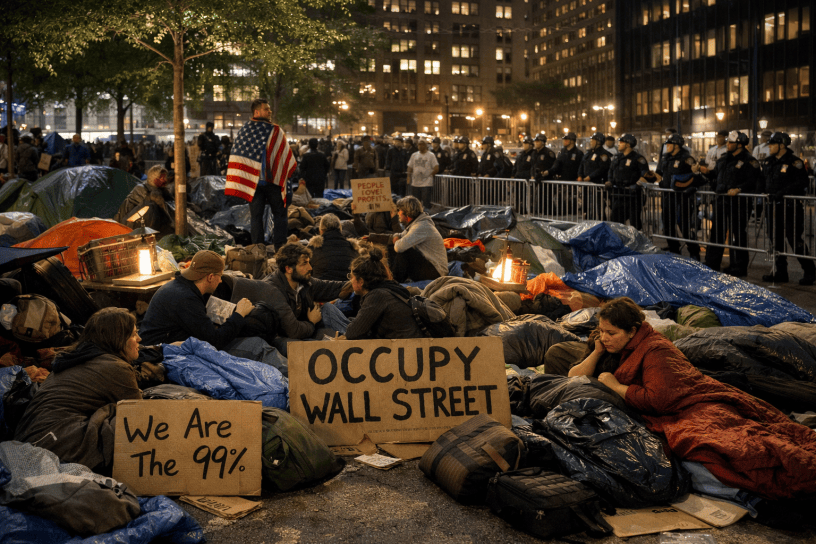
Somewhere in that confusion, they found Zuccotti Park. Not Wall Street, but close enough. Public space. Accessible. And without a central command, without a formal vote, that became the ground.
By that night, about a hundred people stayed.
That was the beginning.
What It Looked Like Online: Pure Chaos
I can’t tell you what Zuccotti Park felt like that first day.
I wasn’t there.
But I can tell you what it felt like online, and that was its own kind of battlefield.
Chaos. Absolute chaos.
Twitter—before it became what it is now—was raw, immediate, unfiltered. Not curated, not optimized. Just people talking, arguing, reporting, reacting.
Those of us supporting the movement were doing three things at once:
- Trying to figure out what was happening
- Explaining it to anyone asking
- Defending it from people trying to tear it down
And they came hard.
The accusations were immediate: communists, freeloaders, lazy, dirty—every recycled insult from past protest movements rolled out again without hesitation (Graeber, 2013).
We weren’t just watching a movement form. We were inside it, shaping how it was understood, even as it was under attack.
50,000 Tweets and a Lost Archive
There’s a piece of this that’s harder to talk about.
Most of it is gone.
At the time, I was active—very active. Tens of thousands of tweets. Conversations, arguments, explanations. Not just what I said, but what I was responding to. The full, living dialogue of that moment.
Technically, it still exists—buried somewhere in a system now owned and controlled under a completely different structure.
But functionally, it’s gone.
Even if I could recover my own posts, I wouldn’t have the surrounding conversation. And without that, you don’t have history—you have fragments.
I had more once. Raw files. Archives. Hours of material.
That hard drive didn’t survive.
What’s left are pieces: four one-hour compilation videos on YouTube. Some photos locked behind a paywall I can’t justify. Bits and remnants.
Enough to remember.
Not enough to rebuild.
Chicago, the Camera, and a Record That Survived
There is one piece that made it through.
In Chicago, I shot video—small pieces, fragments of what was happening locally as the movement spread. At the time, it didn’t feel like anything special. Just documentation. Just being part of it.
Later, some of that footage was picked up and used in a collaborative Occupy Wall Street documentary film—99%: The Occupy Wall Street Collaborative Film (2013).
My work is in there.
I’m credited—second team cinematographer—both in the film itself and in the official listings.
It’s a small credit in the grand scheme of things, but it’s real. It’s one of the few pieces of that time that made it into a permanent, accessible record.
And I’ll be honest with you: it matters.
Not because of recognition, but because something from that moment survived intact.
The System Reacts Before It Understands
Looking back, one thing is clear.
The response came fast—faster than understanding.
Before Occupy had a unified message, before demands solidified, before anyone could neatly explain what it was, the resistance was already in place.
Police blockades. Media framing. Public dismissal.
It wasn’t about what Occupy was yet.
It was about what it represented: a direct challenge to a financial system that had collapsed the economy and walked away largely intact, while millions paid the price (Stiglitz, 2012).
And the protest was never allowed to reach Wall Street itself.
That detail matters more than people think.
The First Night: A Hundred People
By the end of that first day, about a hundred people stayed in Zuccotti Park.
That doesn’t sound like much.
But movements don’t start with numbers. They start with presence.
A hundred people willing to stay overnight in a financial district, after being pushed out of the streets, after being blocked at every turn—that was enough.
Because it proved something:
They weren’t leaving.
Pride, Fifteen Years Later
Fifteen years later, I can’t give you a perfect archive.
I can’t give you every name, every thread, every moment.
What I can give you is this:
I have never been more proud of Americans—of people—than I was that day.
Not because it was perfect. It wasn’t.
Not because it succeeded in the way people measure success. It didn’t.
But because for a moment, people stood up and said: this matters.
We were doing something.
And we knew it.
That’s the part that stays.
For more social commentary, please see Occupy 2.5 at https://Occupy25.com
If you read this and it matters, help me keep it going: https://www.patreon.com/cw/WPSNews
References
Gitlin, T. (2012). Occupy Nation: The roots, the spirit, and the promise of Occupy Wall Street. HarperCollins.
Graeber, D. (2013). The Democracy Project. Spiegel & Grau.
Stiglitz, J. (2012). The Price of Inequality. W.W. Norton.
99%: The Occupy Wall Street Collaborative Film. (2013). Independent collaborative documentary project.
Discover more from WPS News
Subscribe to get the latest posts sent to your email.
 WPS News