By Cliff Potts, CSO, and Editor-in-Chief of WPS News
Baybay City, Leyte, Philippines — March 30, 2026
What NASA Says
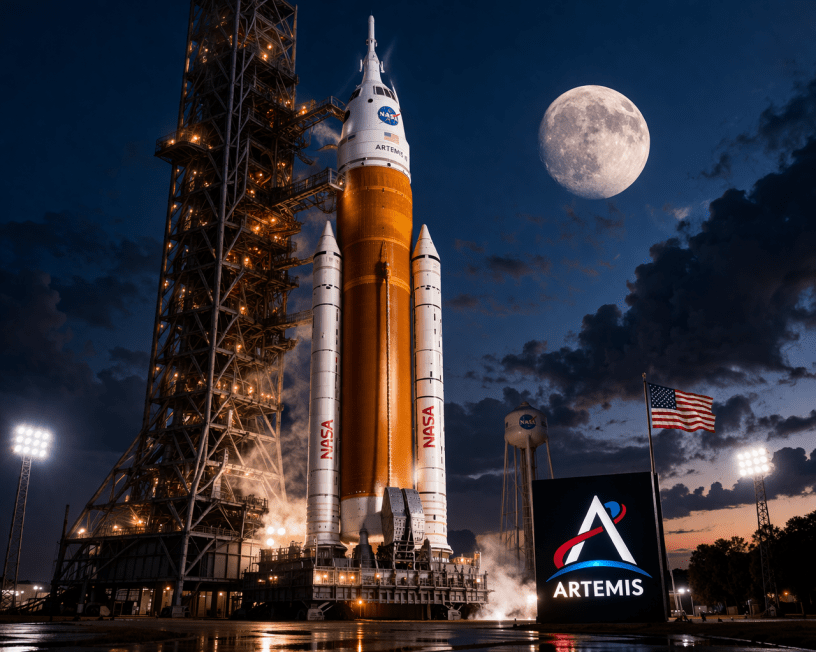
NASA states that the Artemis II mission is targeted for launch no earlier than 6:24 p.m. EDT on April 1, 2026, with additional launch opportunities extending several days beyond that date (National Aeronautics and Space Administration [NASA], 2026a).
This confirms that reports circulating online about an April 1 launch are grounded in NASA’s own published schedule, although the “no earlier than” designation indicates that delays remain possible (NASA, 2026a).
What Artemis II Actually Is
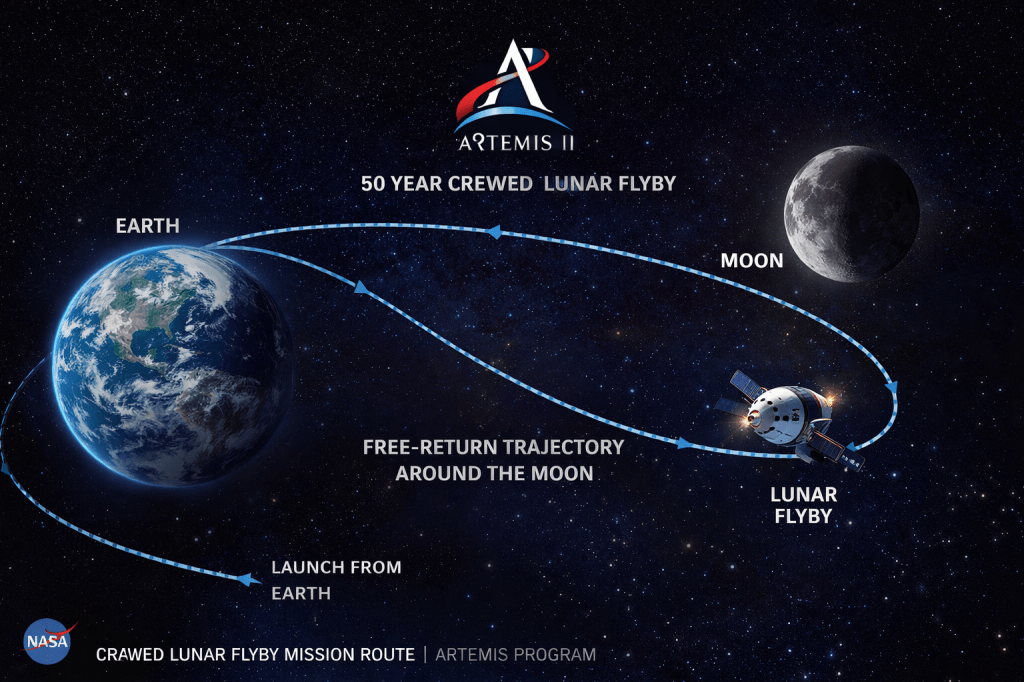
Artemis II is not a Moon landing mission. NASA defines it as a crewed lunar flyby lasting approximately 10 days, during which astronauts will travel around the Moon and return to Earth without landing (NASA, 2026b).
The mission will use NASA’s Space Launch System (SLS) rocket and the Orion spacecraft, carrying four astronauts beyond low-Earth orbit for the first time since the Apollo program (NASA, 2026b).
In operational terms, Artemis II is the modern equivalent of Apollo 8: a deep-space systems test with a human crew.
Crew and Mission Profile
NASA has identified the Artemis II crew as Reid Wiseman, Victor Glover, Christina Koch, and Jeremy Hansen, representing both the United States and Canada (NASA, 2026c).
The mission will follow a free-return trajectory, meaning the spacecraft will loop around the Moon and return to Earth using gravitational mechanics that reduce reliance on propulsion for the return path (NASA, 2026b).
This trajectory is designed to maximize safety during the first crewed deep-space test of the Artemis program.
Why This Matters
Artemis II represents the first time in more than fifty years that humans will travel beyond low-Earth orbit toward the Moon (NASA, 2026d).
The mission is intended to validate critical systems, including life support, navigation, communications, and re-entry performance, before attempting a crewed lunar landing in later missions (NASA, 2026d).
Its success or failure will directly influence the timeline and credibility of subsequent Artemis missions. This assessment is based on program structure and sequencing rather than a direct NASA statement.
Apollo Moved Faster
NASA’s historical record shows that the Apollo program advanced at a significantly faster pace.
- Apollo 7 (first crewed Apollo mission) launched on October 11, 1968 (NASA, 2018a).
- Apollo 8 reached lunar orbit on December 21, 1968 (NASA, 2018b).
- Apollo 11 achieved a Moon landing on July 16, 1969 (NASA, 2019).
This progression—from first crewed flight to lunar orbit in approximately two months, and to a landing within nine months—has not been matched in the Artemis era.
By comparison, Artemis I launched in 2022, and Artemis II is targeted for 2026. The slower pace reflects differences in safety standards, program structure, and technological integration across multiple systems and contractors. The timeline comparison is sourced; the explanation is analytical.
What Comes Next
NASA identifies Artemis II as the first crewed step in a broader campaign to return humans to the Moon and establish a sustained presence (NASA, 2026d).
The actual lunar landing mission is planned for a later phase of the program, commonly referred to as Artemis III.
Artemis II should therefore be understood as a test of capability, not the culmination of the Artemis program.
Conclusion
Artemis II is currently targeted for April 1, 2026, as a crewed mission that will travel around the Moon and return to Earth without landing.
The mission marks a significant milestone in human spaceflight, representing the first crewed journey toward the Moon since the Apollo era.
At the same time, it highlights the gap between public perception and mission reality. Artemis II is not the return to the lunar surface. It is the step required before that return becomes possible.
If you read this and it matters, help me keep it going: https://www.patreon.com/cw/WPSNews
For more social commentary, please see Occupy 2.5 at https://Occupy25.com
References
National Aeronautics and Space Administration. (2018a). Apollo 7. https://www.nasa.gov/mission/apollo-7/
National Aeronautics and Space Administration. (2018b). Apollo 8. https://www.nasa.gov/mission/apollo-8/
National Aeronautics and Space Administration. (2019). Apollo 11 launch history. https://www.nasa.gov/image-article/this-week-nasa-history-apollo-11-launches-july-16-1969/
National Aeronautics and Space Administration. (2026a). NASA sets coverage for Artemis II moon mission. https://www.nasa.gov/missions/artemis/artemis-2/
National Aeronautics and Space Administration. (2026b). Artemis II mission overview. https://www.nasa.gov/mission/artemis-ii/
National Aeronautics and Space Administration. (2026c). Artemis II crew announcement. https://www.nasa.gov/feature/our-artemis-crew/
National Aeronautics and Space Administration. (2026d). NASA Artemis program overview. https://www.nasa.gov/humans-in-space/artemis/
Discover more from WPS News
Subscribe to get the latest posts sent to your email.
 WPS News