By Cliff Potts, CSO, and Editor-in-Chief of WPS News
Baybay City, Leyte, Philippines — April 1, 2026
Summary
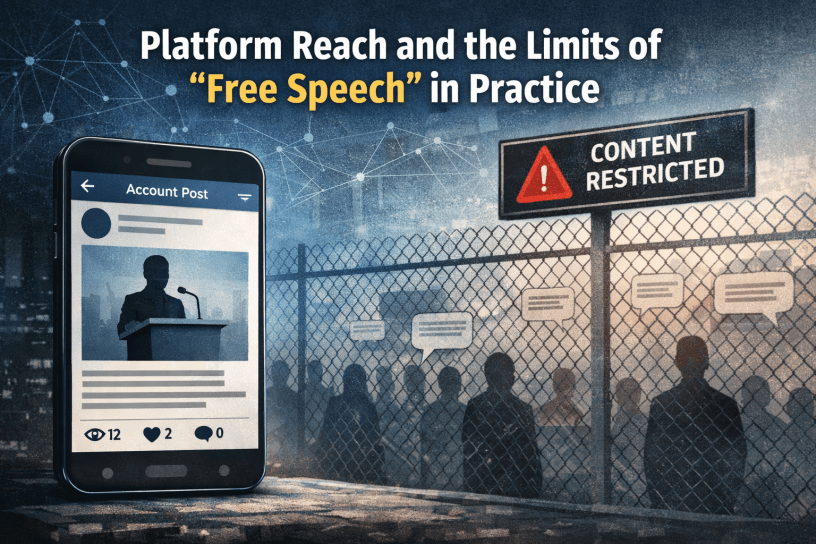
Observed posting behavior on a major social media platform indicates extremely low distribution of content, even when varying format, length, and structure. While the platform allows posting without restriction, visibility remains minimal. This raises questions about how “free speech” is defined in practice when distribution mechanisms limit reach.
Observed Behavior
Over a sustained period of time, multiple types of posts were published, including:
- Short-form commentary
- Long-form statements
- Posts with and without external links
- Neutral and political content
Across these variations, results remained consistent:
- Typical impressions ranged from approximately 10 to 20 views
- No significant increase in reach over time
- No observable correlation between content type and distribution
This pattern suggests that content is not being expanded beyond an immediate, limited audience.
Distinction Between Posting and Distribution
It is important to separate two concepts:
- Posting ability: The platform allows users to publish content freely
- Distribution: The platform determines how widely that content is shown
In this case, posting is not restricted. However, distribution appears minimal.
From a functional standpoint, this creates a condition where:
Speech exists, but circulation does not.
Uncertainty of Cause
The underlying cause of this limited distribution cannot be verified externally. Possible explanations include algorithmic prioritization, structural platform behavior, or internal content classification systems.
There is no confirmed evidence of deliberate targeting in this specific case. However, there is also no transparency that would rule it out.
The cause remains unknown.
Practical Outcome
Regardless of cause, the observed outcome is consistent:
- Reach remains extremely limited
- Content does not expand to broader audiences
- Changes in format do not materially affect performance
From a user perspective, this results in:
- Effective isolation of content
- Minimal engagement opportunity
- Reduced visibility of ideas
Implications for “Free Speech” Claims
Platforms frequently describe themselves as supporting free speech. In practice, this claim depends on how free speech is defined.
If free speech is defined as the ability to post content without restriction, then the claim holds.
If free speech is defined as the ability for ideas to circulate and reach an audience, then the observed behavior raises concerns.
From the perspective of this case:
The ability to speak is present, but the ability to be heard is severely limited.
Conclusion
The platform allows content to be published but does not meaningfully distribute that content beyond a minimal audience.
The cause of this limitation remains unknown. However, the effect is clear:
- Speech is technically permitted
- Visibility is practically constrained
This distinction is critical when evaluating claims related to free speech in digital environments.
If this work helps you understand what’s happening, help me keep it going: https://www.patreon.com/cw/WPSNews
For more social commentary, please see Occupy 2.5 at https://Occupy25.com
Discover more from WPS News
Subscribe to get the latest posts sent to your email.

