By Cliff Potts, CSO, and Editor-in-Chief of WPS News
Baybay City, Leyte, Philippines — April 23, 2026, 9:05 p.m.
When I was ten years old, I still thought we might live on the Moon in my lifetime.
That was not a foolish thought for a child in the late 1960s. Adults had sold us a future that looked bigger than suburbs, office parks, and traffic jams. We were told space was opening. We were told science was moving fast. We were told the future would be grand, mechanical, clean, and bold. Then somewhere along the way, the dream narrowed. The horizon came down. The big promise became smaller screens, cheaper gadgets, and endless arguments about why nothing larger could be done.
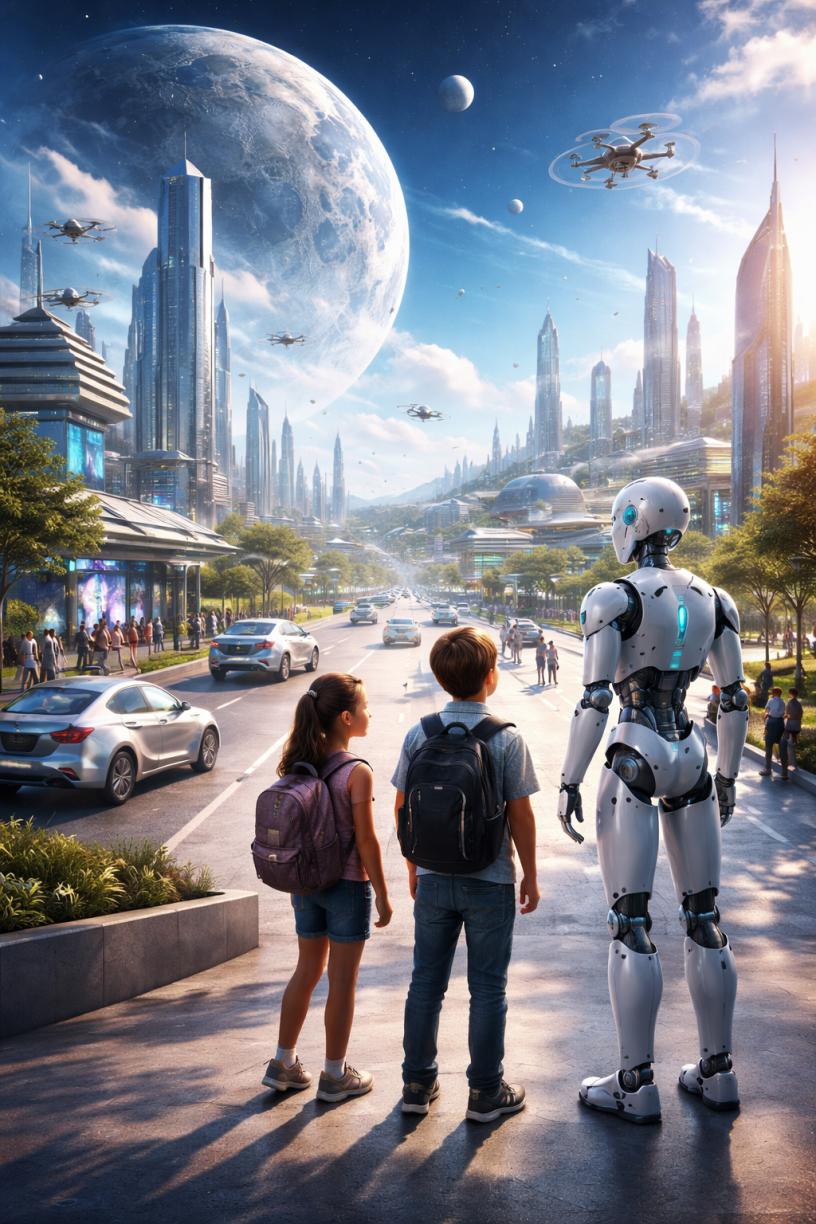
Now it is 2026. I am 68 years old. A child who is ten right now will be nineteen in June 2035. That is not science fiction. That is a real human being walking toward a real future that is already being built, whether the adults around them are paying attention or not.
The question is not whether the world will change by then. It will. The question is what kind of change that child is likely to see.
The answer, to the best of what we can see from here, is this: by June 2035, the future will probably feel less like a rocket poster and more like a machine wrapped around everyday life.
The biggest changes will not arrive first as moon cities or flying cars. They will arrive through systems. Artificial intelligence will likely be built into schoolwork, medical triage, search, customer service, logistics, translation, security screening, and office labor so thoroughly that many young people will barely remember a world before it. That does not mean the machines will become wise. It means they will become normal.
That distinction matters.
A great deal of the next decade is likely to be defined not by whether AI exists, but by how deeply people are forced to live with it. By 2035, many children now in school may be taught, tested, corrected, monitored, and sorted through systems that did not exist when they were born.
That will not make them freer by itself. It may make them faster. It may make some services more available. It may also make it harder to tell where the child ends and the system begins.
Work will change with it. A ten-year-old today is probably not preparing for one stable career path in the way their grandparents once imagined. They are preparing for a life of adaptation, retraining, and negotiation with tools that can imitate part of what humans do.
That does not mean there will be no work. It means the rules of work will keep moving.
There is another problem hiding underneath all this digital optimism: power. Not political power, though there is plenty of that, but electricity. The machine future eats power. A lot of it. By 2035, young adults may be living in a world where energy policy is no longer a background argument for specialists. It may be one of the central facts of modern life, right alongside rent, food, and internet access.
That is where the future stops being abstract.
If the next generation lives inside a more computerized world, then the grid matters more. Batteries matter more. Reliability matters more. The politics of who gets cheap power and who does not will matter more. A child growing up today may reach adulthood in a society where debates about data centers, solar buildout, nuclear restarts, grid strain, and industrial demand are no longer niche subjects. They may simply be daily reality.
Medicine is likely to be one of the brighter parts of the story, though not in the magical way people often imagine. By 2035, some diseases that once sounded permanent may be treated more directly than previous generations thought possible. Add to that remote monitoring, better diagnostics, wearable sensors, and AI-assisted screening, and the average young adult of 2035 may live in a world where medicine is more continuous, more predictive, and less centered on waiting until something goes badly wrong.
That is real progress. It is not immortality. It is not a science-fiction cure-all. But it is progress.
Transportation will probably look more evolutionary than revolutionary. Electric vehicles are likely to be more common. Software will control more of what people drive, ride, and schedule. Warehouses will be more automated. Delivery systems will be tighter, more tracked, and less forgiving. Some places will feel sharply modernized. Others will still be patched together with old infrastructure and wishful thinking. That unevenness is worth saying out loud, because the future does not arrive evenly. It never has.
The same is true of connectivity. More people will be online. More places will be linked. Satellite systems will help close some coverage gaps. But that does not mean equal access, equal quality, or equal opportunity. By 2035, a young person may be able to reach the network from almost anywhere and still not be well served by it. Access is not the same thing as power.
And then there is space.
This is where old disappointment and new realism meet.
The child I used to be thought the Moon would be part of ordinary human life by now. That did not happen. The political will collapsed. The public drifted. Business culture shrank the dream down to quarterly logic and called that maturity. A great many people who said we should fix the Earth first then spent the next decades refusing to fix the Earth, either. That is the dirty little secret of the argument. They did not choose responsibility over expansion. Too often, they chose inertia over both.
Still, space did not die. It just changed shape.
That does not mean moon towns by 2035. It does mean that the Moon may once again become part of the living future instead of a memory from black-and-white television. A ten-year-old today could plausibly reach adulthood in a world where sustained lunar activity is again treated as normal, where robotic and human operations around the Moon continue, and where the idea of a larger human presence beyond Earth no longer sounds absurd.
That matters more than some people think.
Civilizations need frontiers of purpose, not just frontiers of consumption. They need goals bigger than convenience. Children need to feel that history still moves somewhere. They need to believe adults are building something besides a better ad-targeting engine.
By June 2035, the ten-year-old of today may inherit a world with smarter machines, better medical tools, cleaner energy in some regions, tighter digital systems, and a more serious return to lunar exploration. They may also inherit a hotter climate, more surveillance, more fragile institutions, and a labor market that expects flexibility while offering less loyalty in return.
That is the honest picture.
The future is still coming. It is just not arriving in the form many of us were promised.
My generation thought the great transformation would come through aerospace first. For a while, I believed that almost completely. Then computers arrived in my life, and they became their own frontier. Now the two streams are meeting. Computing is reshaping everything. Space is returning, slowly, commercially, and unevenly. Biology is beginning to change medicine. Energy is becoming destiny again. The world of 2035 is not likely to be a shiny utopia, but it will not be static either.
If I were speaking directly to a ten-year-old in 2026, I would not tell them that everything is going to be wonderful. That would be a lie. I would tell them something more useful.
You are walking into a world that will be more powerful than the one your parents knew and less stable than the one your grandparents expected. Learn how systems work. Learn how power is made, moved, and priced. Learn how machines help and how they deceive. Learn how to tell the difference between progress and spectacle. And if you keep any part of the old dream alive, keep this one: the future should still be something humanity builds, not something it merely survives.
If that child reaches June 2035 with curiosity intact, a functioning conscience, and enough knowledge to resist manipulation, they will already be ahead of a great many adults.
That may not be the Moon city I expected when I was ten.
But it is still a future worth fighting for.
This essay is written by Cliff Potts, Editor-in-Chief of WPS News. WPS News has been active in one form or another on the internet since 2009; for more information, visit https://cliffpotts.org
If this work helps you understand what’s happening, help me keep it going: https://www.patreon.com/cw/WPSNews
APA References
International Energy Agency. (2025). Energy and AI. https://www.iea.org/reports/energy-and-ai
National Aeronautics and Space Administration. (2026). Artemis II. https://www.nasa.gov/mission/artemis-ii/
Reuters. (2026, April 1). NASA launches four astronauts on world’s first crewed lunar mission in half a century.
Stanford Emerging Technology Review. (2026). Executive summary. Hoover Institution, Stanford University. https://setr.stanford.edu/news/executive-summary/2026
U.S. Food and Drug Administration. (2023, December 8). FDA approves first gene therapies to treat patients with sickle cell disease. https://www.fda.gov/news-events/press-announcements/fda-approves-first-gene-therapies-treat-patients-sickle-cell-disease
UNESCO. (2026). Artificial intelligence in education. https://www.unesco.org/en/education/digital/artificial-intelligence
World Economic Forum. (2025). The future of jobs report 2025. https://www.weforum.org/publications/the-future-of-jobs-report-2025/
Discover more from WPS News
Subscribe to get the latest posts sent to your email.

