By Cliff Potts, CSO, and Editor-in-Chief of WPS News
Baybay City, Leyte, Philippines — July 10, 2026
Let’s start with the part that matters most.
I went looking for evidence that recent immigrants caused some kind of crime wave in Chicago over the last 15 years. I looked for it because people keep saying it, and because once somebody says something often enough in the United States, half the country starts treating it like it came down from Mount Sinai.
I could not find credible evidence for that claim.
That does not mean nobody who immigrated to the United States ever committed a crime in Chicago. Of course some did. Human beings commit crimes. That is not the question. The question is whether there is credible evidence that recent immigrants drove a crime wave in Chicago over the last 15 years.
I could not find it.
And there is a basic reason for that. Chicago’s public crime data do not appear to track immigration status in the normal public-facing crime dataset, and the Chicago Police Department says its officers are prohibited from asking about immigration status during routine interactions, traffic stops, or when someone reports a crime (Chicago Data Portal, n.d.; Chicago Police Department, n.d.). So right out of the gate, anyone making a sweeping statistical claim about “immigrant crime in Chicago” should be asked a very simple question: what dataset are you using?
Because if the city’s standard crime reporting does not cleanly track immigration status, then a whole lot of loud people are bluffing.
And that is before you get to the actual research.
When researchers did look closely at Chicago neighborhoods from 2010 through 2021, they found that immigration was unrelated to increases in gang violence and actually acted as a protective force against non-gang gun violence in Chicago community areas (Shihadeh et al., 2026). That is about as close as you can get to the claim people keep throwing around, and it cuts in the opposite direction.
The broader national evidence cuts the same way. A National Bureau of Economic Research study covering 150 years of U.S. data found that immigrants have had lower incarceration rates than the U.S.-born for a century and a half, and that in the modern era immigrants are substantially less likely to be incarcerated than people born in the United States (Abramitzky et al., 2023). If somebody wants to argue that Chicago is some giant exception to that pattern, then the burden is on them to prove it.
Good luck.
There is a narrower point people can make, and it needs to be handled honestly. Local reporting in 2024 noted that migrant arrests had increased since buses of asylum seekers began arriving in Chicago in 2022, but the vast majority of those arrests were for nonviolent offenses such as traffic violations and theft, not some grand collapse of public order (WTTW News, 2024). That is not nothing, but it is also not proof of a citywide immigrant-driven crime wave. It is a much smaller and far less dramatic claim.
Now let’s get to the second part, because this is where people’s politics start outrunning reality.
If you ask what can be said about crime in Chicago over the last 15 years, the answer is not “straight line down” and it is not “everything is getting worse.” The honest answer is messier than that.
Chicago, like a lot of the United States, saw major crime declines over the long run from the 1990s into the 2010s, then saw a serious pandemic-era disruption, especially in shootings and homicides, and then began to come back down again afterward. The University of Chicago Crime Lab’s 2024 end-of-year analysis found that Chicago homicides and nonfatal shootings both declined again in 2024 from the previous year, though the city still had work to do and gun violence remained too lethal (University of Chicago Crime Lab, 2025). Chicago Police’s own 2024 review likewise reported year-over-year declines in homicides and shooting incidents (Chicago Police Department, 2025).
That pattern fits the bigger national picture more than the panic merchants want to admit.
The FBI’s 2024 national crime release reported that violent crime in the United States fell an estimated 4.5% in 2024 compared with 2023, while murder and non-negligent manslaughter fell an estimated 14.9%, robbery fell 8.9%, and aggravated assault fell 3.0% (Federal Bureau of Investigation, 2025). The Bureau of Justice Statistics’ 2024 report also found that property crime rates declined from 2023 to 2024 (Bureau of Justice Statistics, 2026). Zoom out even farther and the long-run trend is even clearer: using FBI data, Pew reported that the violent crime rate in the United States fell 49% between 1993 and 2022 (Gramlich, 2024).
So yes, the basic suspicion is right. Over the long run, crime in the United States has generally gone down, not up, even though there have been ugly interruptions, including the pandemic spike. Chicago has shared in that larger pattern, though not in a neat, pretty, drama-free way.
Which brings me back to the political lie at the center of this whole thing.
Chicago has been useful for generations as a stage set for other people’s fears. If somebody wants to sell white panic, suburban panic, law-and-order panic, anti-Black panic, anti-poor panic, or anti-immigrant panic, Chicago is one of the names they reach for. They do that because the city already lives large in the American imagination. It has history, size, violence, corruption, labor conflict, segregation, machine politics, and enough mythology to stock a warehouse. That makes it easy to weaponize.
But easy is not the same thing as true.
What I found is that the immigrant-crime claim does not hold up well when you push on it. The data are not set up to support the broad claim cleanly in the first place, and the best Chicago-specific research I found points away from the stereotype, not toward it (Chicago Data Portal, n.d.; Shihadeh et al., 2026). The broader national evidence points away from it too (Abramitzky et al., 2023).
And once you strip that lie away, what are you left with?
You are left with Chicago being Chicago: a hard city, a real city, a city with crime problems that are rooted in poverty, segregation, guns, political failure, neighborhood abandonment, and the long American habit of treating some people as disposable. You are left with a country where crime, over the long haul, has generally declined even while politicians and media hustlers keep acting like we are all living through the fall of Rome (Federal Bureau of Investigation, 2025; Gramlich, 2024).
That is the trick, isn’t it?
Reality got better in a lot of ways, and the sales pitch got crazier anyway.
So no, I do not buy the idea that immigrants have been dragging Chicago down for the last 15 years. I went looking for evidence, and I did not find credible support for that story. What I found instead was a familiar American racket: take a complicated city, flatten it into a slogan, blame outsiders, and hope nobody bothers to check the numbers.
I checked.
The numbers did not cooperate.
This essay is written by Cliff Potts, Editor-in-Chief of WPS News. WPS News has been active in one form or another on the internet since 2009; for more information, visit https://cliffpotts.org
If this work helps you understand what’s happening, help me keep it going: https://www.patreon.com/cw/WPSNews
References
Abramitzky, R., Boustan, L. P., Jácome, E., & Pérez, S. (2023). Immigrants and incarceration: New evidence over the last 150 years (Working Paper No. 31440). National Bureau of Economic Research. https://www.nber.org/papers/w31440
Bureau of Justice Statistics. (2026). Crime known to law enforcement, 2024. U.S. Department of Justice. https://bjs.ojp.gov/document/ckle24.pdf
Chicago Data Portal. (n.d.). Crimes — 2001 to present. City of Chicago. https://www.chicago.gov/city/en/dataset/crime.html
Chicago Police Department. (n.d.). Immigrant, migrant, and refugee communities. https://www.chicagopolice.org/imr/
Chicago Police Department. (2025). 2024 in review. https://www.chicagopolice.org/wp-content/uploads/2024-in-Review.pdf
Federal Bureau of Investigation. (2025, August 5). FBI releases 2024 reported crimes in the nation statistics. https://www.fbi.gov/news/press-releases/fbi-releases-2024-reported-crimes-in-the-nation-statistics
Gramlich, J. (2024, April 24). What the data says about crime in the U.S. Pew Research Center. https://www.pewresearch.org/short-reads/2024/04/24/what-the-data-says-about-crime-in-the-us/
Shihadeh, E. S., Barranco, R., Stansfield, R., & Ousey, G. C. (2026). Immigration and gun violence in Chicago neighborhoods: Protection from non-gang violence but not gang violence. Journal of Criminal Justice, 92, 102179. https://doi.org/10.1016/j.jcrimjus.2026.102179
University of Chicago Crime Lab. (2025, January 3). 2024 end-of-year analysis: Chicago crime trends. https://crimelab.uchicago.edu/resources/2024-end-of-year-analysis-chicago-crime-trends/
WTTW News. (2024, September 19). Study challenges immigrant crime narrative: “There’s a disconnect between what data shows and what people hear.” https://news.wttw.com/2024/09/19/study-challenges-immigrant-crime-narrative-there-s-disconnect-between-what-data-shows-and
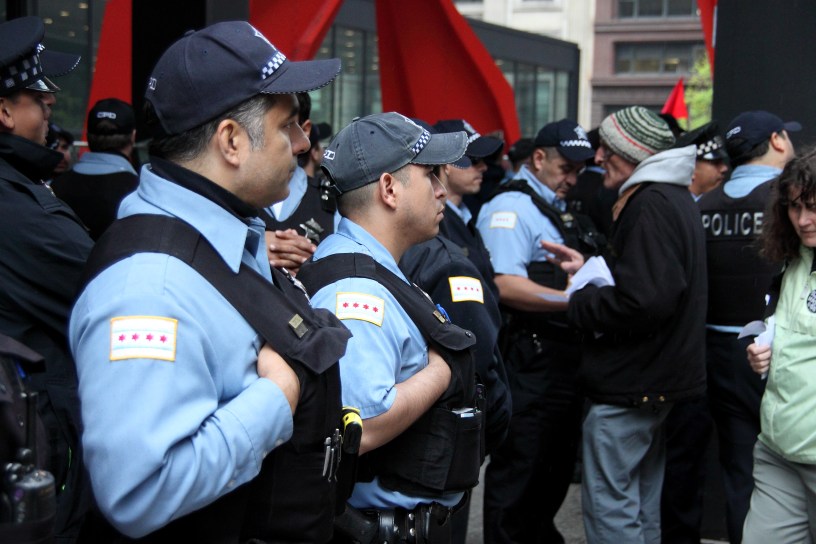
Mikasi from Kenosha, USA, CC BY 2.0 https://creativecommons.org/licenses/by/2.0, via Wikimedia Commons
Discover more from WPS News
Subscribe to get the latest posts sent to your email.


@wps.news Crime in Chicago is a real problem but it's not a local problem. It's a national problem caused mostly by Republicans refusal to allow the government to regulate deadly products such as guns and private motor vehicles.
LikeLike
Remote Reply
Original Comment URL
Your Profile
Why do I need to enter my profile?
This site is part of the ⁂ open social web, a network of interconnected social platforms (like Mastodon, Pixelfed, Friendica, and others). Unlike centralized social media, your account lives on a platform of your choice, and you can interact with people across different platforms.
By entering your profile, we can send you to your account where you can complete this action.