By Cliff Potts, CSO, and Editor-in-Chief of WPS News
Baybay City, Leyte, Philippines — April 11, 2026
The Term That Was Supposed to Impress You
For a while, the internet tried to convince the public that the future of culture, ownership, and investment had arrived in the form of ugly digital pictures. Usually this meant cartoon apes, pixel faces, or some other image that looked like it had been assembled by an exhausted intern with a randomizer tool and no standards. The public was told these were not just pictures. They were assets. They were investments. They were status. They were the future. A lot of normal people looked at that sales pitch and quite reasonably asked: what the duck is an NFT?
NFT stands for non-fungible token. In plain English, that means a unique digital token recorded on a blockchain rather than something interchangeable like cash or ordinary shares of stock. Standard reference definitions describe NFTs as unique digital identifiers used to certify authenticity or ownership of a digital asset, while also noting that ownership of the token does not automatically give the buyer full legal ownership of the underlying intellectual property (Encyclopaedia Britannica, 2026a; Merriam-Webster, 2026).
That last part matters a great deal, because it is where much of the public confusion began. The term sounded technical and futuristic, but the real-world meaning was often much thinner than the marketing. That should have been a warning sign from the beginning. The internet has been doing this kind of thing for a long time. Back in the Y2K era, there was at least some real infrastructure work and legitimate concern under the hype. With NFTs, the ratio was often worse: less substance, more swagger, and a stronger smell of bullshit.
What People Were Actually Buying
The hype around NFTs often made it sound as though buyers were purchasing a one-of-a-kind digital artwork in the same way someone might purchase a painting. That was not usually true in any ordinary common-sense way. In many cases, the buyer was purchasing a token on a blockchain that was associated with a digital file. The token could serve as proof of authenticity or a record of transfer, but it did not necessarily carry copyright, broad reuse rights, or exclusive control over the image itself. A 2024 joint report from the U.S. Copyright Office and the U.S. Patent and Trademark Office noted that consumer confusion over what rights accompany the purchase of an NFT is one of the central legal and practical problems in this area (U.S. Copyright Office & U.S. Patent and Trademark Office [USPTO], 2024).
That is why so many people felt, correctly, that they were being asked to treat a receipt as if it were the object itself. You could “own” the NFT, but other people could often still look at the image, copy the image, repost the image, or mock the image. In many cases, what the buyer really owned was a blockchain record and the bragging rights attached to it. That may be enough for some collectors, but it is not the same thing as owning a physical original, and it sure is not the same thing as owning lasting value (U.S. Copyright Office & USPTO, 2024).
The Monkey Pictures and the Status Game
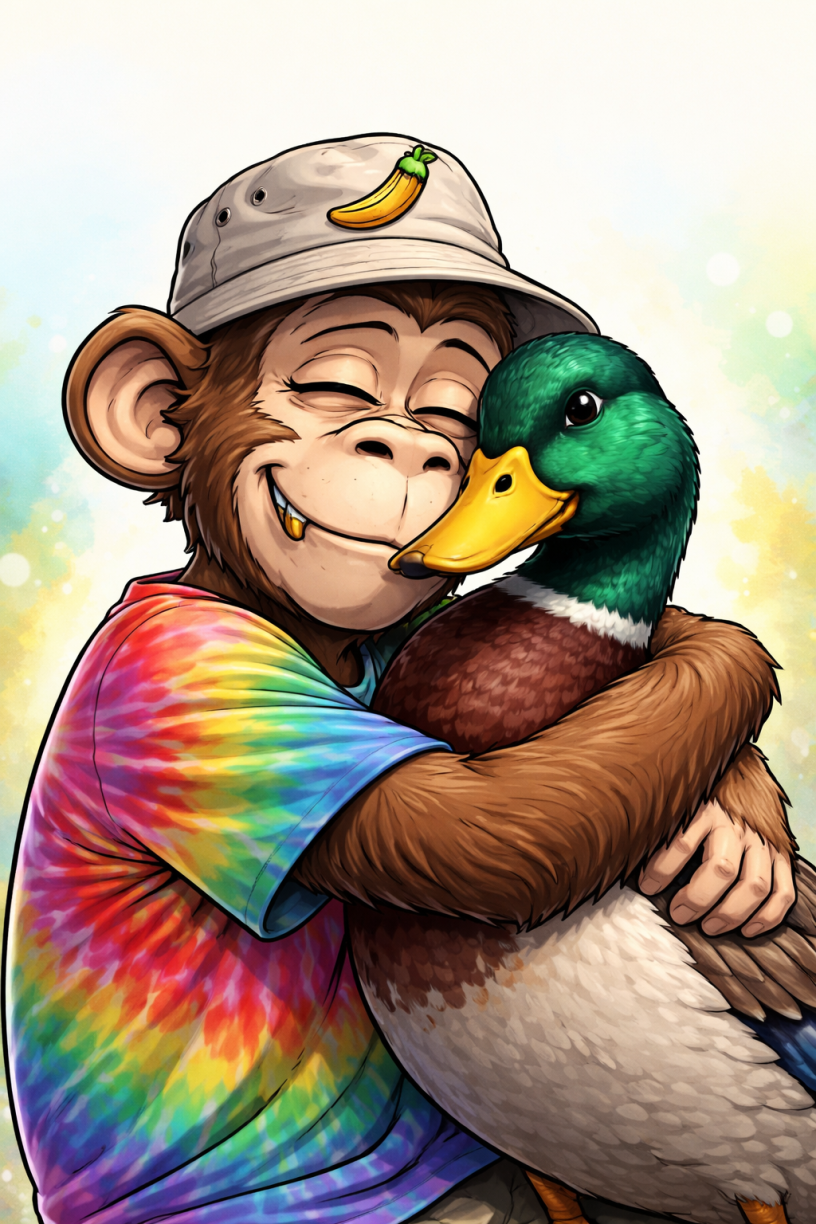
The best-known symbol of the NFT boom was the Bored Ape Yacht Club, launched in April 2021. Yuga Labs describes the collection as 10,000 NFTs that were “not just art” but also a membership pass to a digital club, which tells you a great deal about the sales pitch right there: art, exclusivity, and community all bundled together (Yuga Labs, n.d.). That was the appeal for many buyers. The artwork itself was often secondary. The real product was status. The ape was a badge, a signal, a way to tell the online world that you were early, rich, plugged in, or at least willing to pretend you were.
That is also why the ape images became such a useful shorthand for the absurdity of the whole period. The public was not just being asked to accept that a blockchain token had value. It was being asked to accept that mediocre digital art plus online clout plus engineered scarcity added up to a meaningful investment thesis. That worked for a while because hype can do a lot of work when people stop asking basic questions. But hype is not the same thing as substance, and fashion is not the same thing as value.
The Speculative Bubble Problem
The hard truth is that much of the NFT boom was not really about art. It was about flipping. Buyers were often betting that someone else would come along later and pay more for the token. Reuters reported that NFT sales fell to about $675 million in May 2023, down from a peak of $5.7 billion in January 2022, a collapse that says more about speculative fever than stable investment value (Howcroft, 2023).
That does not mean every NFT project was a scam, and it does not mean the underlying technology had no possible use. It does mean the public-facing craze was saturated with pump-and-dump logic, trend-chasing, celebrity promotion, and the old hope that there would always be a bigger fool available tomorrow. That is not a serious investing framework. That is gambling with extra vocabulary.
The Small Real Idea Buried Under the Noise
To be fair, there was one real idea underneath the mess. Blockchain-based tokens can be used to verify uniqueness, track transfers, and support certain kinds of digital provenance. Reference material on NFTs consistently notes possible applications beyond digital art, including authentication and other tokenized uses (Encyclopaedia Britannica, 2026b). The joint federal NFT report likewise found that blockchain technology and NFTs can play a role in supporting the management, transfer, and licensing of rights, even while warning about fraud, inaccurate information, and confusion over what buyers are actually getting (U.S. Copyright Office & USPTO, 2024).
That is the part worth remembering. The basic mechanism was not automatically nonsense. The mania built around it was. In other words, there may have been a real screwdriver somewhere in the box, but most of the public got hit in the face with the packaging instead.
So What the Duck Is an NFT?
An NFT is a unique blockchain-based token that can be used to mark authenticity or ownership claims connected to a digital asset. That is the clean definition. The messier reality is that NFTs were often sold to the public as if digital scarcity automatically created lasting worth. It did not. What many buyers actually got was a technologically dressed-up receipt, uncertain rights, and the hope of resale. Some projects built communities around that idea. Some made money for early entrants. Many others exposed the difference between hype and value in the most expensive way possible.
So if somebody looked at a bored cartoon monkey selling for absurd money and asked, “What the duck is an NFT?” that reaction was not ignorance. That was common sense doing its job.
If you have money to burn on NFTs, you would do more good putting it into a primary long-term news knowledge base that is trying to preserve information people may actually need later. In the long run, that has a better chance of paying off for the public than one more overpriced digital monkey. If this work helps you understand what’s happening, help me keep it going: https://www.patreon.com/cw/WPSNews
This essay was written by Cliff Potts, Editor-in-Chief of WPS News. WPS News has been active in one form or another on the internet since 1998, in the old Y2K-era web, and more information is available at https://cliffpotts.org.
References
Encyclopaedia Britannica. (2026a, March 2). What is an NFT? Britannica. https://www.britannica.com/story/what-is-an-nft
Encyclopaedia Britannica. (2026b, March 26). Crypto token types | NFTs, stablecoins, asset-backed, & utility. Britannica Money. https://www.britannica.com/money/digital-token-types
Howcroft, E. (2023, June 15). Three Arrows Capital’s NFTs fetch $10.9 million at Sotheby’s. Reuters. https://www.reuters.com/technology/three-arrows-capitals-nfts-fetch-109-mln-sothebys-2023-06-15/
Merriam-Webster. (2026, March 27). NFT. In Merriam-Webster.com dictionary. https://www.merriam-webster.com/dictionary/NFT
U.S. Copyright Office, & U.S. Patent and Trademark Office. (2024, March 12). Non-fungible tokens and intellectual property: A report to Congress. U.S. Copyright Office. https://www.copyright.gov/policy/nft-study/Joint-USPTO-USCO-Report-on-NFTs-and-Intellectual-Property.pdf
Yuga Labs. (n.d.). About Yuga. https://yuga.com/about/
Discover more from WPS News
Subscribe to get the latest posts sent to your email.

