By Cliff Potts, CSO, and Editor-in-Chief of WPS News
Baybay City, Leyte, Philippines — August 8, 2026
Before we get to the missiles of October, we need to go back to a quieter moment.
Picture a long table in 1919. The First World War has just ended, and the men in that room are not daydreaming. They are reacting. Aircraft had changed everything. For the first time, borders could be ignored from above. Mountains did not matter. Rivers did not matter. Distance did not matter the way it used to. So they did something simple and necessary. They agreed that the sky above a nation belonged to that nation. Not as poetry. As survival. Because if the ground had borders but the sky did not, then borders meant very little at all.
They wrote it down in 1919. They wrote it down again in 1928. And they wrote it down again in 1944.
By the time the Cold War began, this was not a new idea. It was settled. The sky above a country belonged to that country.
And then we broke it.
In the late 1950s, the United States began flying reconnaissance missions directly over the Soviet Union. Not near it. Not around it. Over it. We knew the rule. We had helped write the rule. And we violated it anyway because we believed the stakes were high enough to justify it.
That may explain the choice. It does not legalize it.
That matters because once a great power decides rules apply only when convenient, it loses the right to act surprised when other great powers start thinking the same way.
Cuba is where that logic turned combustible.
After the Spanish-American War, the United States occupied Cuba and shaped its early independence. Decades later, Fulgencio Batista ruled as a corrupt and repressive dictator, creating the conditions that helped bring Fidel Castro to power in 1959. Castro came to the United States that same year trying to present his revolution on his own terms. He was not trusted. He was not taken seriously. And he was not handled with much wisdom.
Then came the Bay of Pigs in April 1961, a failed U.S.-backed invasion that pushed Cuba even harder toward the Soviet Union.
Then came October 1962.
Illegal U-2 overflights photographed Soviet missile sites under construction in Cuba, confirming that Moscow had placed nuclear-capable missiles on the island. What those photographs did not immediately prove was whether nuclear warheads were already in place. In practical terms, that mattered less than it sounds. In a nuclear age, capability is enough. Leaders assume the worst and act on it.
Years later, it became clear that nuclear weapons were indeed present in Cuba during the crisis.
So the intelligence was real. The danger was real. But the method that produced it still rested on a contradiction the United States had already accepted. Washington condemned Soviet missiles ninety miles from Florida while downplaying two inconvenient facts. First, the United States had already spent years violating Soviet sovereign airspace. Second, it had already placed its own missiles in Turkey within reach of the Soviet Union.
This was not a clean morality play. It was a pattern.
Great powers break rules when they feel threatened. They assume the worst. They act. And then they call it defense.
Now bring that forward to Asia.
China places missiles along its coastline that can reach Taiwan and the Philippines. The Philippines, in turn, looks to build its own defensive capability. Each side calls its actions defensive. Each side calls the other side provocative.
That is not strange. That is familiar.
Sovereign nations build weapons on their own territory. That is not unusual. It is not mysterious. It is not irrational by itself. The real question is not why missiles exist. The real question is whether missiles are enough.
Missiles are effective. Modern systems are fast, accurate, and politically useful. They deter. They signal. They shape the opening moments of a conflict.
They also look very good on television.
But missiles are events. They are bursts of power, not continuous control. They require targeting, timing, and resupply. They do not patrol coastlines. They do not control sea lanes. They do not adapt once launched. They can shape the start of a fight. They do not manage everything that comes after.
That is where the harder lesson begins.
During the American Revolution, colonial forces often relied on mobility, local knowledge, and selective engagement against stronger British and Hessian forces. In the Second World War, PT boats and other small craft imposed problems on larger naval forces in confined waters. In later wars, smaller forces repeatedly forced larger powers into costly and uncertain operations by refusing to fight on conventional terms.
The lesson is not ideological. The lesson is structural.
A weaker force does not need to match strength. It needs to complicate it.
That is where the Philippines still has work to do.
The country is investing in deterrence. It is not investing enough in denial.
Missiles tell an adversary not to come. But if the adversary comes anyway, missiles alone do not control the environment. In an archipelago, control depends on persistence. It depends on numbers. It depends on systems that can absorb loss, repair quickly, and return to operation without waiting for distant supply chains.
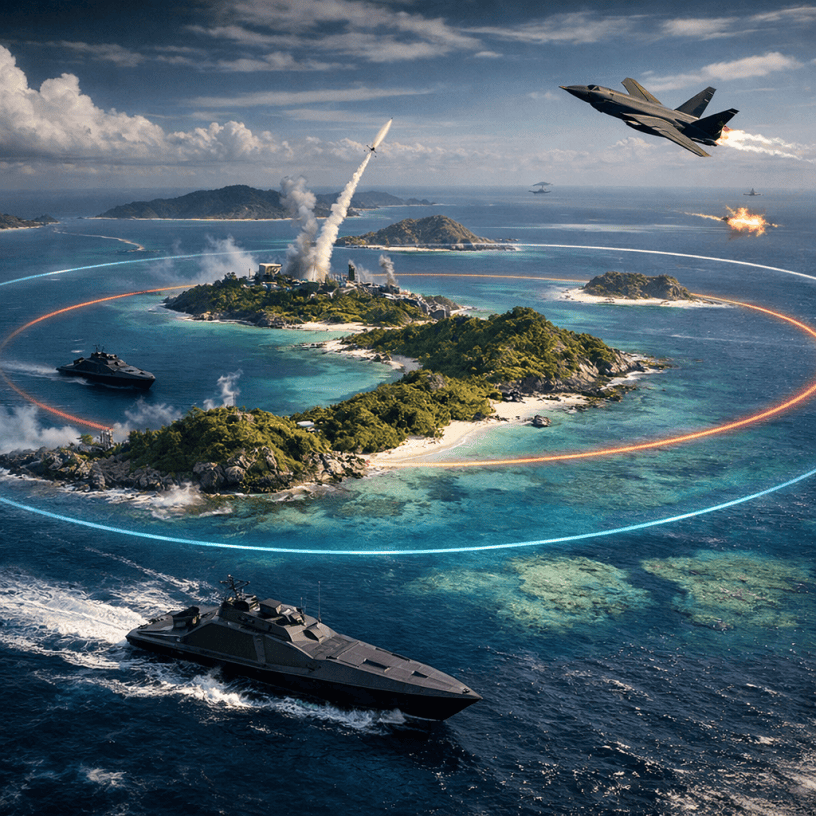
That is where the Stealth Runner concept comes in.
It is not a replacement for missiles. It is the missing layer.
The idea is simple: small, inexpensive, locally producible craft built from accessible materials such as marine plywood and other common timbers. Not because they are perfect, but because they are available, repairable, and replaceable. A system built this way can be maintained locally. It can take damage and return to service. It can put more hulls in the water for the same money. And in an archipelago, quantity has a quality of its own.
Missiles are designed for the opening exchange.
Distributed coastal craft are designed for what comes after.
A dispersed force does not need to be invulnerable. It only needs to be difficult enough to erase that an attacker cannot turn a dramatic first strike into lasting control. That is the point. The more small craft a defending nation can put into the water, the harder it becomes for any outside force to impose control quickly or cleanly.
Air sovereignty matters.
Missiles matter.
But in an archipelago, control is not decided only at altitude or at long range. It is decided at sea level, over time, by what remains in the fight after the first exchange.
Power is not just what you can strike with.
It is what you can keep in the fight.
If this work helps you understand what’s happening, help me keep it going: https://www.patreon.com/cw/WPSNews
For more from Cliff Potts, see https://cliffpotts.org
Discover more from WPS News
Subscribe to get the latest posts sent to your email.

