By Cliff Potts, CSO, and Editor-in-Chief of WPS News
Baybay City, Leyte, Philippines — September 25, 2026
During Occupy, a lot of people with names, credentials, and platforms explained the movement back to the people who were actually living inside it. Some of them were smart. Some of them were sincere. Some of them were both. But too many of them were talking from above the weather instead of inside it.
Chris, you were one of those people.
This is not a question of whether you understood history. It is not a question of whether you meant well. It is a question of distance. A man can know a great deal and still miss what is right in front of him if he is standing too far away.
From where you stood, the arguments made sense. The state owns violence. The state is better at violence. A movement that tries to beat the state on that ground is walking into a trap. Fine. That is a real argument. It has history behind it.
But Occupy was not just an argument.
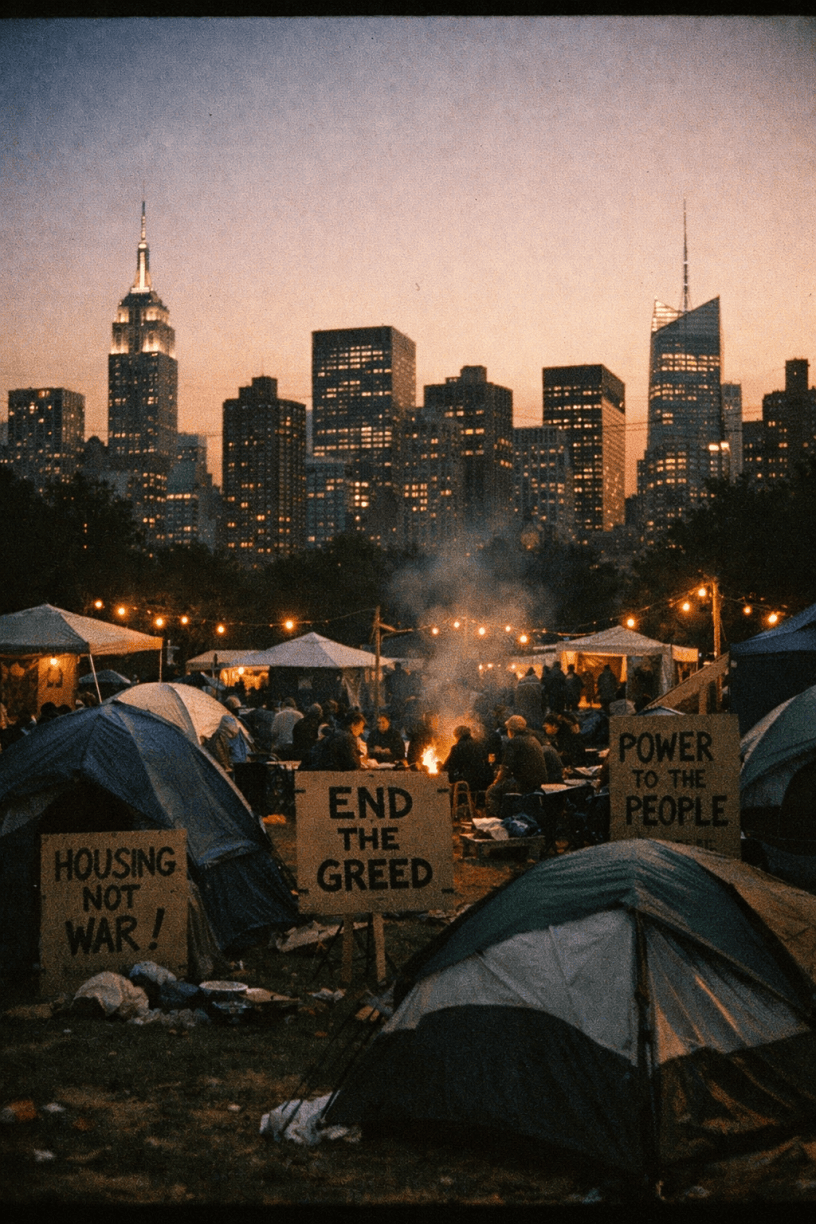
Occupy was people on the ground trying to build something in real time under pressure. It was cold nights, police presence, shifting rules, infiltration, exhaustion, ego clashes, confusion, hunger, hope, and a hundred practical problems that never make it into the essays later. It was not a laboratory. It was not a clean moral exercise. It was not a panel discussion. It was a living situation.
And that is what you missed.
You were arguing over tactics as if the movement existed mainly in theory. For those of us who were there, the movement existed in bodies, time, risk, and strain. It existed in the simple act of staying present when the system wanted us gone. It existed in the fact that people who had been isolated from one another suddenly found each other and began naming the same broken structure. That mattered more than many of the people talking about Occupy seemed willing to admit.
You also missed something else. Occupy was not just Zuccotti Park.
That is one of the most irritating habits of the commentary class, then and now. New York happens, and suddenly New York becomes the whole country. It was never the whole country. It was not the whole movement either. Occupy happened in Chicago. It happened in cities and towns all over the United States. It happened internationally. It took different forms in different places, because people were dealing with different pressures, different police departments, different local cultures, and different internal dynamics.
If you thought Occupy was just a New York tactical argument, then you were looking at the wrong piece of the elephant.
And yes, there is source material for that. There is primary-source material from the ground. WPS News still has some of it. The Occupy Chicago footage is on YouTube in a four-part playlist. There is more in the archive going back to 2011. It is not polished theory. It is not after-the-fact interpretation. It is source material from people who were living it while the experts were still deciding what it meant.
That matters.
Because one of the enduring problems of Occupy was that too many people with public authority talked over the people doing the actual work. There was always someone ready to define the movement, discipline the movement, clean up the movement, or scold the movement from a safer distance. Meanwhile, the people on the ground were trying to hold together something fragile enough to break under its own contradictions even without outside commentary helping the process along.
That was the real tension.
Occupy did not fail because one side won an elegant argument about tactics. It came under pressure from every direction at once. Police pressure. Media pressure. logistical pressure. internal pressure. personality pressure. exhaustion. drift. confusion. opportunists. genuine believers. people who wanted process. people who wanted action. people who wanted attention. people who wanted a home for a while because the rest of the country had failed them. That was the mix.
It was human, which is to say it was unstable.
That does not mean it was meaningless. Quite the opposite. It means it was alive.
And that is why voices like yours frustrated so many of us. Not because you were always wrong in the abstract, but because you were too sure that the abstract was the whole story. It wasn’t. You saw pattern. We lived texture. You saw principle. We lived consequence. You saw the movement from the height of commentary. We saw it from the sidewalk, where the weather, the police, the cold, the confusion, and the actual people all had votes.
So yes, Chris, you missed something.
You missed the fact that the ground is not theory.
You missed the fact that movements are not neat.
You missed the fact that people doing the actual work do not experience history as a clean argument.
And if you ever want to understand what Occupy really was, start with the source material. Start with the voices from the ground. Start with the people who were there before you explain it to them again.
Discover more from WPS News
Subscribe to get the latest posts sent to your email.

