By Cliff Potts
Baybay City, Leyte, Philippines — November 24, 2026
It is a Wednesday in late November, 1735.
There is no holiday approaching, no shared pause, no expectation that the week will end in reflection or ritual, and no football. It has not been invented yet. The day ahead is not special. It is simply another day that must be worked through.
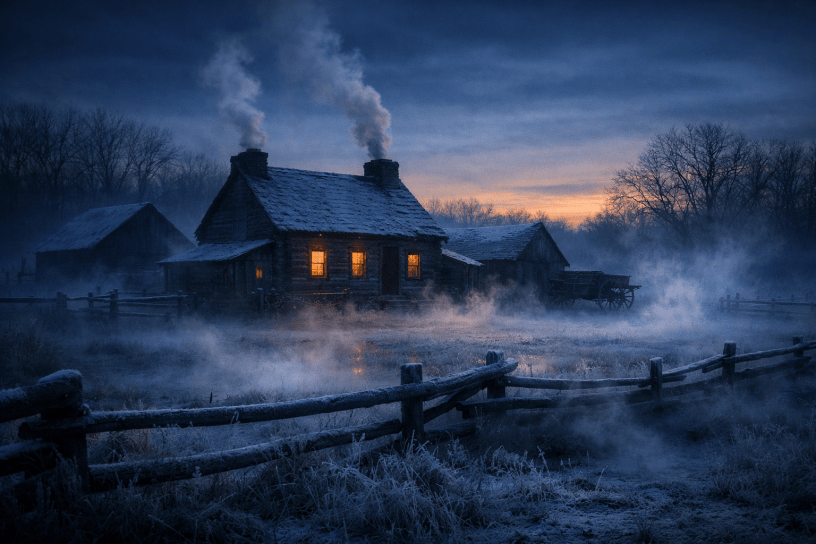
Before dawn, Newark is still.
Beyond the houses and fields, the land softens into marsh. The Passaic River moves outward into low ground where the shoreline does not hold its shape. Cattails stand broken and brown. Frost lies thin across flattened grass. The air carries a faint trace of decay, muted now by the cold, more earth than rot. Geese move overhead in uneven lines, honking as they pass, the sound carrying through the morning, while ducks settle somewhere out in the channels beyond sight.
The houses stand in rough order, not in rows but in relation to one another, each placed with purpose. They are wood, timber-framed and plank-sided, some with clapboard, some left rough. The roofs are steep and shingled with split wood, darkened by weather. Chimneys rise from one end, built of stone or brick where it can be managed. Smoke marks every one of them.
Windows are small. Some hold uneven glass. Others are covered with oiled paper. Doors open directly into the main room.
Inside one house, the fire is coaxed back from embers. The room is everything—kitchen, workroom, living space. The floor is wood planking. A long table stands near the center, benches beside it. A bed is set into one corner, framed in wood, filled with straw or, if the household can afford it, a feather tick. It is large enough for more than two people.
A ladder leads upward to a loft.
That is where the children sleep.
Several of them, wrapped in wool blankets, sharing warmth under a low roof where heat rises. There are no separate bedrooms. Privacy is not part of the design. The family sleeps as a unit, arranged by space and necessity.
Pillows, if present, are simple. Stuffed with straw, wool, or feathers. Blankets are heavy, layered, sometimes patched. A rope bed may be used in some homes, tightened by hand to support the mattress.
Night ends not because people are rested, but because the fire must be brought back.
Breakfast begins as the flame takes hold.
Cornmeal porridge, sometimes called hasty pudding.
If there is milk, it is added. If there is molasses, a little sweetness follows. If not, it is eaten plain. Bread sits nearby, coarse and brown. Cider fills the cup, sometimes warmed.
By first light, the town begins to move.
Outside, a woman steps from one house as another approaches along the path.
“Your beans hold?”
“Enough. Not as last year.”
“We’ll see it through.”
A nod, and they part.
By midmorning, the men cross paths near a fence line.
“Ground’s turning.”
“Soon enough.”
“You ready for it?”
“Have to be.”
Work resumes without pause.
The fields are mostly bare now, but not empty. Corn has been harvested and dried. Wheat and rye are stored. Root vegetables—turnips, carrots, onions—are pulled as needed from cellars dug into the earth.
Today’s work is not planting. It is protection.
Fence rails are checked. Firewood is cut and stacked. A misjudged pile will not forgive in winter.
Inside, dough is kneaded from rye flour. A pot simmers with salt pork, cabbage, dried beans. Nothing is wasted.
Children move through the space with purpose.
A boy carries water from the well. A girl tends the fire. Learning happens without being named. Expectation becomes habit.
By midday, the meal is taken.
Bread. Stew. Cheese, if it has kept. Cider or small beer, low and safe.
Water can be drawn, but not always trusted. Safer to drink what has already been changed.
The afternoon continues.
Wood is cut. Tools are repaired. A broken handle is replaced. A hog may be slaughtered, the cold making it possible. Nothing is discarded.
As daylight fades, the town draws inward.
Firelight fills the room. The same table, the same benches. The evening meal resembles the midday one, warmer, deeper from hours over the flame.
There is no excess.
Conversation is practical. What must be done tomorrow. What will be needed before winter deepens.
The man who helped found this place is long gone, buried back in Connecticut. The houses remain. The patterns remain.
Night settles again.
The fire is banked. The room darkens.
The adults take the main bed. The children climb to the loft or settle into shared space below if needed. Bodies close together hold heat against the cold. Wool blankets are pulled tight. The smell of smoke and earth remains in the air.
There is no isolation in sleep.
Only proximity, necessity, and the quiet understanding that the day will begin again soon enough.
Value is measured in what is built, maintained, and carried forward. In whether the house stands, the fire burns, the food lasts.
There is no holiday waiting.
There is only the continuation of what has already been set in motion.
It is not comfort.
It is continuity.
It simply is.
Discover more from WPS News
Subscribe to get the latest posts sent to your email.

