By Cliff Potts, CSO, and Editor-in-Chief of WPS News
Baybay City, Leyte, Philippines — October 29, 2026 — 12:35
October 29, 2026 marks the 97th anniversary of Black Tuesday, the stock market collapse of October 29, 1929 that became the symbolic beginning of the Great Depression. That anniversary is a useful moment not just for remembrance, but for comparison. The question is not whether the Great Recession was identical to the Great Depression. It was not. The better question is what the United States learned after 1929 that made life more survivable in 2008, even during a severe financial crisis, and what that says about the value of public institutions built in response to earlier catastrophe.
The Great Recession of 2007–2009 is often remembered as severe, but not catastrophic.
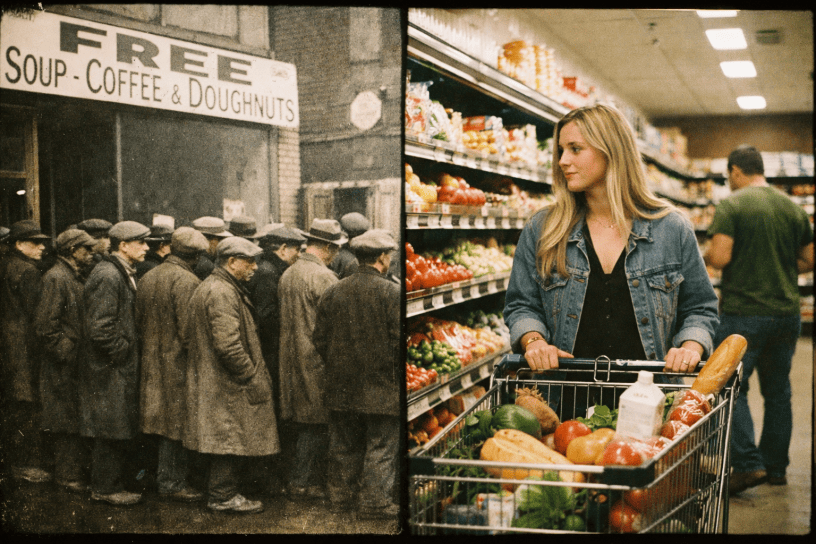
That comparison usually rests on one visible difference: there were no breadlines.
That conclusion is misleading.
Visible Crisis vs. Absorbed Crisis
During the Great Depression, economic collapse was visible everywhere.
Unemployment reached approximately 24.9% in 1933. Industrial production fell nearly 47%, and real GDP declined by roughly 25–30% between 1929 and 1933. Thousands of banks failed. Breadlines and shantytowns became defining images of the era.
The Great Recession did not look like that.
At its peak, official unemployment reached 10.0% in October 2009, with broader underemployment rising significantly above that. GDP declined about 4.3%, and industrial production fell roughly 15%.
By comparison, the numbers were smaller.
But that is only part of the story.
The Role of the Safety Net
The United States that entered the Great Depression had almost no federal safety net.
There was no unemployment insurance.
No federal food assistance system.
No Social Security.
Those systems were built in response to the catastrophe of the 1930s.
By 2008, they were fully operational.
Food assistance served tens of millions of Americans during and after the Great Recession. Unemployment insurance provided income support to displaced workers. Social Security stabilized income for retirees and disabled individuals.
These programs did not prevent the crisis.
They changed how it appeared.
Why You Didn’t See Breadlines
The absence of breadlines in 2008 is often cited as evidence that the crisis was less severe.
What it actually shows is that the country had built systems capable of absorbing visible economic distress.
In 1929, job loss translated directly into hunger.
In 2008, job loss was filtered through programs that provided at least minimal support.
The suffering did not disappear.
It moved.
The Housing Collapse
Housing distress was severe in both eras.
During the Great Depression, foreclosure was widespread and devastating, especially in urban and farm communities.
During the Great Recession, more than 6 million U.S. homes were lost to foreclosure between 2007 and 2014. Housing prices declined by approximately 30% nationwide.
The difference was not whether people lost homes.
It was how that loss was processed and recorded.
Banking and Financial Stability
Bank failures defined the Great Depression.
Approximately 9,000 banks failed between 1930 and 1933, wiping out savings and triggering widespread panic.
In the Great Recession, bank failures occurred, but deposit insurance and federal intervention prevented retail bank runs from becoming the public face of the crisis.
The system was stabilized.
The experience of households was different.
Poverty and Income
During the Great Depression, personal income collapsed and poverty reached levels difficult to measure precisely but clearly far beyond anything seen in recent decades.
During the Great Recession, median household income declined sharply, and the poverty rate rose to its highest level in years.
Again, the numbers were smaller.
But they were still severe.
What Changed and What Didn’t
The Great Recession was not the Great Depression.
Economic output fell less.
Unemployment was lower.
The financial system did not collapse in the same way.
That is progress.
It reflects lessons learned from the 1930s, including the creation of unemployment insurance, financial regulation, deposit insurance, and social safety programs.
But the underlying pattern remained.
Financial instability led to widespread job loss, housing loss, and long-term economic damage for millions of people.
The Difference That Matters
The key difference between 1929 and 2008 is not that one crisis was real and the other was not.
It is that by 2008, the United States had built enough institutional support to prevent economic collapse from turning into mass public destitution.
That is not an argument for complacency.
It is an argument for remembering what public policy can do when it is designed to keep people alive.
The damage was still there.
It was simply less visible.
References
Bureau of Labor Statistics. (2010). Labor force statistics from the Current Population Survey.
Federal Reserve. (2013). Industrial production and capacity utilization data.
National Bureau of Economic Research. (2014). Macroeconomic effects of the Great Depression.
U.S. Department of Agriculture. (2010). Supplemental Nutrition Assistance Program participation data.
Federal Deposit Insurance Corporation. (2012). Historical statistics on banking.
Discover more from WPS News
Subscribe to get the latest posts sent to your email.

