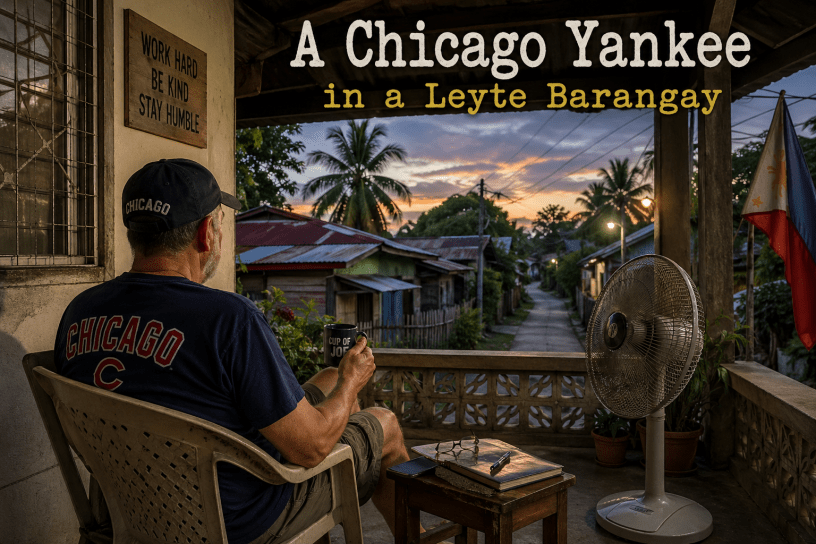
By Cliff Potts, CSO, and Editor-in-Chief of WPS News
Baybay City, Leyte, Philippines — August 2, 2026
The third month is when food stops being a curiosity and starts becoming a problem.
Not a crisis. Not starvation. A problem.
Because this is the point where you realize you are not on vacation. You are living here. And the things you assumed you could “just get” are either different, inconsistent, or not available at all.
This is where a lot of people get stuck.
The Expectation Trap
You arrive with a mental catalog of food:
- brands
- recipes
- tastes
- routines
You assume you can rebuild that.
You can’t. Not exactly.
The Philippines has its own food system. It is built around what grows here, what ships here, and what people here actually eat. That system does not care what you are used to.
Once you accept that, things get easier.
Grocery Reality
Local grocery stores carry what locals buy.
That means:
- different cuts of meat
- different seasoning profiles
- different product availability
You will find staples. You will not always find your staples.
Places like Puregold, Metro Mall, and Price Mall in Baybay give you consistency, but not completeness.
If you want imported items, specialty ingredients, or specific brands, that usually means one thing:
Manila.
Cooking: The Adjustment Phase
This is where you either adapt or get frustrated.
Recipes from the United States rarely translate directly. Ingredients behave differently. Measurements feel off. Substitutions become necessary.
So you learn to build versions, not replicas.
You already figured out one of the core truths:
Chili is not chili here.
So you improvise:
- pork and beans
- chili con carne (with or without beans)
- hot dogs if that’s what’s available
It works. Not perfectly. But it works.
That’s the goal.
Letting Go of Exact Matches
This is the mental shift.
If you chase exact flavor matches, you will lose.
If you aim for:
- “close enough”
- “good in its own way”
You win.
That applies to everything:
- bread
- cheese
- sauces
- snacks
You are not recreating home. You are building a working kitchen.
Eating Out: Your Stabilizers
This is where chains matter more than people expect.
Familiar Anchors
- Shakey’s Pizza in Baybay City gives you something close to American-style comfort food
- Jollibee is the local heavyweight
Jollibee is not a copy of McDonald’s. It’s its own thing:
- fried chicken with rice (standard)
- sweet-style spaghetti
- smaller, messier burgers
- ice cream sundaes
It’s not perfect. It’s reliable.
And reliability matters.
Coffee and Quick Stops
- Dunkin’ is everywhere
You’ll use it more than you expect.
Fried Chicken Economy
Fried chicken is a national fallback.
When nothing else works, fried chicken will.
Even smaller outlets like Crispy King deliver solid, well-seasoned food at low cost.
It’s not fancy. It’s effective.
The Surprise: Some Things Are Better
This is where expectations flip.
In Tacloban City, even McDonald’s can outperform what you remember in the United States.
Fresher ingredients. Cleaner preparation. More attention to assembly.
It stops being “just like home” and becomes something else entirely.
That’s a pattern you’ll see more than once.
Wet Markets: A Different World
If you like seafood, the wet markets are a major advantage.
Fresh fish, fresh cuts, local supply chains—this is where the Philippine system excels.
If you don’t like seafood, you learn quickly where not to linger.
Either way, it’s part of the landscape.
The Emotional Side of Food
This is the part people don’t talk about.
Food is memory.
When you can’t recreate something familiar, it’s not just about taste. It’s about routine, comfort, and identity.
That’s why frustration hits harder than expected.
The solution isn’t perfection. It’s replacement.
New routines. New go-to meals. New defaults.
Workarounds
By the third month, you should be building a system:
- keep a list of hard-to-find items
- batch-buy when you find something useful
- plan Manila runs strategically
- experiment with substitutions instead of chasing exact recipes
Most importantly:
Cook more than you think you need to. Leftovers become insurance.
The Third Month, Defined
You are no longer trying to eat like you did before.
You are learning how to eat well here.
That’s the difference.
Once you make that shift, food stops being a problem and becomes part of the solution.
If this work helps you understand what’s happening, help me keep it going: https://www.patreon.com/cw/WPSNews
For more from Cliff Potts, see https://cliffpotts.org
References
Food and Agriculture Organization. (2025). Philippine food systems overview. FAO.
Department of Agriculture Philippines. (2025). Local food supply chains and markets. Government of the Philippines.
Numbeo. (2026). Cost and availability of groceries in the Philippines. Retrieved 2026.
World Bank. (2025). Food systems and consumer adaptation in Southeast Asia. World Bank Publications.
Discover more from WPS News
Subscribe to get the latest posts sent to your email.
 WPS News