By Cliff Potts, CSO, and Editor-in-Chief of WPS News
Baybay City, Leyte, Philippines — February 5, 2031 — 21:05 PHST
Where the Camera Could Go
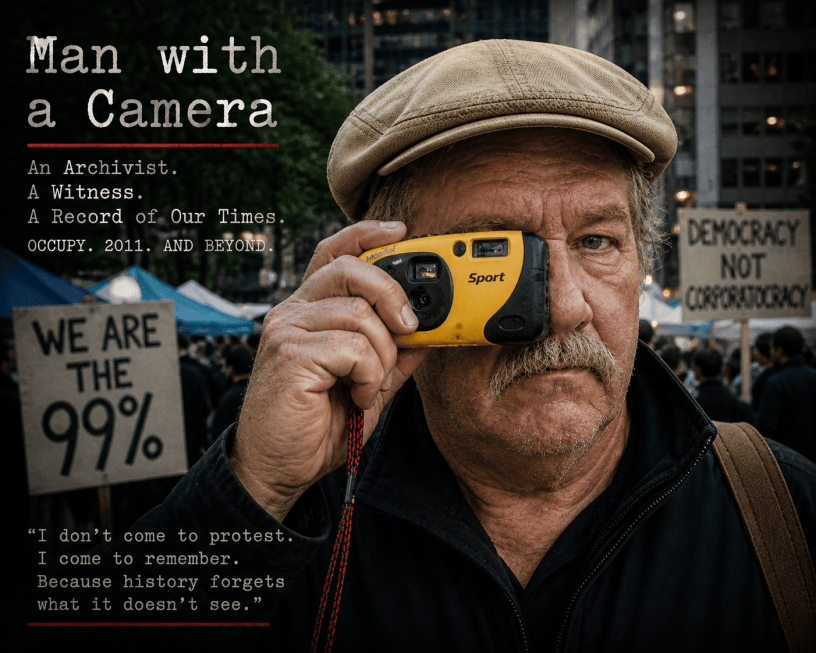
I stayed where I could record.
That was the rule, whether I said it out loud at the time or not.
If Occupy Chicago was in the street, on a sidewalk, in a park, or moving through the city, I could document it. Public space meant public record. The courts in Illinois had already made clear that what happens in public can be recorded.
So that’s where I worked.
The Shape of the Archive
That decision shaped everything that survives.
Ninety-nine percent of what I shot was outside. Not because nothing happened indoors, but because indoors came with conditions. Once the movement shifted into buildings, into offices, into what later got called the “clubhouse,” the rules changed.
Recording inside meant permissions. It meant asking. It meant navigating who was comfortable being on camera and who wasn’t.
That slows things down. Sometimes it stops things altogether.
Out in the street, none of that applied.
So the archive followed the street.
What Changed
Early on, everything was outside.
The first gatherings were small—around twenty people, depending on the day. Then the numbers grew. The crowds filled space, drew attention, made noise. That’s the version people remember when they think about Occupy Wall Street spreading across cities.
But that phase was never meant to last forever.
There was an understood window—start in September, wind down toward the end of the year. In Chicago, that put the expected end of the street phase somewhere around late December 2011.
That expectation mattered.
By the time winter hit, a lot of people thought the first phase was already ending.
The Street Narrows
At the same time, pressure was building.
There were attempts to take the horse. There were arrests. There were limits placed on how and where people could gather. None of it happened in a neat sequence, and from the outside it didn’t look coordinated. It just accumulated.
Somewhere in that stretch—late fall into early winter—the movement began shifting indoors.
I can’t give you a clean date for when the “clubhouse” became central. I wasn’t working out of it. It wasn’t my lane.
But by winter, it was clear that Occupy Chicago was no longer only a street movement.
What Stayed Visible
That December General Assembly—cold, wet, under a walkway near Michigan and Congress—was one of the last times in 2011 that the movement operated clearly in public space the way it had at the start.
Not the last time anything happened.
But one of the last times it was fully visible.
After that, more of the activity moved into spaces where a camera wasn’t always welcome, or at least not automatically allowed.
Inside and Out
I did go inside a few times.
Public functions. Events where people were already presenting themselves openly. In those cases, I could take some video, more often still photographs.
Most of those still images didn’t survive. Hardware failure took them out later.
What remains is what was recorded where it could be recorded without restriction: outside, in public, in the open.
That’s the record.
The Difference Between Presence and Access
It’s easy, years later, to assume that if something wasn’t recorded, it didn’t happen.
That’s not true.
A lot happened that isn’t on camera. Meetings, decisions, conflicts, organizing work that took place away from the street.
But what is on camera—the marches, the assemblies, the public confrontations—that is what the world could see.
That is what I could document.
What This Actually Is
So when you look at the archive, understand what you’re seeing.
You’re seeing the public face of Occupy Chicago.
You’re seeing what was visible, what was audible, what stood in the open long enough to be recorded.
You’re not seeing everything.
You’re seeing what the street allowed.
And in a movement that began by taking public space, that’s not a bad place to start.
For more from Cliff Potts, see https://cliffpotts.org
If this work helps you understand what’s happening, help me keep it going: https://www.patreon.com/cw/WPSNews
References
Gitlin, T. (2012). Occupy nation: The roots, the spirit, and the promise of Occupy Wall Street. HarperCollins.
Tarrow, S. (2011). Power in movement: Social movements and contentious politics (3rd ed.). Cambridge University Press.
Discover more from WPS News
Subscribe to get the latest posts sent to your email.
 WPS News