By Cliff Potts, CSO, and Editor-in-Chief of WPS News
Baybay City, Leyte, Philippines — February 19, 2031 — 21:05 PHST
The Space That Made Sense
There was a place in Chicago that actually worked.
Right at the opening to Grant Park, where Michigan Avenue meets what is now Ida B. Wells Drive, stand the twin statues The Bowman and The Spearman.
That’s what we called “the horse.”
And that space wasn’t just decorative. It had structure—broad steps, open ground, a natural bowl that could hold people without forcing them into a line. It functioned like an amphitheater.
If you were trying to build a working General Assembly in public space, it was about as close to perfect as you were going to get in downtown Chicago.
Why We Wanted It
We weren’t chasing symbolism. We were solving a problem.
Early Occupy Chicago spaces worked for gathering, but not always for organizing. You need to see the speaker. You need people to hear each other. You need a place that doesn’t scatter the moment it gets larger than a few dozen people.
The horse gave you that.
People could sit. Speakers had a natural focal point. Conversations didn’t dissolve into noise.
And if things had developed that way, there was even room—at least in theory—for tents.
The One Hard Rule
There weren’t many clean rules.
But there was one that mattered.
Grant Park had a curfew. Roughly 11 p.m. to 4 a.m., the park was closed. That was the line the city enforced.
Everything else—how long you could stand somewhere, what counted as a gathering, what might be tolerated—shifted depending on the situation.
But the curfew?
That was the reset switch.
How It Was Supposed to Work
Under normal conditions, curfew violations weren’t a major event.
You’d get a ticket. Maybe a court date. And more often than not, those cases didn’t go very far.
It was a nuisance, not a crackdown.
How It Actually Worked
During Occupy, that changed.
Instead of citations, police cleared the space and made arrests. People weren’t just told to move along—they were processed, taken in, and held.
That difference wasn’t accidental.
It became a legal issue later, when a judge looked at how the city enforced curfew. Chicago had allowed large crowds to remain in Grant Park after hours before—most notably during the 2008 election night celebration for Barack Obama.
You couldn’t allow it one time and criminalize it another, not without explanation.
The court eventually threw the cases out.
What That Meant on the Ground
That legal argument came later.
On the street, what mattered was the immediate risk.
If you stepped into that space after curfew, you weren’t looking at a ticket. You were looking at being taken off the street.
And that shaped behavior.
My Line
I had my own calculation to make.
At the time, I was carrying a Texas driver’s license. If I got picked up, I couldn’t assume I’d be processed and released the same way someone with an Illinois ID might be.
There was a real chance I’d stay in custody.
So I made a decision.
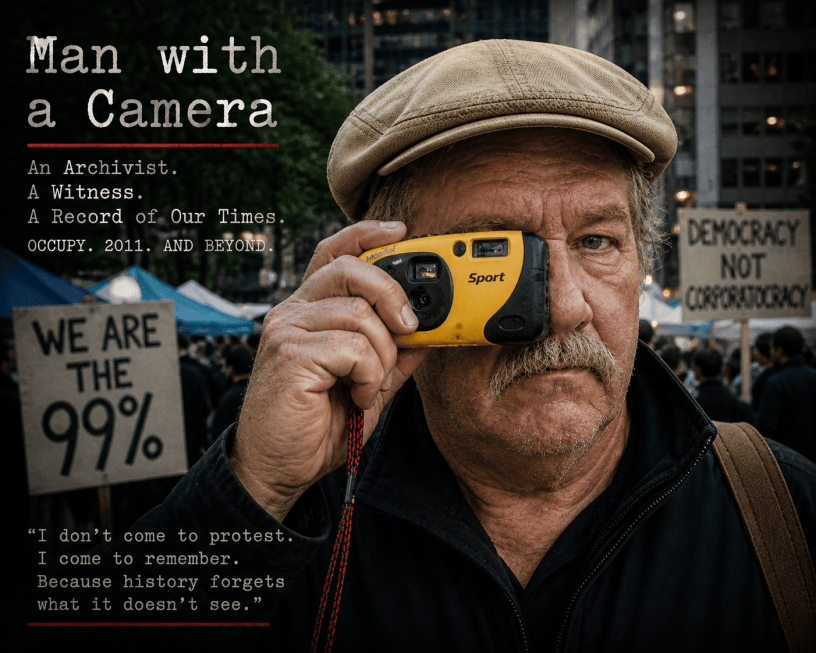
I stayed close enough to document what was happening. But I didn’t cross lines that would take me—and the camera—out of the street and into a holding cell.
That wasn’t distance from the movement.
That was protecting the record.
The Attempts
We did try to take that space.
More than once.
It wasn’t a formal operation. It was movement—people stepping into a place that made sense, trying to hold it long enough to make it work as a center.
From the outside, it probably looked scattered.
From inside, the goal was clear:
Find a space that could sustain the work, not just display it.
Why It Didn’t Hold
It didn’t stick.
Part of that was enforcement. Part of it was timing. By late fall, the original arc of the occupation—September into December—was already running its course in people’s minds.
And every night, the curfew wiped the slate clean.
You couldn’t build continuity in a space that emptied on a schedule.
What Remains
If you walk past the horse now, it’s just an entrance to the park.
People pass through it without thinking.
But for a moment, it was something else—a place where a movement tried to find footing in public space, with just enough structure to work and just enough visibility to matter.
It just never got the time it needed.
For more from Cliff Potts, see https://cliffpotts.org
If this work helps you understand what’s happening, help me keep it going: https://www.patreon.com/cw/WPSNews
References
City of Chicago Municipal Code, Grant Park curfew regulations.
Cook County Circuit Court rulings on Occupy Chicago curfew enforcement, 2011–2012.
Gitlin, T. (2012). Occupy nation: The roots, the spirit, and the promise of Occupy Wall Street. HarperCollins.
Discover more from WPS News
Subscribe to get the latest posts sent to your email.

