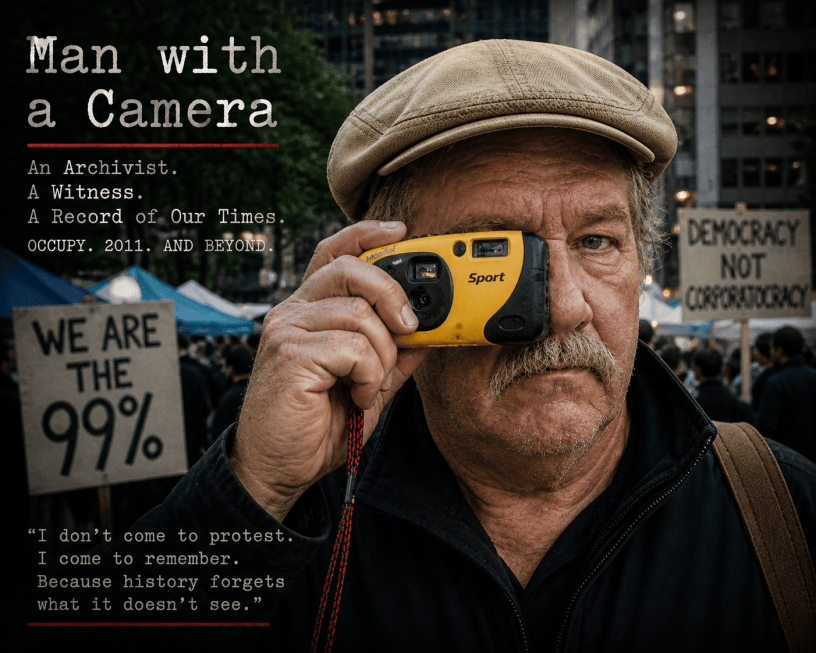
By Cliff Potts, CSO, and Editor-in-Chief of WPS News
Baybay City, Leyte, Philippines — March 5, 2031 — 21:05 PHST
It Didn’t Start Where You Think
When Occupy Chicago began, it didn’t “step off.”
It gathered.
The first meeting point was the Willis Tower—and if you’re from Chicago, it’s still the Sears Tower. Always will be. You can rename it on paper, but not in conversation.
I wasn’t there that first day. I was at work. But I was watching.
The Question of Impact
Very quickly, the question became simple:
Where do you go if you want to matter?
There was real-time discussion happening, mostly over social media, about where the movement should land. If you’re going to protest economic power, you don’t just stand anywhere—you stand where that power is visible.
I made my suggestion:
Go to the Chicago Board of Trade.
That’s Wall Street in Chicago.
The Financial Canyon
They made the right call.
The group moved to LaSalle and Jackson—right in the financial corridor.
On one corner stood the Chicago Board of Trade Building. On another sat the Federal Reserve Bank of Chicago.
That wasn’t abstract symbolism.
That was the machinery.
And the decision that followed mattered just as much as the location itself.
They didn’t hide in a park.
They took up space on the sidewalk in front of the Federal Reserve.
Public. Visible. Impossible to ignore.
Why That Location Worked
It worked because it was honest.
There was no confusion about what was being protested. No need to explain the target. Anyone standing there knew exactly what those buildings represented.
Finance. Currency. Policy. Power.
If Occupy Chicago was going to exist anywhere, that was the place to start.
From Target to Structure
But a target is not a home.
Standing in front of the Federal Reserve gave the movement visibility. It did not give it structure. You could gather there. You could protest there. But you couldn’t easily build something that lasted there.
That realization came quickly.
From there, the conversation shifted:
Where can we actually function?
That’s how the movement started looking toward the space at the entrance to Grant Park—the area around the Bowman statue, what we called “the horse.”
The Path That Formed
So the path of Occupy Chicago, in those early days, wasn’t random.
It followed a logic:
Gather at the Sears Tower.
Move to the financial district.
Hold ground at LaSalle and Jackson.
Then look for a space that could sustain the work.
That’s how we got from the start to the horse.
What People Miss
Looking back, people tend to compress all of this into one moment—tents, marches, slogans.
But it wasn’t one moment.
It was a series of decisions, made in real time, with incomplete information, by people trying to figure out how to build something that had never been built before.
Some of those decisions worked.
Some didn’t.
But they weren’t random.
They were attempts to match place with purpose.
Where I Fit
I wasn’t leading any of that.
But I was watching it closely, and I understood what was happening.
The location choices made sense. The movement wasn’t wandering—it was feeling its way through the city, testing where it could exist, where it could be seen, and where it might last.
And from the moment it hit LaSalle and Jackson, it had already said what it needed to say.
Everything after that was about whether it could keep saying it.
For more from Cliff Potts, see https://cliffpotts.org
If this work helps you understand what’s happening, help me keep it going: https://www.patreon.com/cw/WPSNews
References
Potts, C. (2011–2013). Occupy Chicago series. WPS News. https://wps.news/
City of Chicago. (n.d.). Chicago municipal code. American Legal Publishing. https://codelibrary.amlegal.com/codes/chicago/latest/chicago_il/0-0-0-2485380
Gitlin, T. (2012). Occupy nation: The roots, the spirit, and the promise of Occupy Wall Street. HarperCollins.
Discover more from WPS News
Subscribe to get the latest posts sent to your email.

