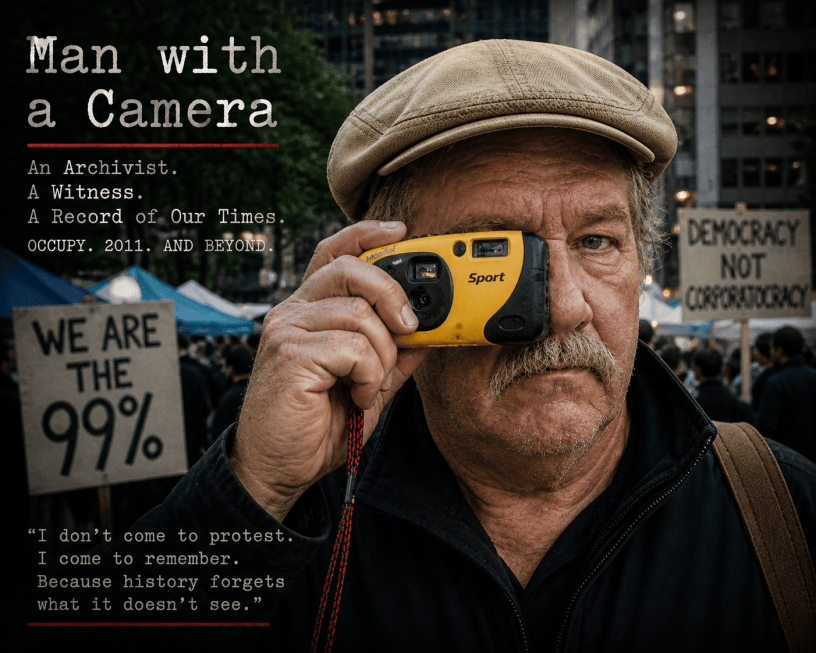
By Cliff Potts, CSO, and Editor-in-Chief of WPS News
Baybay City, Leyte, Philippines — October 10, 2026 (15th Anaversery Of Occupy Chicago) 12:35
Watching It Happen
I wasn’t there that first night.
I was at work, a couple weeks into a new job, already sick as a dog, and not in a position to take a day off. But I was watching it unfold in real time through Twitter, following what the early group was trying to do and how it was going.
That’s how I saw it happen.
The First Attempt
The early occupiers tried to sleep on the sidewalk in front of the Federal Reserve Bank of Chicago.
No tents. No infrastructure. Just people trying to hold space overnight and prove that the movement could stay.
And then Chicago did what Chicago does in September.
It rained.
Hard.
The Washout
That first night didn’t hold.
You can’t sleep on a sidewalk in a heavy rain and pretend it’s strategy. At some point, people have to choose between staying and functioning.
Most of them left.
Not because they quit, but because the conditions made it impossible to maintain any kind of presence.
The Question in Real Time
Whoever was running the Occupy Chicago Twitter account asked what they should do next.
That’s how fluid things were. There was no fixed plan. Decisions were being made as events unfolded.
I suggested something simple.
The L
Get on the train.
Ride the Blue Line out to Jefferson Park, cross the platform, and ride it back. Stay dry. Stay moving. Grab whatever sleep you can while the rain burned off.
Then come back.
It wasn’t symbolic.
But it worked.
The Return
When the rain let up, people came back.
The attempt hadn’t succeeded, but it hadn’t ended anything either. It showed how quickly reality could disrupt something that looked straightforward on paper.
The Boundaries
Once they were back, the lines became clearer.
The sidewalk in front of the Federal Reserve was public space. They could stand there, gather there, protest there.
But the building itself wasn’t.
Federal security made that clear. You couldn’t lean against the structure. That was private property.
So people turned and leaned against the planters instead.
Same location. Different boundary.
The Shift Decision
Camp Downpour forced a practical decision.
If people could not safely or reasonably sleep on the sidewalk through bad weather, the occupation still had to remain visible. So the answer became shifts.
Day shift. Afternoon shift. Overnight shift.
From that point forward, Occupy Chicago was not just a crowd that appeared and disappeared. It became a presence maintained in rotation.
For most of the day, we filled that intersection. Late at night, the numbers thinned, sometimes down to only a handful, but the occupation did not disappear.
Even in the wee hours of the morning, someone was still there.
What It Showed
Camp Downpour wasn’t planned.
It wasn’t named at the time.
It was just what happened when a group of people tried to hold space overnight and ran straight into weather, property lines, and the limits of what could be sustained without preparation.
What Stayed
The rain passed.
The people came back.
And from that point forward, everyone involved understood something that hadn’t been fully tested yet:
Occupying space wasn’t just about showing up.
It was about staying—however you had to.
For more from Cliff Potts, see https://cliffpotts.org
If this work helps you understand what’s happening, help me keep it going: https://www.patreon.com/cw/WPSNews
References
Potts, C. (2011, November 3). For the sake of the record. WPS News. https://wps.news/2011/11/03/for-the-sake-of-the-record/
City of Chicago. (n.d.). Chicago municipal code. American Legal Publishing. https://codelibrary.amlegal.com/codes/chicago/latest/chicago_il/0-0-0-2485380
Discover more from WPS News
Subscribe to get the latest posts sent to your email.

