By Cliff Potts, CSO, and Editor-in-Chief of WPS News
Baybay City, Leyte, Philippines — June 12, 2026 — 12:30 p.m.
Before we can talk about vacuum tubes, radios, transmitters, antennas, or any imagined attempt to rebuild a tricorder from old technology, we have to start with the force underneath all of it.
Electricity.
That sounds simple enough. Everybody uses electricity. We plug in phones. We charge batteries. We turn on lights. We use fans, routers, radios, televisions, and computers. Electricity is so common that most of us stop thinking about it unless the power goes out.
But electricity is not a thing in the same way a wrench is a thing. Electricity is a behavior of matter. It is what happens when electric charge is present, stored, separated, or moving.
At the center of this subject is the atom.
Atoms are the basic building blocks of ordinary matter. They contain protons, neutrons, and electrons. Protons have positive electric charge. Electrons have negative electric charge. Neutrons have no electric charge. Electricity, in most of the circuits we will discuss, is connected to the behavior of electrons (U.S. Energy Information Administration, n.d.).
That is the first step.
Electricity is not magic. It is not a mysterious fluid running through wires. It is tied to the movement and arrangement of charged particles.
When electric charge is not moving, we may be dealing with static electricity. That is the kind of electricity people notice when a shock jumps from a doorknob or when hair stands up after being rubbed by a balloon. Charge has built up. It has not yet moved through a useful circuit.
When electric charge moves, we have electric current.
Current is the flow of electric charge through a material. In a metal wire, that usually means electrons are moving through the conductor. The formal unit for electric current is the ampere, or amp. One ampere represents the movement of one coulomb of electric charge past a point in one second (National Institute of Standards and Technology, 2018).
That sounds more complicated than it needs to be at this stage.
For now, think of current as flow.
If electricity were water, current would be the amount of water flowing through the pipe.
That brings us to voltage.
Voltage is the push. More precisely, voltage is electric potential difference. It is the difference in electric potential energy between two points. That difference is what can push charge through a circuit (Encyclopaedia Britannica, 2026a).
If electricity were water, voltage would be like pressure.
A battery has voltage because it has created a difference between its two terminals. One side has a different electric condition than the other side. When we connect a circuit between those terminals, charge can move. That movement can do work.
It can light a bulb.
It can heat a wire.
It can turn a motor.
It can carry a signal.
That is where electronics begins.
Electronics is not just about electricity existing. It is about controlling electricity so it performs useful tasks.
A flashlight is a simple example. A battery provides voltage. A switch opens or closes the path. When the path is closed, current flows through the bulb or LED. The device converts electrical energy into light.
A radio is more complex, but the same basic idea still applies. Electricity is controlled, shaped, amplified, filtered, and converted into sound.
A computer is far more complex, but it is still using controlled electrical behavior. The difference is scale. A modern processor contains billions of tiny electronic switches. An old tube radio used far fewer parts, but those parts were large enough to see, test, and sometimes replace by hand.
That is one reason Electronic Archaeology begins here.
Modern electronics hides the process. Older electronics exposes it.
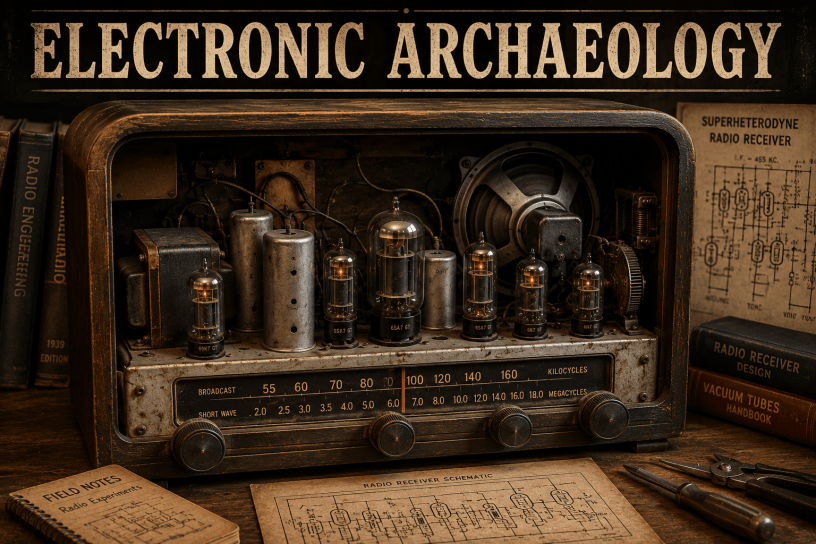
In a vacuum tube, you can see the glass envelope, the heater, the metal parts, and sometimes the glow. In an old radio, the circuit is spread out across a chassis. It may look confusing at first, but it is not sealed away inside a chip. The machine invites investigation.
To understand that machine, we need a few basic words.
Voltage is the push.
Current is the flow.
Resistance is opposition to that flow.
Power is the rate at which electrical energy is used or transferred.
Those four ideas will return again and again. They are the foundation of the course.
For now, we do not need to calculate much. We only need the basic picture.
Electricity begins with charge. Charge can be stored. Charge can move. When charge moves through a controlled path, useful work becomes possible.
The earliest electrical experimenters did not begin with microchips. They began with sparks, batteries, wires, coils, magnets, and questions. Over time, those questions became telegraphs, telephones, radios, vacuum tubes, radar systems, computers, and eventually the networked world we live in now.
That is the path we are going to follow.
We are not starting with modern electronics because modern electronics is too well hidden. We are starting closer to the beginning, where the pieces are large enough to understand.
There is also a practical warning.
Electricity can injure or kill. Even simple circuits deserve respect. Old tube equipment can be especially dangerous because it often uses high voltages, and capacitors inside old equipment can hold a charge after the power is turned off. This series is about understanding first. It is not an instruction to start poking around inside powered equipment.
The first goal is knowledge.
If we understand electricity, we can understand why a resistor matters.
If we understand resistance, we can understand Ohm’s Law.
If we understand Ohm’s Law, we can begin to understand circuits.
If we understand circuits, we can begin to understand radios.
And once we understand radios, we are no longer just using technology. We are reading the bones of the electronic age.
Next week, we take up one of the simplest and most important parts in electronics: the resistor.
If this work helps you understand what’s happening, help me keep it going: https://www.patreon.com/cw/WPSNews
For more from Cliff Potts, see https://cliffpotts.org
References
Encyclopaedia Britannica. (2026a, May 7). Electricity. Encyclopaedia Britannica. https://www.britannica.com/science/electricity
Encyclopaedia Britannica. (2026b, April 24). Electric current. Encyclopaedia Britannica. https://www.britannica.com/science/electric-current
National Institute of Standards and Technology. (2018, May 15). Ampere: Introduction. https://www.nist.gov/si-redefinition/ampere-introduction
U.S. Energy Information Administration. (n.d.). The science of electricity. https://www.eia.gov/energyexplained/electricity/the-science-of-electricity.php
Discover more from WPS News
Subscribe to get the latest posts sent to your email.

