Cliff Potts, CSO and Editor-in-Chief WPS News
BAYBAY CITY, Leyte, Philippines — July 4, 2026
There are two different questions people often confuse when talking about SpaceX, Blue Origin, NASA, and the future of human spaceflight.
The first question is whether these companies receive federal money. They do. SpaceX and Blue Origin both have major NASA contracts, and SpaceX also has major national-security space work. That part is not mysterious, scandalous, or even unusual. Boeing, North American Aviation, Grumman, McDonnell Douglas, Rocketdyne, Morton Thiokol, Martin Marietta, Northrop Grumman, and the rest of the old aerospace-industrial ecosystem all built pieces of the American space program while operating as private contractors.
That is how American spaceflight has usually worked. NASA sets goals, Congress funds them, federal agencies supervise them, and private companies build much of the hardware.
The better question is whether SpaceX and Blue Origin are only government-money machines, or whether they have begun doing space work that exists outside NASA’s direct command.
The answer is split.
SpaceX has clearly made the transition from NASA contractor to independent space power. Blue Origin is trying to make that transition, but it has not reached the same level yet.
Government Money Does Not Make a Space Company Fake
NASA money does not automatically make a company fake, dependent, or unserious. The Saturn V, the space shuttle, the International Space Station, commercial crew, national-security launch, and Artemis all relied on private contractors working under federal contracts.
That does not make those contractors meaningless. It means the United States has always treated spaceflight as a public-private industrial project.
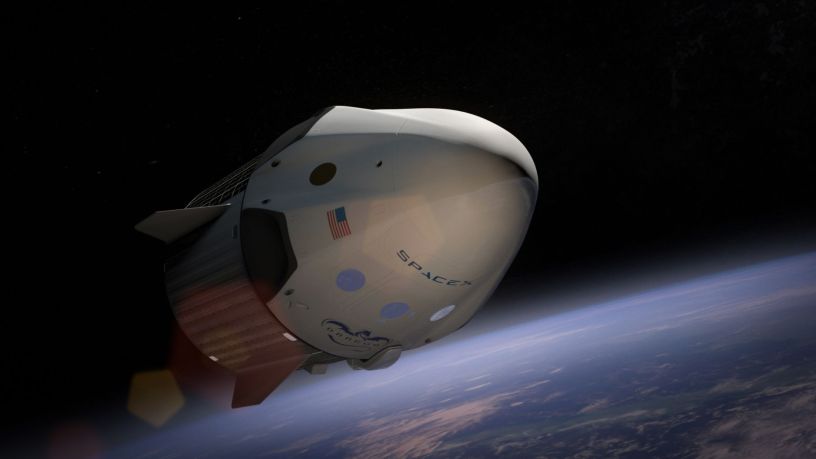
SpaceX is deeply tied to NASA. It flies astronauts to the International Space Station under NASA’s Commercial Crew Program. It flies cargo. It is building the Starship Human Landing System for Artemis. It won the contract to build the U.S. Deorbit Vehicle that will eventually help bring down the International Space Station safely. It launches NASA science missions. It is now one of the central pillars of American space operations.
Blue Origin is also tied to NASA. NASA selected Blue Origin to build the second Artemis lunar lander, Blue Moon, under a firm-fixed-price contract valued at $3.4 billion. That work is supposed to support Artemis V and future lunar missions, giving NASA a second commercial lunar-lander provider alongside SpaceX.
So the federal money is real.
But the more important issue is whether these companies have a private center of gravity.
SpaceX Does
SpaceX is not merely waiting for NASA checks.
Its biggest independent business is Starlink, even though Starlink is still inside the larger Musk/SpaceX world. That distinction matters. If Starlink launches are treated as internal accounting, that is fair. SpaceX launching its own satellites is not the same thing as an outside customer paying for a launch.
But Starlink’s customers are real. Residential users, businesses, airlines, ships, mobile networks, and enterprise customers are outside payers. Starlink’s 2025 progress report said the service added more than 4.6 million active customers in 2025 and expanded to 35 additional countries, territories, and markets.
That changes the argument. SpaceX is no longer simply a launch company with a government customer. It is a global satellite-internet company with a launch system attached to it.
SpaceX also sells commercial launches. Its rideshare program offers small satellite customers access to orbit at published prices. It launches satellites for private communications companies, international operators, and commercial constellations. That is not Mars romance. That is transportation business.
Then there is private human spaceflight.
Inspiration4, launched in 2021, was the world’s first all-civilian orbital mission. It did not go to the International Space Station. It was not a NASA crew rotation. It was a private orbital mission flown by SpaceX’s Falcon 9 and Dragon system.
Polaris Dawn went further. The 2024 private mission reached a high Earth orbit, tested SpaceX’s extravehicular activity suit, performed the first commercial astronaut spacewalk, and tested Starlink laser communications in space. That is not just billionaire tourism. That is private capability development.
Fram2, flown in 2025, sent a private crew into polar orbit. Again, that was not a NASA crew delivery to the ISS. It was SpaceX using its own human-spaceflight system for a private mission profile.
Axiom missions are more complicated because they use SpaceX Dragon to reach the International Space Station, which remains a NASA-led orbital laboratory. Those missions are private in customer structure but not fully independent in destination. They still show the direction of travel: NASA is no longer the only entity buying seats to orbit.
The Mars Question
The Mars question is where the signal and the hype get tangled.
Elon Musk and SpaceX are not shy about Mars. SpaceX describes Starship as a fully reusable transportation system designed to carry crew and cargo to Earth orbit, the Moon, Mars, and beyond. Its Mars materials speak directly of making human life multiplanetary and building toward a civilization on Mars.
That is not ordinary contractor language.
Boeing does not talk that way. Northrop Grumman does not talk that way. Blue Origin talks about millions of people living and working in space, but SpaceX is the company already flying crews, launching satellites at scale, operating a global satellite-internet business, and testing the vehicle it says is meant to make the Mars program possible.
Still, the timeline deserves skepticism. Starship is not operational as a crewed deep-space vehicle. The technical mountain is enormous: reliable reuse, orbital refueling, cryogenic propellant transfer, life support, radiation protection, Mars entry and landing, surface power, habitats, food, medicine, and return propellant production.
NASA’s inspector general warned in 2026 that lander development challenges are delaying Artemis schedules. The same technical issues that make Starship hard for the Moon make it even harder for Mars.
So the honest answer is this: the Mars goal is real, but the schedules should be treated as aspirational until the hardware proves otherwise.
The dream is not fake.
The calendar probably is.
Is Musk D. D. Harriman?
This is where the Heinlein comparison becomes useful.
In Robert A. Heinlein’s The Man Who Sold the Moon, D. D. Harriman is the obsessive businessman who wants to force humanity to the Moon. He raises money, manipulates markets, sells the dream, bends institutions, and pursues the impossible with a mix of vision, ego, salesmanship, and moral ambiguity.
That does sound familiar.
Musk is not Harriman exactly. Harriman was a fictional robber baron aimed almost entirely at the Moon. Musk is a real-world industrialist operating inside a far more complex system of federal contracts, private capital, launch licensing, environmental regulation, national-security work, labor conflict, public spectacle, and political controversy.
But the archetype fits better than it should.
Musk has done something rare: he turned space from a government program into a private industrial campaign with its own internal logic. NASA helped him. Federal contracts helped him. The U.S. government helped create the market in which SpaceX could survive long enough to become dominant.
But SpaceX did not stop at being paid to perform a government task. It built Falcon 9 into a reusable workhorse. It made Dragon operational. It used Starlink to create a space-based revenue engine. It began flying private crews. It is now gambling much of its future on Starship.
That is Harriman-like behavior.
It is also why political disgust should not blind anyone to the technical and business reality. Musk’s associations, public behavior, and politics can be criticized. They should be. But none of that erases the fact that SpaceX changed the launch market and is now reaching for something larger than contract fulfillment.
He is not a saint. He is not merely a carnival barker. He is not just a government contractor.
He is a man grabbing for the brass ring on the carousel, and whether anyone likes him personally is secondary to the harder fact: he may be one of the few people alive actually trying to build the road.
On July 4, that point lands with extra force. The American story has always contained both the builder and the hustler, the frontier dreamer and the dangerous ego, the inventor and the promoter. Sometimes those roles occupy the same person. Sometimes the result is disaster. Sometimes it changes history.
SpaceX has already changed history. Mars is the unanswered part.
Blue Origin: Real, But Not There Yet
Blue Origin is harder to judge because its story is less advanced.
First, Blue Origin is not Amazon. It was founded by Jeff Bezos, who also founded Amazon, but Blue Origin is not simply an Amazon division. Amazon’s satellite-internet business, now known as Amazon Leo and formerly Project Kuiper, is separate.
Blue Origin has done independent work. New Shepard carried passengers and payloads on suborbital flights. It served research customers, students, NASA payloads, universities, and commercial companies. Blue Origin says New Shepard payload customers can use the vehicle for microgravity, lunar-gravity, partial-gravity, and high-altitude research, with payloads flying inside the capsule or exposed to the space environment.
But Blue Origin paused New Shepard flights in 2026 for at least two years to redirect resources toward human lunar capability. Reuters reported that the program had flown paying passengers and research experiments across dozens of brief suborbital flights before the pause.
That is real revenue, but it is not yet a durable independent space economy.
Blue Origin also sells engines. Its BE-4 engine powers Blue Origin’s own New Glenn booster and United Launch Alliance’s Vulcan rocket. That matters because ULA is not a Bezos company.
Even there, the money trail is mixed. ULA launches commercial, civil, and national-security missions. So BE-4 engine sales are commercial in customer structure but often connected to government launch demand.
New Glenn is Blue Origin’s biggest chance to become a true SpaceX competitor. Blue Origin has signed commercial launch agreements, including work connected to AST SpaceMobile’s BlueBird satellite constellation. That is exactly the kind of outside commercial customer Blue Origin needs.
Blue Origin has also announced TeraWave, a proposed space-based communications network aimed at enterprise, data center, and government customers. The company says TeraWave would use thousands of optically linked satellites and offer very high-capacity communications service. Reuters reported that the system is aimed at governments, data centers, and businesses rather than ordinary consumer broadband.
That could become Blue Origin’s Starlink-like revenue base.
But as of mid-2026, it remains a plan, not a proven business comparable to Starlink.
The Bezos Difference
Jeff Bezos has his own space vision. Blue Origin’s slogan, “Gradatim Ferociter,” roughly means “step by step, ferociously.” The company’s long-term idea is not just flags and footprints. Bezos has talked for years about millions of people living and working in space, with heavy industry eventually moved off Earth.
That is a real vision.
But Blue Origin has moved slowly compared with SpaceX. It has money, talent, engines, NASA contracts, and now New Glenn. What it does not yet have is SpaceX’s operational record: routine orbital launch cadence, crew transport, a global satellite business, private orbital missions, and a tested culture of moving fast through hardware failure.
Blue Origin is trying to become a full private space power. It may still get there. Competition would be good. America should not want one company, one billionaire, or one launch system to dominate the road to orbit.
But Blue Origin still has more to prove.
The Verdict
SpaceX has crossed the line. It is a NASA contractor, a national-security contractor, a launch company, a satellite-internet company, and a private human-spaceflight operator. Its future still depends partly on federal money, but it no longer depends only on federal money.
Blue Origin has not crossed that line in the same way. It has real technology, real NASA contracts, real engine work, real commercial launch customers, and serious plans. But its independent commercial identity is still incomplete. Too much of its trajectory still depends on NASA lunar work, Amazon-linked launch demand, U.S. national-security ambitions, and future systems that have not yet matured into operating businesses.
The old question was whether private space companies were just living on government contracts.
For SpaceX, that answer is now no.
For Blue Origin, the answer is: not only, but still mostly.
That distinction matters. The next American space age may still be funded partly by NASA, but it will not be run only by NASA. The real fight is over which private companies can turn government-supported technology into independent infrastructure.
SpaceX has done it first.
Blue Origin is still trying.
And somewhere between NASA, billionaires, launch pads, satellites, private crews, lunar landers, and the impossible old dream of Mars, the United States may be watching the beginning of something larger than a contract.
It may be watching the road being built.
References
Blue Origin. (2023). NASA selects Blue Origin as second Artemis lunar lander provider.
Blue Origin. (2024). AST SpaceMobile selects Blue Origin’s New Glenn rocket to deliver next-generation BlueBird satellites to space.
Blue Origin. (2026). Blue Origin introduces TeraWave, a 6 Tbps space-based network for global connectivity.
Blue Origin. (2026). Blue Origin to pause New Shepard flights for no less than two years.
Heinlein, R. A. (1950). The man who sold the Moon. Shasta Publishers.
NASA. (2021). As Artemis moves forward, NASA picks SpaceX to land next Americans on Moon.
NASA. (2022). NASA awards SpaceX more crew flights to space station.
NASA. (2023). NASA selects Blue Origin as second Artemis lunar lander provider.
NASA. (2024). NASA selects International Space Station U.S. Deorbit Vehicle.
NASA Office of Inspector General. (2026). NASA’s management of the Human Landing System contracts.
Polaris Program. (2024). Polaris Dawn mission.
Reuters. (2024). Blue Origin, AST SpaceMobile ink New Glenn rocket launch deal.
Reuters. (2026). Blue Origin shutters New Shepard rocket program to focus on moon lander development.
Reuters. (2026). Bezos’ Blue Origin to deploy thousands of satellites for new TeraWave communications network.
SpaceX. (2021). Inspiration4 mission.
SpaceX. (2025). Fram2 mission.
SpaceX. (n.d.). Mission: Mars.
SpaceX. (n.d.). Smallsat rideshare program.
SpaceX. (n.d.). Starship.
Starlink. (2026). Starlink 2025 progress report.
Discover more from WPS News
Subscribe to get the latest posts sent to your email.

