By Cliff Potts
Editor-in-Chief, WPS News
BAYBAY CITY, Leyte, Philippines — July 20, 2026 — 2105 PhST
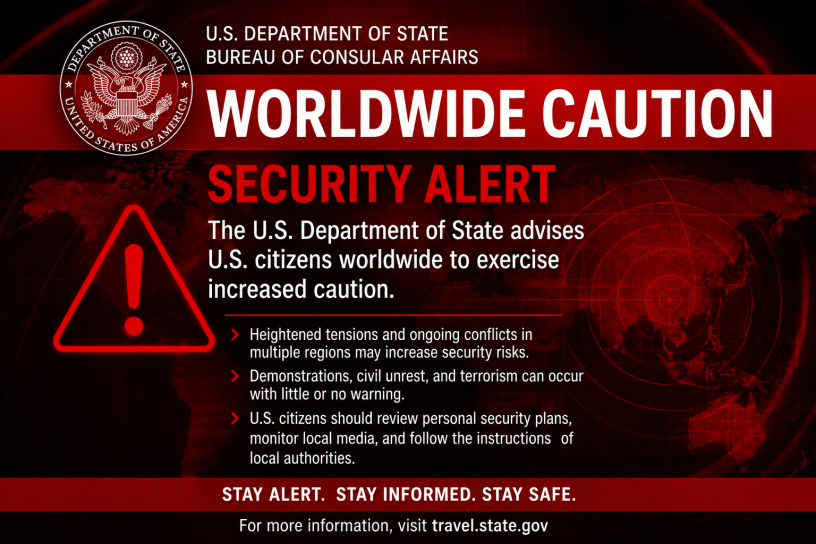
The U.S. State Department issued a worldwide security caution on July 18 as renewed warfare between the United States and Iran spread across the Persian Gulf and killed two American service members in Jordan.
Contrary to claims circulating on TikTok and other social-media platforms, the department did not order every American citizen overseas to return to the United States. It also did not declare a universal “red alert,” a term that is not part of the State Department’s standard four-level travel-advisory system.
The official notice advises Americans worldwide—and particularly those in the Middle East—to exercise increased caution, follow instructions issued by the nearest U.S. embassy or consulate, and prepare for possible airspace closures and other travel disruptions.
“Groups supportive of Iran may target other U.S. interests,” the State Department warned. It also noted that American diplomatic facilities, including some outside the Middle East, have previously been targeted (U.S. Department of State, 2026).
That is a serious warning. It is not, however, an evacuation order.
What Happened During the Previous 72 Hours
The security notice followed several days of rapidly intensifying combat.
American forces conducted a seventh consecutive night of strikes against Iran on July 17 and continued the campaign into an eighth night after an Iranian attack killed two U.S. service members and left another missing in Jordan.
The United States said its latest attacks targeted Islamic Revolutionary Guard Corps facilities, missile-storage locations, coastal surveillance systems, maritime infrastructure, and other military assets used to threaten American forces and commercial shipping.
Iran answered with ballistic missiles and drones aimed at American forces and U.S.-aligned governments across the region. Jordan, Kuwait, Bahrain, Qatar, and other Gulf states have reported attacks, interceptions, air-raid warnings, or damage since the renewed fighting began.
Kuwait accused Iran of striking critical civilian infrastructure, including facilities connected to electricity generation and water desalination. Missile and drone activity also forced temporary airspace restrictions and sent residents of several Gulf countries into shelters.
The attacks in Jordan represented an especially dangerous turning point. Once American personnel were killed, the political pressure on Washington to retaliate became considerably stronger, reducing the space available for quiet de-escalation.
The exchange has now moved beyond limited strikes intended primarily to send political messages. Both governments are attacking military capabilities, transportation links, ports, surveillance networks, shipping, and infrastructure that supports their opponent’s ability to continue fighting (Associated Press, 2026a; Reuters, 2026a).
The Strait of Hormuz Remains the Center of the Crisis
The most dangerous point of confrontation is the Strait of Hormuz, the narrow waterway connecting the Persian Gulf with the Gulf of Oman and the Arabian Sea.
Approximately one-fifth of the world’s petroleum liquids have historically passed through the strait. Even when oil remains physically available, warfare, insurance restrictions, naval blockades, attacks on ships, and frightened crews can prevent it from reaching the global market.
Commercial traffic through the strait has dropped sharply. Reuters reported that only nine vessels passed through on one recent day, compared with much heavier traffic under ordinary conditions. No very large crude carriers or liquefied-natural-gas tankers were observed during that period (Reuters, 2026b).
Iran claims authority to regulate traffic and has threatened or attacked vessels that refuse its instructions. The United States rejects that claim and has resumed enforcing a naval blockade against Iranian ports.
Both sides now claim that they are defending lawful navigation while accusing the other of threatening international shipping. In practice, their competing military operations are making the waterway increasingly dangerous.
This matters far beyond the Middle East. Prolonged disruption could increase fuel, transportation, electricity, food, and fertilizer costs around the world. Energy-importing countries such as the Philippines would not need to be directly attacked to experience significant economic consequences.
Where the Conflict Is Most Likely Heading
The most likely immediate course is continued escalation followed by intense pressure for another ceasefire.
Neither Washington nor Tehran currently appears ready to accept the other side’s terms. The United States wants Iran to reduce its control over shipping through the strait and stop attacking American troops and regional partners. Iran wants the United States to halt its strikes, end the blockade, and accept a larger Iranian role in regulating Gulf traffic.
Those positions are not presently compatible.
The next several days will probably bring additional American strikes against missile sites, Revolutionary Guard installations, coastal defenses, command facilities, bridges, ports, and military logistics. Iran will likely continue using missiles, drones, proxy forces, and attacks on shipping to demonstrate that the United States cannot conduct a low-cost air campaign.
The greatest danger is not necessarily a deliberate decision by either government to begin a much larger war. It is miscalculation.
Another successful attack that kills a substantial number of American personnel could trigger a much broader U.S. response. A strike that causes mass civilian casualties inside Iran could produce wider Iranian retaliation. An Iranian missile entering Israeli airspace—or appearing to target Israel—could bring Israeli forces directly back into the fighting.
There is also a growing possibility that infrastructure attacks will expand beyond military targets. Water facilities, power stations, ports, bridges, fuel terminals, communication networks, and commercial vessels are increasingly becoming part of the battlefield.
Diplomatic mediation remains possible, particularly through Qatar, Oman, Pakistan, Egypt, or other governments capable of communicating with both sides. However, diplomacy is currently being conducted under the sound of missiles and airstrikes, and the previous interim agreement has largely collapsed (Associated Press, 2026b).
What the Warning Means for Americans in the Philippines
There is currently no State Department instruction telling U.S. citizens to leave the Philippines because of the Iran conflict.
Americans living in the Philippines should treat the worldwide caution as an instruction to remain aware—not as a signal to panic or purchase an immediate ticket home.
Practical precautions include monitoring notices from the U.S. Embassy in Manila, avoiding demonstrations near diplomatic sites, keeping travel documents current, and checking flight routes before traveling through the Middle East.
Travelers connecting through Gulf hubs should pay particularly close attention to cancellations, rerouting, airspace restrictions, and changing advisories. Conditions can shift faster than the general travel-advisory pages are updated.
The blunt assessment is that the TikTok claim was exaggerated, but it grew from a real and increasingly dangerous situation.
The State Department has not ordered Americans everywhere to come home. The United States and Iran are, however, engaged in sustained warfare that has killed American troops, damaged civilian infrastructure, severely disrupted one of the world’s most important shipping routes, and created a genuine risk of a wider regional conflict.
That is serious enough without inventing an evacuation order that does not exist.
References
Associated Press. (2026a, July 19). U.S. strikes Iran over troop deaths as Israel warns Tehran’s attacks are coming close.
Associated Press. (2026b, July 17). What remains of the Iran deal as fighting rages.
Reuters. (2026a, July 18). U.S. renews strikes on Iran after two military personnel killed by Iranian attack.
Reuters. (2026b, July 16). Fewer vessels travel through Hormuz after U.S. resumes blockade.
U.S. Department of State. (2026, July 18). Worldwide caution.
Discover more from WPS News
Subscribe to get the latest posts sent to your email.

