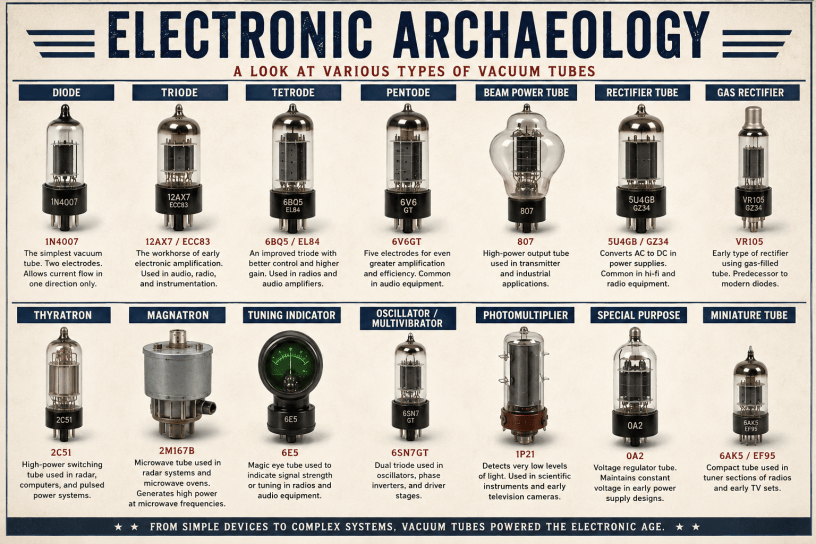
By Cliff Potts, CSO, and Editor-in-Chief of WPS News
Baybay City, Leyte, Philippines — October 2, 2026 — 12:30 p.m.
So far, our journey through vacuum tubes has focused primarily on receiving tubes.
These were the tubes that amplified radio signals, powered home receivers, and helped engineers process information.
This week we move to the other end of the spectrum.
Power tubes.
If receiving tubes were the ears of the Electronic Age, power tubes were its voice.
Their purpose was not merely to amplify.
Their purpose was to deliver energy.
Lots of it.
Whether broadcasting a radio program across an entire nation or producing radar pulses powerful enough to detect distant aircraft, power tubes made it possible.
The basic principles remain familiar.
A heated cathode releases electrons.
A positively charged plate attracts them.
One or more control grids regulate the flow.
The difference lies in the scale.
Power tubes operate at much higher voltages.
They carry much larger currents.
They dissipate enormous amounts of heat.
Some are small enough to fit comfortably in your hand.
Others are taller than a person.
The largest transmitting tubes ever built resemble industrial machinery more than electronic components.
Many require forced-air cooling.
Some require circulating water to remove heat.
Others use specially designed metal or ceramic construction rather than traditional glass.
The more power engineers demanded, the larger and more impressive the tubes became.
Electronic Archaeology Note
One of the things that fascinated me as a student was simply seeing photographs of these enormous transmitting tubes.
Until then, I had assumed all vacuum tubes looked like the ones found in old radios.
Then I discovered tubes that required blowers, cooling systems, and thousands of volts to operate.
That realization changed my perspective.
Vacuum tubes were not just little glowing glass bottles.
They were serious industrial equipment capable of producing extraordinary amounts of electrical energy.
Power tubes appeared everywhere.
AM broadcast stations.
Shortwave transmitters.
Television stations.
Military communications.
Radar installations.
Scientific laboratories.
Industrial heating equipment.
Wherever engineers needed large amounts of radio-frequency power, vacuum tubes became the preferred solution.
One reason power tubes remained important long after transistors became available is that certain applications demanded voltages and power levels beyond the practical limits of early semiconductor devices.
Even today, many high-power broadcast transmitters continue using vacuum tubes in their final output stages.
Some amateur radio operators also prefer tube transmitters because of their durability and ability to tolerate temporary overloads.
That does not mean tubes are always better.
Modern solid-state transmitters are remarkably efficient and reliable.
They require less maintenance.
They consume less power.
They occupy less space.
But when extremely high power is required, vacuum tubes still have advantages in certain specialized applications.
Electronic Archaeology reminds us that engineering is rarely a matter of declaring one technology completely superior to another.
Instead, engineers ask a different question.
Which technology is best suited for this job?
Sometimes the answer is a transistor.
Sometimes it is an integrated circuit.
Sometimes it is still a vacuum tube.
Power tubes also demonstrate another lesson.
Heat is the enemy of electronics.
The more electrical power a device handles, the more heat it must safely remove.
Designing a successful transmitter often involves managing heat just as carefully as managing electricity.
Cooling fins.
Forced-air blowers.
Water cooling.
Heat sinks.
All become essential parts of the engineering solution.
Power is never free.
It always demands careful design.
Looking back, it is remarkable that engineers accomplished so much with technology that many people now consider obsolete.
Entire continents received radio broadcasts powered by vacuum tubes.
Global communication networks depended upon them.
Scientific discoveries relied upon them.
The Electronic Age was built one glowing tube at a time.
The giants of that era deserve to be remembered.
Next week we will explore one of the most recognizable vacuum tubes ever built.
The rectifier tube.
Although we have already discussed rectification as a concept, it is time to examine the specialized tubes whose only job was turning alternating current into the direct current that powered nearly every electronic device of the twentieth century.
If this work helps you understand what’s happening, help me keep it going: https://www.patreon.com/cw/WPSNews
For more from Cliff Potts, see https://cliffpotts.org
References
Horowitz, P., & Hill, W. (2015). The Art of Electronics (3rd ed.). Cambridge University Press.
Tyne, G. F. J. (1977). Saga of the Vacuum Tube. Howard W. Sams & Co.
Encyclopaedia Britannica. (2025). Vacuum tube. Encyclopaedia Britannica. https://www.britannica.com/technology/vacuum-tube
Discover more from WPS News
Subscribe to get the latest posts sent to your email.

