By Cliff Potts, CSO, and Editor-in-Chief of WPS News
Baybay City, Leyte, Philippines — October 23, 2026 — 12:30 p.m.
Throughout this series we have learned how electronic components perform individual jobs.
Resistors control current.
Capacitors store electrical energy.
Transformers move energy from one circuit to another.
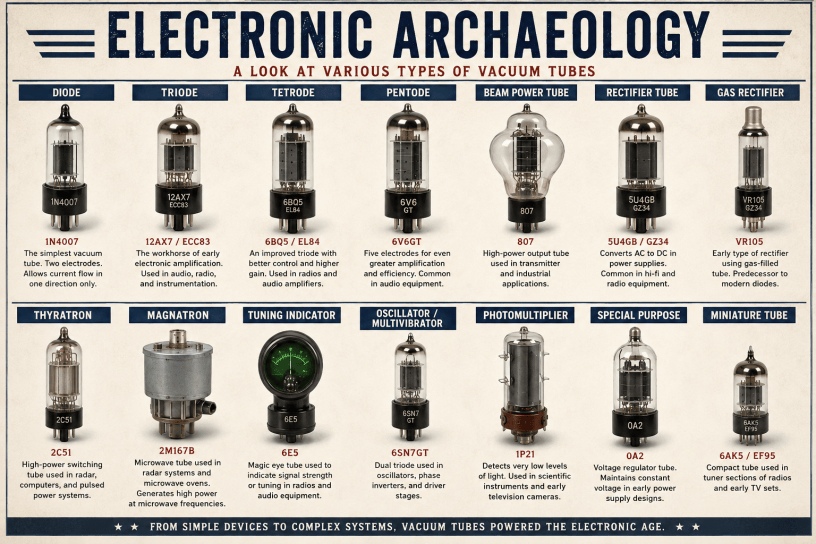
Vacuum tubes amplify signals.
Now we arrive at the component that gives electronics a heartbeat.
The oscillator.
Without oscillators, there would be no radio broadcasting.
No television.
No Wi-Fi.
No GPS.
No cellular phones.
No computers keeping accurate time.
Nearly every electronic communication system begins with one simple requirement.
A stable, repeating electrical signal.
That is exactly what an oscillator produces.
An oscillator is a circuit that generates an electrical waveform continuously without requiring a changing input signal.
Once started, it keeps producing a predictable output frequency until power is removed.
Think of it as an electronic musician holding a perfectly steady note.
That single note becomes the foundation for everything that follows.
If the note drifts, the entire system drifts with it.
The earliest oscillators relied on vacuum tubes.
Engineers discovered that by feeding a small portion of a tube’s output back into its input under carefully controlled conditions, the circuit would continue producing a signal indefinitely.
The signal could be a sine wave.
It could be a square wave.
It could be another waveform designed for a specific purpose.
The important point was consistency.
Radio stations depend upon precise frequencies.
If a transmitter wandered randomly up and down the dial, listeners would never be able to find it.
Stable oscillators solved that problem.
One of the earliest and most successful designs was the Hartley oscillator.
Another was the Colpitts oscillator.
Still another was the crystal-controlled oscillator, which used the remarkable properties of quartz crystals to achieve extraordinary frequency stability.
Many of these circuits remain in use today, although transistors and integrated circuits have replaced vacuum tubes in most applications.
The underlying principles, however, remain the same.
Electronic Archaeology Note
Oscillators were one of those topics that fascinated me because they seemed almost impossible.
How could a circuit make electricity simply by being connected to a power supply?
At first glance, it almost looked like it was creating something from nothing.
Of course, it wasn’t.
The power came from the power supply.
The oscillator simply converted that steady source of energy into a repeating electrical waveform.
Once I understood that, the mystery disappeared.
What remained was an appreciation for just how elegant the design really was.
Every radio transmitter begins with an oscillator.
The oscillator establishes the carrier frequency.
That carrier is then amplified.
Finally, information such as voice or music is added through modulation before the signal is sent to the antenna.
Without the oscillator, there is no carrier.
Without the carrier, there is nothing to transmit.
Receivers also depend upon oscillators.
Modern superheterodyne receivers contain a local oscillator that mixes with the incoming radio signal to produce an intermediate frequency.
We will examine that remarkable process in a future lesson.
For now, remember that oscillators appear on both sides of every radio conversation.
The transmitter has one.
The receiver has one.
Both must remain remarkably stable.
Oscillators appear far beyond radio.
Computers contain clock oscillators that synchronize billions of operations every second.
Digital watches keep time using quartz crystal oscillators.
Laboratory equipment uses precision oscillators for testing.
Even your smartphone depends upon several oscillators working together behind the scenes.
Most people never notice them.
Yet without them, modern electronics would quickly descend into chaos.
Electronic Archaeology reminds us that some of the most important inventions are invisible.
You cannot hear a radio-frequency carrier.
You cannot see an oscillator working inside a circuit.
Yet nearly every communication system depends upon one.
It quietly establishes order.
It provides timing.
It creates stability.
In many ways, the oscillator is the conductor of the electronic orchestra.
Every other component performs its own job.
The oscillator keeps everyone playing in the same key.
Next week we will follow that steady electrical note into the next stage of the journey.
The radio transmitter.
There we will discover how a simple oscillating signal becomes a voice traveling through the air to listeners hundreds—or even thousands—of kilometers away.
If this work helps you understand what’s happening, help me keep it going: https://www.patreon.com/cw/WPSNews
For more from Cliff Potts, see https://cliffpotts.org
References
Horowitz, P., & Hill, W. (2015). The Art of Electronics (3rd ed.). Cambridge University Press.
Hayward, W. M. (2001). Experimental Methods in RF Design. American Radio Relay League.
Encyclopaedia Britannica. (2025). Oscillator. Encyclopaedia Britannica. https://www.britannica.com/technology/electronic-oscillator
Discover more from WPS News
Subscribe to get the latest posts sent to your email.

