By Dr. Cliff Potts Editor-in-Chief, WPS News
BAYBAY CITY, Philippines — September 26, 2026, 4:35 p.m. PHT
This article began with a warning from family in the United States.
I had been operating under an assumption that now requires correction. I believed that the United States had survived the most dangerous period of its recent political crisis when it survived the January 6, 2021, attack on the Capitol and completed the constitutional transfer of presidential power.
That assessment was too optimistic.
The message I received from inside the United States was straightforward: the political climate there is considerably worse than it appears from outside the country.
So WPS News took another look.
What we found does not justify panic. It does justify attention.
THE DANGER HAS CHANGED
January 6 was visible. Americans watched windows break, police fight rioters and members of Congress flee or shelter as the certification of a presidential election was disrupted.
What is happening in 2026 is different.
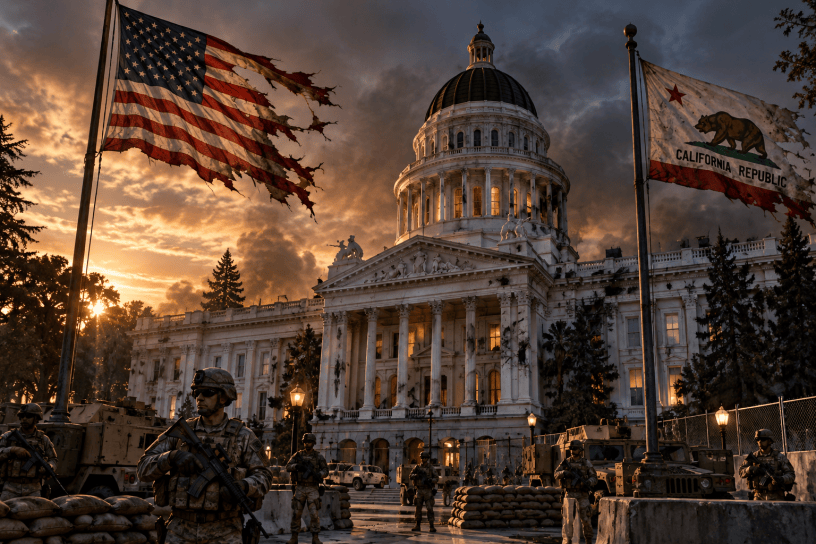
There is no single event around which the entire crisis can conveniently be organized. Instead, several separate pressures are occurring simultaneously: extraordinary immigration enforcement, military involvement in domestic affairs, escalating political violence and fear of that violence, conflicts between the presidency and the press, and increasingly expansive assertions of executive authority.
Any one of these could be debated individually.
Taken together, they describe a country under significant political strain.
POLITICAL VIOLENCE IS NO LONGER A FRINGE CONCERN
One of the clearest warning signs comes from Americans themselves.
A Reuters/Ipsos survey conducted August 28–31 found that 61% of Americans considered attacks by domestic ideological extremists a greater threat than attacks originating overseas. Thirty-three percent identified domestic terrorism as the greatest threat to Americans’ safety, compared with 20% who selected foreign terrorism. Another 42% identified random violence, including mass shootings (Lange, 2026).
That does not mean political violence is inevitable, nor does it mean the United States is approaching civil war.
It means Americans themselves perceive serious danger originating inside their own country.
That deserves attention.
IMMIGRATION ENFORCEMENT HAS REACHED RECORD LEVELS
Immigration enforcement provides another measurable change.
U.S. Immigration and Customs Enforcement arrested 50,925 people in August, according to the Department of Homeland Security—the third consecutive monthly record (U.S. Department of Homeland Security, 2026).
Reuters subsequently reported that deportations did not increase proportionately. Despite the enormous increase in arrests, deportations remained around 1,200 per day. Reuters found that the people being arrested increasingly included individuals without final deportation orders and people without criminal convictions (Cooke, 2026).
Supporters of the administration regard aggressive enforcement as fulfillment of Trump’s campaign promises and enforcement of existing immigration law.
Critics see something considerably more troubling: an expanding federal enforcement apparatus reaching deeply into American communities.
Whichever interpretation one accepts, the scale of what is happening is not imaginary.
THE MILITARY IS BECOMING MORE VISIBLE AT HOME
National Guard deployments have also become increasingly prominent in American domestic life.
More than 3,100 Guard members from 18 states, Puerto Rico and the District of Columbia were serving in Washington as part of the administration’s crime initiative this month (Associated Press, 2026).
And senators from both parties emerged frustrated from a September 17 Pentagon briefing in which questions included the possibility of National Guard personnel being deployed around polling locations during the coming midterm elections. Some senators said Pentagon officials failed to provide satisfactory answers, although Republican Sen. Jim Banks characterized the briefing more positively (Associated Press, 2026).
This distinction matters.
Concern about military involvement in civilian affairs does not establish that an unlawful use of the military will occur.
But questions that once would have sounded extraordinary are now questions members of the United States Senate are asking the Pentagon.
THE PRESS IS NOW PART OF THE CONFRONTATION
The conflict has reached journalism itself.
On September 19, reporters from CNN, MS NOW and Politico were denied access to White House grounds after Trump announced that those organizations would be barred. The organizations characterized the action as unconstitutional retaliation against unfavorable reporting. Trump defended his position by describing their reporting as fake news (Reuters, 2026a).
The administration has also increasingly invoked national security to justify actions across several areas of government. Legal scholars interviewed by Reuters have questioned the breadth of those claims, while the administration argues that presidential national-security authority supports its actions (Reuters, 2026b).
This is exactly where careful journalism becomes essential.
Opposition to Donald Trump does not automatically make every allegation against his administration true.
Neither does presidential authority make every exercise of that authority harmless.
Evidence matters.
THIS IS NOT JANUARY 6
We should resist the temptation to force 2026 into the January 6 template.
There are not thousands of rioters storming the Capitol today.
There is something more complicated happening.
The United States is experiencing simultaneous conflicts over immigration enforcement, presidential authority, military involvement in domestic affairs, political violence, elections and press freedom.
Some Americans support many of the administration’s actions. Others consider them profound threats to democratic government. Courts, Congress, state governments, journalists and voters continue to contest those actions.
Those institutions still matter.
America has not ceased being a constitutional republic simply because its institutions are under enormous pressure.
But neither should we pretend that pressure is normal because catastrophe has not occurred.
PAY ATTENTION
For those of us living outside the United States, there is another problem.
Distance makes everything look cleaner.
We receive headlines, court decisions, polling numbers and video clips. We don’t necessarily experience what Americans encounter at workplaces, schools, neighborhoods, protests, immigration offices and dinner tables.
That is why reports from people actually living there deserve consideration—not as substitutes for evidence, but as signals telling journalists where to look.
I looked.
What I found caused me to revise my assessment.
I was too optimistic.
That does not mean Americans should panic. It does not mean Americans should flee their country. And it certainly does not mean anyone knows what happens next.
It means the political situation inside the United States is serious enough that Americans—and those of us with people we love there—should stop assuming the worst has already passed.
Pay attention.
Because the evidence currently available gives us little reason to assume these pressures will simply disappear on their own.
References
Associated Press. (2026, September 17). Senators from both parties voice criticism about Pentagon briefing on U.S. defense strategy.
Associated Press. (2026, September). National Guard crime task force member arrested in D.C., accused of drawing gun on fellow Guard member.
Cooke, K. (2026, September 14). ICE arrests keep soaring. Here’s why they are not leading to more deportations. Reuters.
Lange, J. (2026, September 8). 25 years after 9/11, Americans fear domestic extremists more than foreign attacks, Reuters/Ipsos poll finds. Reuters.
Reuters. (2026a, September 19). White House turns away CNN, MS NOW, Politico reporters after Trump’s ban.
Reuters. (2026b, September 22). As resistance mounts, Trump reaches for a familiar shield: national security.
U.S. Department of Homeland Security. (2026, September 2). ICE’s August arrests break record for number of illegal aliens arrested.
Discover more from WPS News
Subscribe to get the latest posts sent to your email.

