Voters Rejected a Stricter Constitutional Formula, Leaving the Country’s Long-Standing Policy Largely Where It Was
By Cliff Potts, Editor-in-Chief, WPS News
BAYBAY CITY, LEYTE, Philippines — Tuesday, October 6, 2026
Support WPS News — Patreon: https://www.patreon.com/cw/WPSNews
THE SWISS HAVE SPOKEN
Switzerland held its national referendum on the “Safeguard Swiss Neutrality” initiative on September 27, 2026.
The answer was decisive.
The initiative received 789,130 yes votes, or 29.85 percent, against 1,854,767 no votes, or 70.15 percent. Turnout was 47.06 percent, and not a single canton produced a majority supporting the proposal (Federal Statistical Office, 2026).
What did Switzerland vote against?
Not neutrality.
The initiative would have written a considerably stricter interpretation of permanent armed neutrality into the Swiss Constitution, limiting Switzerland’s ability to participate in sanctions and restricting cooperation with military alliances.
Swiss voters instead chose to leave their government substantially the same room to maneuver that it already possessed.
In practical terms, the European security landscape did not change very much.
NEUTRALITY REMAINS THE POLICY
Switzerland remains permanently and militarily neutral.
Swiss law says the country does not participate in wars between states, while armed neutrality means Switzerland maintains military forces capable of defending its territory and preventing belligerents from using Swiss territory for military purposes (Federal Department of Foreign Affairs [FDFA], 2026a).
Switzerland also remains outside NATO.
But neutrality does not mean complete isolation.
Switzerland joined NATO’s Partnership for Peace in 1996 and continues military training, interoperability work and other cooperation while NATO formally recognizes and respects Swiss neutrality (NATO, 2025).
The September referendum did not turn Switzerland toward NATO membership.
It simply rejected an attempt to make the existing policy more restrictive.
A FORMULA WITH A LONG HISTORY
There is an understandable reason Switzerland is reluctant to abandon the arrangement.
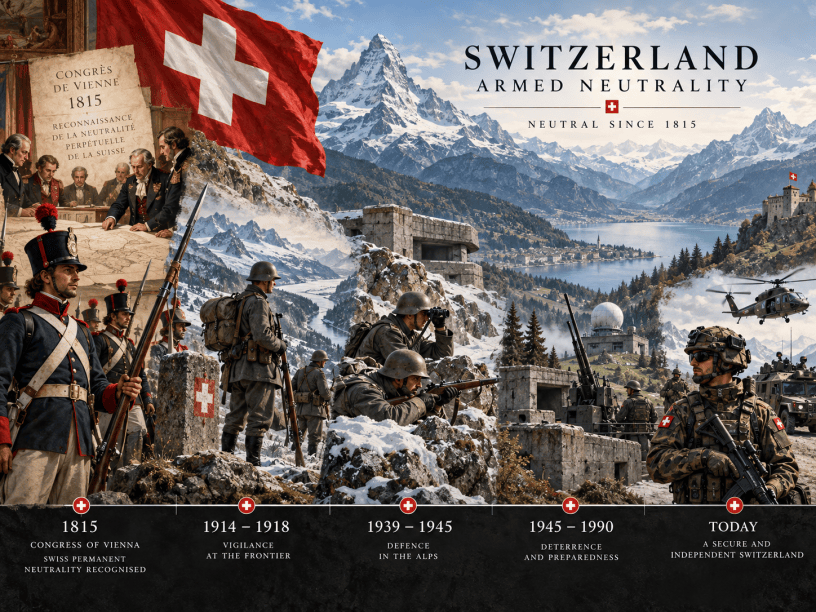
Its permanent neutrality was internationally recognized in 1815 following the Napoleonic Wars (FDFA, 2026b).
Switzerland remained outside the First World War and reaffirmed neutrality again at the beginning of the Second World War. It mobilized its armed forces during both conflicts to protect its territory (Swiss Federal Archives, 2026).
That history should not be romanticized. Switzerland’s own official account acknowledges economic pressures, compromises and problems surrounding neutrality during World War II.
Still, the basic outcome is difficult to ignore: Switzerland avoided becoming a battlefield during two wars that devastated much of the continent.
It is therefore not surprising that Swiss voters are reluctant to discard a security tradition that has endured for generations.
RUSSIA HAS CHANGED THE ENVIRONMENT—NOT THE VOTE
Russia’s invasion of Ukraine has made Swiss neutrality harder to practice.
Switzerland condemned the invasion and largely adopted European Union sanctions against Russia, while Moscow has argued that those actions undermine Swiss neutrality. Bern rejects that interpretation and maintains that neutrality law prohibits military participation in a war but does not require political silence or prohibit every economic sanction (Swiss Federal Council, 2026).
Meanwhile, NATO continues strengthening its eastern defenses and describes Russia as a long-term threat to Euro-Atlantic security (NATO, 2026).
That does not mean another European-wide war is inevitable.
As of this writing, Russia and NATO are not engaged in sustained direct combat. The alliance remains focused publicly on deterrence: building enough military strength that Moscow has little reason to test NATO territory.
ANALYSIS
THE REFERENDUM PRESERVES THE STATUS QUO
The easiest way to understand the September vote is that Switzerland decided not to lock itself into a narrower definition of neutrality.
That gives Bern flexibility.
Switzerland can remain outside NATO while cooperating with it.
It can maintain armed neutrality while adapting its defense forces.
And it can respond politically and economically to events such as Russia’s invasion without automatically becoming a participant in the war.
For now, that formula continues to work.
A much larger Russia-NATO conflict would put Swiss neutrality under far greater pressure, but the referendum itself would not suddenly become legally meaningless. Switzerland’s neutrality is designed precisely for situations in which other states are at war.
The real question would become whether Switzerland could continue enforcing neutrality while surrounded by states engaged in a major European conflict.
That would be an entirely different test.
READER TAKEAWAY
Swiss voters were not choosing between NATO and neutrality.
They were choosing between the existing flexible version of Swiss neutrality and a substantially stricter constitutional version.
They chose the existing system by more than two to one.
After more than two centuries of internationally recognized armed neutrality—and after remaining outside both world wars—the Swiss have decided that their present course still deserves a chance to work.
Given the uncertainty surrounding Europe today, maintaining that option is hardly an irrational choice.
APA-Style Sources
Federal Department of Foreign Affairs. (2026a). Neutrality.
Direct link: https://www.eda.admin.ch/eda/en/fdfa/foreign-policy/international-law/neutrality.html
Federal Department of Foreign Affairs. (2026b). Switzerland’s neutrality.
Direct link: https://www.aboutswitzerland.eda.admin.ch/en/neutrality
Federal Statistical Office. (2026, September 27). Popular Initiative “Safeguard Swiss neutrality (Neutrality Initiative).”
Direct link: https://abstimmungen.admin.ch/en/embed/2026-09-27?cardType=map&proposalId=6880
NATO. (2025). Relations with Switzerland.
Direct link: https://www.nato.int/en/what-we-do/partnerships-and-cooperation/relations-with-switzerland
NATO. (2026, July 8). The Ankara Summit Declaration.
Direct link: https://www.nato.int/en/about-us/official-texts-and-resources/official-texts/2026/07/08/the-ankara-summit-declaration
Swiss Federal Archives. (2026). Armed neutrality and active service in Switzerland.
Direct link: https://www.bar.admin.ch/en/armed-neutrality-and-active-service-in-switzerland
Swiss Federal Council. (2026). Neutrality Initiative.
Direct link: https://www.admin.ch/en/neutrality-initiative
Discover more from WPS News
Subscribe to get the latest posts sent to your email.

