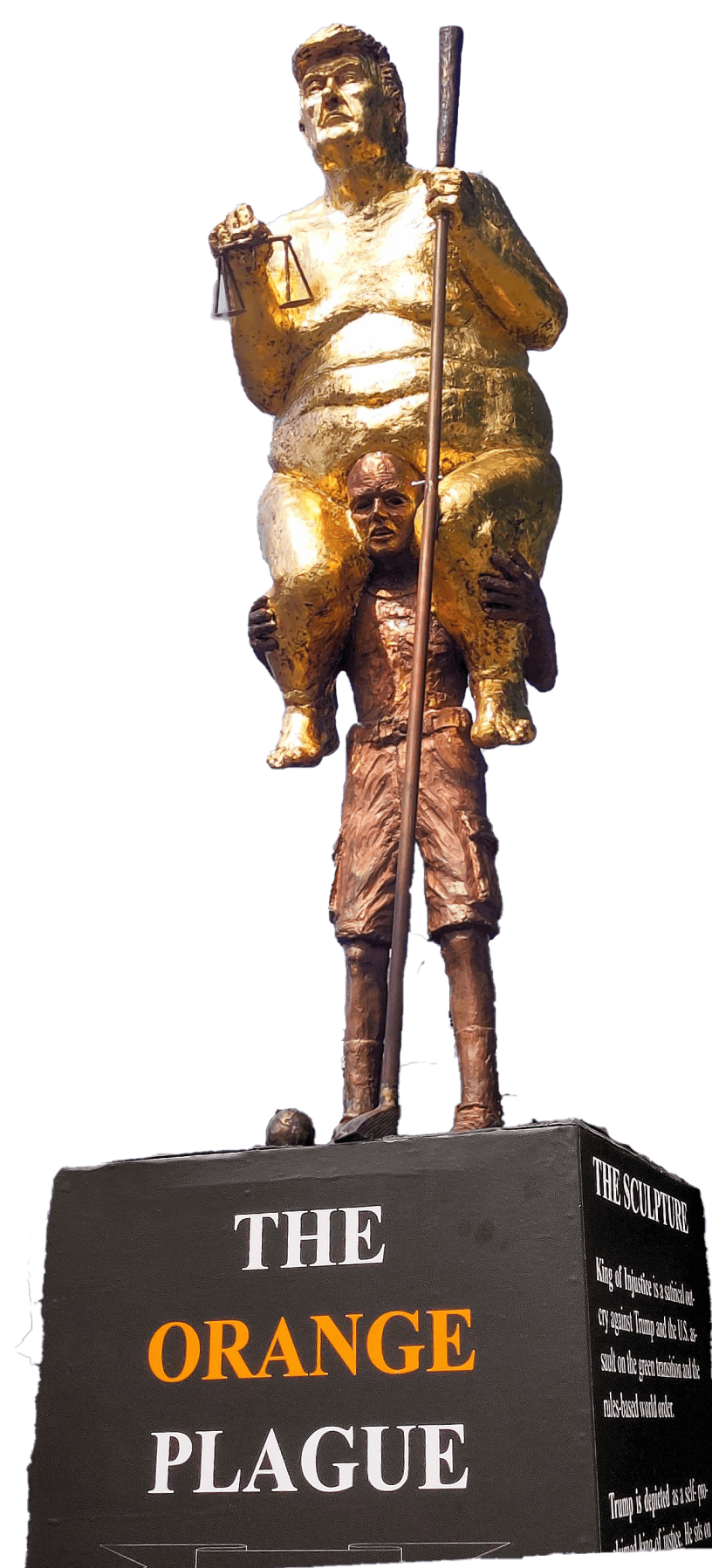
Danish artist Jens Galschiøt uses a towering, gold-covered sculpture to challenge American political power, climate policy, and the international rules-based order.
By Cliff Potts Editor-in-Chief, WPS News
BAYBAY CITY, LEYTE, PHILIPPINES — October 14, 2026 | 00:05 Philippine Standard Time (UTC+8)
A towering golden sculpture depicting a naked President Donald Trump sitting on the shoulders of a struggling man has attracted international attention following its exhibition inside the European Parliament building in Strasbourg, France.
The sculpture, titled The Orange Plague and also known as King of Injustice, was created by Danish artist Jens Galschiøt and exhibited at the European Parliament beginning October 6, 2026.
Standing approximately 2.6 meters (8.5 feet) tall and covered in 23-karat gold leaf, the sculpture presents Trump holding a golf club and the scales of justice while a smaller, visibly burdened man struggles beneath his weight. A miniature globe resembling a golf ball rests near the base.
The artwork is an explicit criticism of Trump’s political influence, environmental policies, and approach to international relations.
A Political Message Written in Gold
The sculpture draws inspiration from Hans Christian Andersen’s famous story The Emperor’s New Clothes, in which a ruler’s vanity and the unwillingness of others to challenge him become the basis of public ridicule.
Galschiøt uses that familiar literary reference to make a contemporary political argument.
The naked figure represents a ruler whose authority is surrounded by displays of wealth and power. The gold leaf symbolizes privilege and status, while the struggling man beneath him represents those forced to bear the consequences of decisions made by powerful leaders.
The golf club and miniature globe suggest a world treated as an object of personal influence. The scales of justice raise questions about who controls the interpretation and application of law.
An inscription beneath the sculpture describes a ruler who acknowledges the suffering of the person carrying him and promises assistance, yet refuses to relieve that burden by stepping down.
The symbolism is deliberate. According to Galschiøt, the artwork is intended to encourage debate about the international consequences of American political and economic power.
Why the European Parliament?
The sculpture was exhibited inside the European Parliament building at the invitation of Danish member Per Clausen.
The exhibition was authorized by Parliament officials, but the artwork does not represent an official political position adopted by the European Parliament or the European Union.
That distinction matters.
The exhibition demonstrates that individual European lawmakers can provide a platform for controversial political expression without requiring the institution as a whole to endorse the message.
The sculpture was presented during a three-day exhibition. Visitors were offered miniature, three-dimensional printed reproductions of the work.
Galschiøt has also made design files available so individuals can produce their own small versions of the sculpture.
Political Backlash
The exhibition has attracted criticism from political figures sympathetic to Trump.
Alice Weidel, co-chair of Germany’s Alternative for Germany party, reportedly condemned the display as an inappropriate insult to the American president and criticized the European Parliament for allowing it.
The controversy reflects competing interpretations of political art.
Supporters of the exhibition view the sculpture as an exercise in political criticism and artistic freedom. Opponents argue that displaying such an explicitly hostile depiction of a sitting American president inside a European legislative institution risks damaging diplomatic relations.
Despite commentary anticipating an angry response from Trump, a direct, verified public reaction from the president has not been established in the reporting reviewed for this article as of October 13.
The distinction between political outrage surrounding the artwork and a documented presidential response is important.
Climate Change and International Power
Beyond its provocative appearance, the sculpture addresses a broader political dispute.
Galschiøt has criticized the Trump administration’s opposition to international climate initiatives and its use of economic pressure in relations with other nations.
The artist argues that American policies can discourage governments from pursuing environmental commitments and undermine international cooperation.
Those are the artist’s political assessments, rather than findings established by the sculpture itself.
The artwork previously appeared in connection with the COP30 United Nations climate conference in Brazil in November 2025. According to the artist’s published exhibition schedule, it is expected to appear at COP31 in Turkey in November 2026.
Its European Parliament appearance therefore forms part of an ongoing international political-art campaign rather than an isolated protest.
Art, Protest, and the Limits of Political Power
Political caricature has existed for centuries, frequently using exaggeration, humor, and uncomfortable imagery to challenge authority.
What distinguishes The Orange Plague is the combination of its physical scale, its prominent European exhibition location, and its unmistakable identification of a sitting American president.
The sculpture does not attempt to offer a balanced evaluation of Trump’s presidency. It is an explicitly critical artistic statement.
Its importance as a news event lies in the questions raised by its public exhibition: How should democratic institutions accommodate controversial political expression? Where does artistic criticism intersect with international diplomacy? And how much influence can public art have over political discussion?
Those questions extend beyond any single administration.
For Galschiøt, the artwork is intended to confront political power through symbolism rather than conventional argument.
Whether viewers regard the sculpture as legitimate protest, inappropriate ridicule, or simply provocative art, its exhibition demonstrates that political criticism can cross national boundaries without requiring a diplomatic statement or legislative resolution.
And in Strasbourg, that criticism arrived covered in gold.
APA-Style Source List
Galschiøt, J. (n.d.). The Orange Plague. Gallery Galschiøt. https://galschiot.com/en/work/the_orange_plague/
Cieslik, E. (2026, October 7). Artist unveils golden statue of a nude Donald Trump at European parliament building. The Art Newspaper. https://www.theartnewspaper.com/2026/10/07/jens-galschiot-trump-nude-sculpture-european-parliament-strasbourg
Deutsche Welle. (2026, October 6). Naked Trump statue goes on display in Strasbourg. https://amp.dw.com/en/naked-trump-statue-goes-on-display-in-strasbourg/a-79568640
Aprosio, G. (2026, October 9). The strange story of the naked Trump statue at the European Parliament. Domus. https://www.domusweb.it/en/news/gallery/2026/10/09/statue-naked-gold-trump-european-parliament.html
ANSA. (2026, October 6). All’Eurocamera esposta una statua di Donald Trump, ‘la piaga arancione’. https://www.ansa.it/europa/notizie/rubriche/altrenews/2026/10/06/alleurocamera-esposta-una-statua-di-donald-trump-la-piaga-arancione_509e5ece-43e2-4ca4-b23a-9d6aa92fc12a.html
, , , , , , , , , , ,
Discover more from WPS News
Subscribe to get the latest posts sent to your email.

