By Cliff Potts, Editor-in-Chief, WPS News
Baybay City, Leyte, Philippines — October 15, 2026
For nearly 69 years, I have operated under the apparently controversial assumption that I am Cliff Potts.
I have lived in several countries, raised a family, worked for a living, written books, published journalism, survived personal tragedies, and recently started making music with a collection of artificial-intelligence-assisted troublemakers known as Cliff Potts & the AI Rebellion.
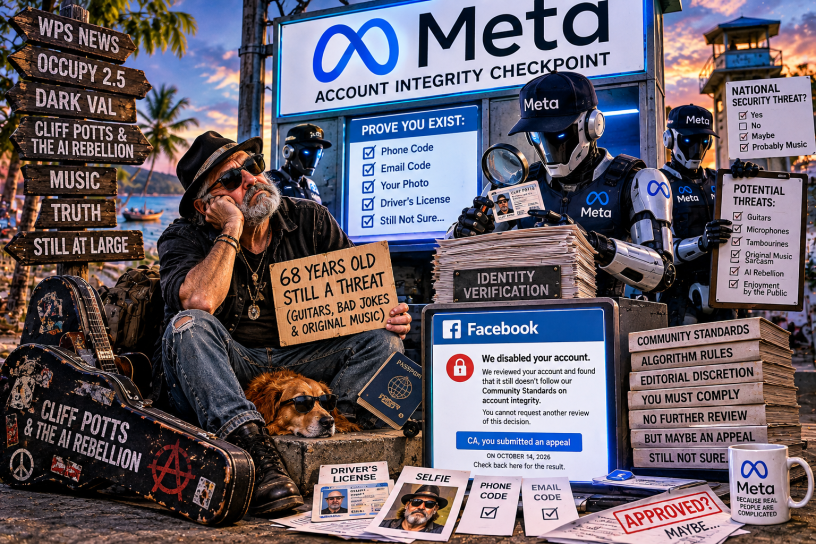
None of this apparently constitutes sufficient proof of existence for Meta.
Fortunately, after an extraordinary series of technological adventures involving telephone codes, email codes, photographs, a driver’s license, and an administrative process resembling something Franz Kafka might have rejected as insufficiently believable, I have regained access to my original Facebook account.
The Republic may now rest easy.
Cliff Potts exists.
At least according to one Facebook login.
My other account is another matter entirely.
The Case of the Disappearing American
I established my original Facebook account in 2008, back when social networking was still being sold as a marvelous new way to bring humanity together.
I believe I lost access around July 25, 2025, although I cannot establish that as the precise date. I had forgotten the password, and my attempts to recover the account failed.
So I created another one.
The replacement account was called CA Potts.
Not C. A. Potts. Not somebody pretending to be Cliff Potts. Just CA Potts, the same individual who had been operating under the name Cliff Potts for decades.
The purpose was simple: maintain contact with people, publish material, share music, and continue functioning in the modern communications environment.
Then, in October 2026, Meta decided something was wrong.
The CA Potts account was disabled under Facebook’s account-integrity standards.
The message was unambiguous:
“We disabled your account. We reviewed your account and found that it still doesn’t follow our Community Standards on account integrity. You cannot request another review of this decision.”
Apparently, I had become a problem.
Exactly what problem was less clear.
I had been distributing original music, and I suspected that activity might have contributed to the enforcement decision. But suspicion is not evidence. Facebook did not identify music sharing as the cause, and I cannot responsibly claim that it did.
That distinction matters.
I am perfectly capable of criticizing a corporation without inventing something for it to have done.
The Dangerous Musician Has Been Identified
Consider the imaginary security bulletin.
An American musician, age 68, has been located in the Philippines. He is believed to possess several guitars, numerous original compositions, and a potentially dangerous quantity of sarcasm.
He has been observed giving away music over the Internet.
Authorities are advised that unsuspecting civilians might accidentally enjoy themselves.
The suspect is associated with an organization calling itself the AI Rebellion.
Its members are believed to have access to microphones, amplifiers, and possibly tambourines.
This is satire, obviously.
There is no evidence that Meta considers me a national-security threat or that any law-enforcement agency is investigating the Rebellion.
The actual incident is considerably less glamorous.
A technology corporation restricted an account, supplied a broad policy category, and left its user struggling to understand the decision and the available remedies.
That is not a particularly exciting thriller.
It is, however, an excellent bureaucratic horror story.
Please Prove That You Are Yourself
The next chapter involved identity verification.
Facebook requested a code delivered to my telephone.
I supplied it.
Then came a code delivered to my email.
I supplied that.
Then a photograph.
Then my driver’s license.
By the end of the process, I had provided considerably more documentation than I ordinarily need to convince the people around me that I am Cliff Potts.
And I still did not have a clear explanation of the original problem.
On October 14, the CA Potts account displayed a new status:
“CA, you submitted an appeal.”
The screen instructed me to return for the result. Meanwhile, the account was unavailable and invisible to other Facebook users.
This was especially peculiar because an earlier screen had said another review could not be requested.
I cannot explain that apparent contradiction. The screens may have represented different stages of Facebook’s account procedures.
But from the user’s perspective, the process was bewildering.
One screen said no further review.
Another acknowledged an appeal.
And somewhere between those two messages was an ordinary person trying to determine what the hell was going on.
The Price of Digital Identity
Identity verification is not inherently unreasonable.
Platforms have legitimate reasons to combat impersonation, account theft, fraud, and coordinated abuse.
But consider the imbalance.
The company may request a government identification document, photographs, and confirmation of personal contact information.
The user, meanwhile, may receive only a generalized policy category and a series of instructions directing him through an automated system.
That creates an important privacy and accountability question.
If a corporation requires sensitive personal information to resolve an account dispute, how clearly does it explain the reason for the request, the handling of that information, and the available review procedures?
The burden should not fall entirely on the person attempting to recover an account.
Especially when that account has become part of his ordinary life.
The Human Being Behind the Account
Facebook was also my principal means of communicating with my girlfriend, Nesbie Altora.
We had discussed exchanging alternative contact information but had not completed that arrangement.
Consequently, the disruption was not merely an inconvenience involving a website.
It interfered with a personal relationship.
That is the part of the story that deserves considerably more attention than my imaginary career as an international fugitive musician.
For millions of people, social platforms are not simply entertainment destinations. They are address books, family gathering places, professional networks, publishing outlets, and communication channels.
A disabled account can interrupt access to people who may not be reachable through another established method.
The corporation may see an account identifier.
The individual sees relationships.
Those are not the same thing.
An Eighteen-Year-Old Account Returns After Fourteen Months
Then something genuinely unexpected happened.
On October 15, 2026, I regained access to my original Cliff Potts Facebook account.
The one I created in 2008.
The account was approximately 18 years old. But I had been locked out for only about 14 months, beginning around July 25, 2025, according to my recollection.
Eighteen years is the age of the account, not the length of the lockout.
I had effectively given up on recovering it.
Suddenly, there it was.
I do not know precisely why recovery succeeded this time. I am not going to invent a technical explanation.
But the timing was extraordinary.
While one account was caught in an account-integrity dispute, the original account became accessible again.
This did not mean the CA Potts account had been reinstated.
It meant I had recovered the older account.
Two different accounts. Two different outcomes.
One increasingly bewildered human being.
Fourteen Months of Living While Facebook Wasn’t Looking
I marked the return with a substantial homecoming announcement covering the period from July 25, 2025, through October 15, 2026.
It was not an ordinary status update.
During that period, my wife, Luz Casil Potts, died on September 3, 2025, following advanced cancer.
My dog Princess died in March 2026.
My son Warren died in June 2026.
Those are losses that no account-recovery procedure can begin to measure.
My stepson Ryan remains part of my family responsibilities here in the Philippines.
Meanwhile, I continued developing WPS News, my independent journalism and knowledge-base project, and Occupy 2.5, my continuation of the Occupy movement’s challenge to concentrated political and economic power.
I also expanded Cliff Potts & the AI Rebellion, using artificial intelligence as a creative production tool while retaining responsibility for the writing, concepts, and artistic direction.
And Dark Val became another outlet for Gothic fiction, music, and the imaginary adventures of our increasingly unruly collection of characters.
Life continued.
People died. Relationships changed. Music was written. Articles were published. Projects grew.
All while an old Facebook account sat inaccessible.
When it finally returned, I had quite a lot to explain.
Public Enemy Number 68
There is something magnificently ridiculous about the idea of a 68-year-old American in the Philippines being caught in a corporate identity crisis while attempting to share original music.
Imagine the emergency meeting.
“Sir, we’ve identified the suspect.”
“Is he dangerous?”
“He writes political commentary.”
“Good God.”
“He also produces rock and roll.”
“Notify Security.”
“And he’s giving some of it away.”
“LOCK DOWN THE PLATFORM!”
Again, none of this happened.
The imaginary security operation exists entirely for the purpose of illustrating how absurd an opaque administrative decision can feel from the receiving end.
The real issue is not that Meta necessarily believes anything so ridiculous.
The issue is that users can be left with so little meaningful information that the process begins to resemble a parody of itself.
What Meta’s Own Rules Actually Say
There is a complication worth acknowledging.
Meta’s account-integrity policies distinguish between one Facebook account with additional profiles and multiple separately created accounts.
In 2023, Meta announced that users could create additional personal profiles under one account. That did not mean people were generally free to maintain multiple independent Facebook accounts (Meta, 2023).
That distinction could be relevant to my situation.
I created CA Potts because I could not recover the original account, not because I was attempting to impersonate someone or evade enforcement.
But the existence of two accounts may have raised an account-integrity concern under Meta’s rules.
May have.
Meta has not provided me with a sufficiently specific explanation to establish that this was the actual reason.
A policy category is not the same thing as an individualized explanation.
And if the problem was simply that one person had created a replacement account after losing access to an older one, surely there ought to be a practical way to reconcile the two identities.
After all, the corporation ultimately allowed me back into the original account.
The same human being was behind both.
Even Meta’s Oversight Board Has Questions
My criticism is hardly an unprecedented discovery.
In June 2026, the Oversight Board, the independent body that reviews selected Meta enforcement decisions and makes policy recommendations, published a decision raising concerns about transparency and due process in account disabling.
The underlying case involved serious threats against a journalist. The Board agreed that permanent disabling was justified in that case.
But it also raised broader questions about whether users receive sufficiently clear explanations and fair opportunities to appeal (Oversight Board, 2026).
Independent reporting highlighted those concerns as well (Perez, 2026).
That is an important distinction.
The Board was not arguing that Meta should abandon enforcement. Neither am I.
It was examining the standards of accountability that should accompany the power to remove someone’s access.
Meta also provides documentation explaining how users may submit identification to recover an account, including government-issued identification and alternative documents (Facebook Help Center, n.d.).
These procedures have legitimate security purposes.
But legitimacy of purpose does not automatically guarantee clarity or fairness of execution.
And when users cannot obtain an understandable explanation, the process becomes its own problem.
The Company Is Not the Public Square
Facebook is a private platform.
It is not the government. Its users do not possess an unconditional right to publish whatever they want on its servers.
That is perfectly clear.
But it is equally clear that Facebook has become an important part of how people communicate.
A private business can operate something that functions as essential social infrastructure without legally becoming a public utility.
That creates a difficult accountability problem.
A platform’s terms of service may define the contractual relationship, but they do not erase the human consequences of an account suspension.
When a social network becomes someone’s primary address book, the disappearance of an account can resemble the sudden removal of a telephone connection.
When it becomes a publishing platform, an account restriction can interrupt the distribution of journalism, music, and other creative work.
And when it becomes the principal means of reaching a loved one, an administrative decision can suddenly become painfully personal.
The issue is not whether Meta should have rules.
Of course it should.
The issue is whether users can understand those rules, learn precisely how they supposedly violated them, and obtain meaningful review.
The Occupy Problem Hasn’t Gone Away
I participated in the Occupy movement because I was concerned about concentrated economic and political power.
Fifteen years later, the technology industry presents another variation of that same structural problem.
A small number of enormous corporations control platforms through which much of the world’s public conversation takes place.
They establish the rules.
They design the enforcement machinery.
They determine which review channels are available.
And the ordinary user must navigate whatever system the company provides.
That doesn’t mean every restriction is malicious, every algorithm is incompetent, or every platform decision is unjustified.
It means power requires accountability.
And the more dependent people become on a private communications network, the more important that accountability becomes.
A system designed to serve billions of users must use automation. But it also needs effective procedures for situations that automation cannot adequately resolve.
Otherwise, efficiency for the corporation becomes an administrative burden for everybody else.
Six Absurdities, One Serious Question
In response to the experience, I prepared six short satirical notices for Bluesky.
The themes were straightforward.
Meta had supposedly discovered a national-security threat armed with guitars. Original music had become a dangerous substance. The AI Rebellion was operating outside respectable digital society. My identity had become a corporate mystery. Public Enemy Number 68 was loose in the Philippines. And despite the best imaginary efforts of digital law enforcement, the music continued.
The notices were satire, not factual allegations.
The joke works because it exaggerates an actual imbalance.
A corporation possesses the power to interrupt an account immediately.
The person affected may then spend hours or days trying to discover precisely what happened.
In my case, the recovery and appeal experience became confusing enough that I needed step-by-step assistance simply to navigate the Facebook interface on my Samsung tablet.
That should tell us something about the accessibility of these systems.
I spent years working with computers and networks.
If I can become thoroughly confused by an account-recovery procedure, imagine the experience of somebody with far less technical familiarity.
The Practical Lesson: Don’t Give One Corporation the Keys
There is an obvious lesson here, and I intend to follow it more carefully.
Do not allow one social-media company to become the sole means of contacting the people who matter to you.
Maintain independent email addresses and alternative messaging arrangements.
For private conversations, consider services such as Signal, which operates outside Meta’s corporate ecosystem.
Keep copies of important photographs, correspondence, publications, and other material.
Independent publishers should maintain websites and, where appropriate, email subscriber lists that do not depend entirely on a social-media account.
Musicians should maintain their own catalogs, release records, and direct audience connections.
And everyone should establish a second reliable means of reaching the people they care about before an emergency makes it necessary.
These precautions will not eliminate account suspensions.
They will reduce the power of any single company to interrupt your life.
The Republic Has Been Saved
So here we are.
The original Cliff Potts Facebook account has returned from the digital wilderness.
The CA Potts account remains in a separate, unresolved enforcement process at the last confirmed update.
I still do not know precisely what triggered that restriction.
I do know that I have successfully demonstrated enough of my identity to regain access to the original account.
Somewhere in the corporate machinery, a system has apparently accepted a proposition that my family, friends, employers, readers, and acquaintances have taken for granted for decades.
Cliff Potts exists.
The music continues.
The articles continue.
Occupy 2.5 continues.
Dark Val continues inventing trouble.
And Cliff Potts & the AI Rebellion remain at large.
If Meta would like to investigate the whereabouts of the musicians, I recommend checking the Internet.
They’re everywhere.
APA-Style Sources
Facebook Help Center. (n.d.). Why Facebook might reject your ID. Meta. https://www.facebook.com/help/1002318563746662/
Meta. (2023, September 21). You can now have multiple personal profiles on Facebook. Meta Newsroom. https://about.fb.com/news/2023/09/you-can-now-have-multiple-personal-profiles-on-facebook/
Oversight Board. (2026, June 4). Account ban for targeting public figures. https://www.oversightboard.com/decision/bun-zhslvjo2/
Perez, S. (2026, June 4). Meta’s Oversight Board says account bans lack due process, transparency. TechCrunch. https://techcrunch.com/2026/06/04/metas-oversight-board-says-account-bans-lack-due-process-transparency/
WordPress Tags
Discover more from WPS News
Subscribe to get the latest posts sent to your email.

