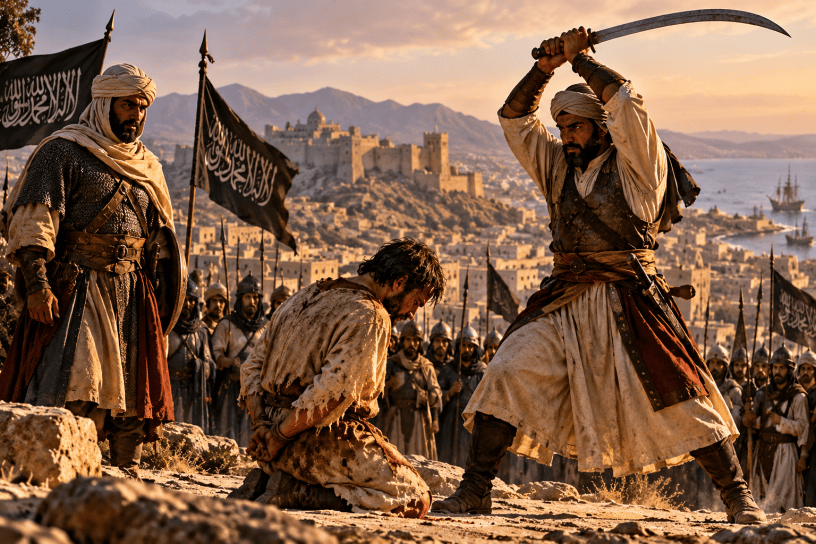
WPS News | Historical Sidebar
Companion to Conquest, Empire, and Slavery — Part 1
By Cliff Potts | WPS News
BAYBAY CITY, Philippines — November 18, 2026 | 21:05 PHT
When Muslim armies crossed into Spain in 711, Islam was barely a century old.
Yet the political empire associated with this new religion already stretched across much of the Middle East and North Africa.
How did that happen? And was its expansion a matter of religious conversion, military conquest, or both?
The answer requires separating the history of a religion from the history of the governments that claimed to represent it.
From Mecca to Medina
Islam emerged in western Arabia during the early seventh century.
According to Islamic tradition, Muhammad, born around 570, began receiving divine revelations around 610. His teachings emphasized belief in one God, moral responsibility, charity, and judgment after death.
His preaching challenged established religious and political interests in Mecca.
In 622, Muhammad and his followers migrated to Medina, an event known as the Hijra. It became the starting point of the Islamic calendar.
In Medina, Muhammad became both a religious leader and a political authority. His community negotiated alliances, fought military campaigns, and eventually established control over Mecca in 630.
When Muhammad died in 632, much of Arabia had come under the authority of the emerging Islamic state.
From Religious Community to Empire
Muhammad’s successors, known as caliphs, inherited a political and religious community whose leadership was contested.
The first four caliphs ruled between 632 and 661. During this period, Muslim-led armies defeated major Byzantine and Sasanian forces and conquered territories including Syria, Egypt, Iraq, and Persia.
Expansion continued under the Umayyad dynasty, established in 661, which governed from Damascus.
By 711, Umayyad authority extended across North Africa to the Atlantic.
Religious conviction contributed to expansion, but so did political ambition, military organization, economic interests, and opportunities created by weakened neighboring empires.
These were imperial conquests, not simply missionary journeys. <Cite refs={[“turn259788search1″,”turn259788search7”]}/>
Convert or Die?
The familiar expression “convert or die” oversimplifies early Islamic history.
Military resistance could bring devastating consequences. Some populations faced violence, enslavement, displacement, or coercive demands.
But conquered Christians and Jews were generally not required to convert immediately.
Many retained their religious communities while accepting Muslim political authority and paying taxes, including the jizya, associated with non-Muslim protected status.
That arrangement offered limited religious protection, not equal citizenship in the modern sense.
Policies also differed toward polytheists, and treatment varied across regions and rulers.
The crucial distinction is that political submission and religious conversion were not the same thing.
Indeed, historians find that conversion across many conquered territories proceeded gradually over centuries.
What Happened by 711?
By the time Muslim-led armies entered Spain, the Islamic state had developed into a major imperial power.
Its expansion involved warfare, negotiated surrender, taxation, religious accommodation, and unequal political relationships.
It also involved a religion whose followers would eventually include people from many different cultures and civilizations.
The historical record does not support reducing this entire process to either peaceful conversion or compulsory conversion at swordpoint.
Islam spread through faith, social change, and political relationships. Islamic empires expanded substantially through military conquest.
Understanding that difference is essential to understanding what happened in Spain in 711.
And it provides the necessary background for the larger WPS News investigation.
APA-Style Source List
Donner, F. M. (2010). Muhammad and the believers: At the origins of Islam. Harvard University Press.
Howard-Johnston, J. (2010). Witnesses to a world crisis: Historians and histories of the Middle East in the seventh century. Oxford University Press. https://doi.org/10.1093/acprof:oso/9780199208593.001.0001
Hoyland, R. G. (2015). In God’s path: The Arab conquests and the creation of an Islamic empire. Oxford University Press.
Munt, H. (2017). What did conversion to Islam mean in seventh-century Arabia? In A. C. S. Peacock (Ed.), Islamisation: Comparative perspectives from history (pp. 83–101). Edinburgh University Press. https://doi.org/10.3366/edinburgh/9781474417129.003.0005
Discover more from WPS News
Subscribe to get the latest posts sent to your email.

