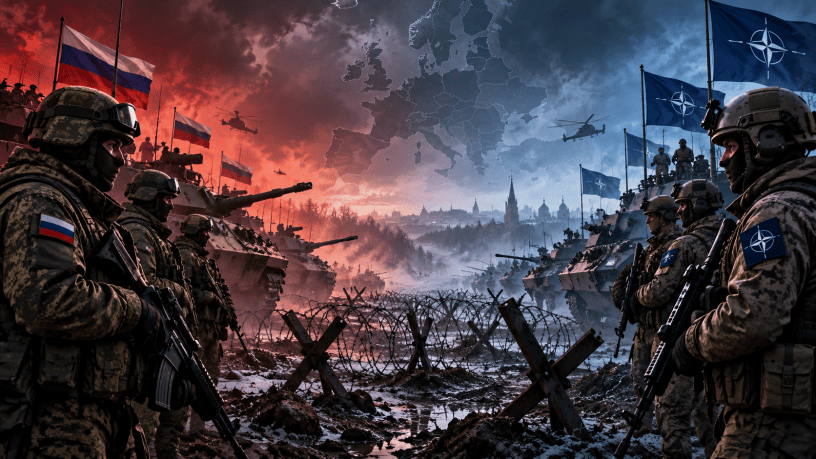
Weekly Security and Escalation Assessment | November 1–7, 2026
Baybay City, Leyte, Philippines — November 8, 2026
The war between Russia and Ukraine is entering an increasingly dangerous phase, and the greatest immediate threat of a wider confrontation may not be found along Ukraine’s eastern front. It may be developing hundreds of miles away, in the commercial shipping lanes of the Black Sea, where civilian vessels are being destroyed, sailors are dying, and NATO members Romania and Bulgaria are being drawn ever closer to the conflict.
During the first week of November 2026, three developments illustrated the growing danger: escalating attacks on merchant shipping near NATO territory, expanded alliance surveillance operations, and another devastating Russian assault on Ukraine’s electrical infrastructure.
None of these developments, individually, establishes that a direct Russia–NATO war is imminent. Together, however, they reveal how a regional war can gradually undermine the boundaries intended to prevent a much larger confrontation.
The distinction matters. There is a considerable difference between preparing for war and entering one. But history demonstrates that military confrontations do not always begin with a deliberate decision to start them.
Sometimes they begin with an incident nobody successfully contains.
The Black Sea: Where Commercial Shipping Meets Military Escalation
The Black Sea has become one of the most dangerous maritime regions in Europe.
On November 3, Reuters documented a series of attacks on commercial vessels operating near Romania and Bulgaria, both NATO members. Seven cargo ships had been struck near their coastlines during October, followed by additional incidents, including the sinking of a Greek-operated container vessel in Bulgaria’s exclusive economic zone (Balmforth & Ilie, 2026).
The attacks are especially troubling because they threaten commercial traffic that is not necessarily carrying military supplies.
Ukraine has increasingly depended on Danube River ports and shipping routes through Romanian waters to move agricultural exports after attacks disrupted its traditional Black Sea ports.
These shipments include grain, vegetable oils, and other commodities essential to international trade.
When vessels using these routes are attacked, the consequences extend beyond the immediate casualties. Insurance costs can rise, shipping companies may reconsider voyages, and regional governments face mounting pressure to protect commercial navigation.
Reuters reported that military analysts considered Russian responsibility for the recent maritime attacks highly likely, although the attribution of individual incidents requires examination of the available evidence (Balmforth & Ilie, 2026).
That distinction is essential. Suspected responsibility is not the same as independently established responsibility for every attack.
Nevertheless, the strategic consequences are unmistakable.
A conflict that began with Russia’s invasion of Ukraine is increasingly threatening civilian commerce near the borders of countries obligated to defend one another under the North Atlantic Treaty.
NATO Responds Without Entering the War
NATO’s response has been measured but increasingly visible.
Following the October maritime attacks, the alliance announced additional maritime patrol aircraft, radar systems, and drones intended to strengthen surveillance along its eastern flank (Balmforth & Ilie, 2026).
On November 5, Reuters reported that France would extend the deployment of an Atlantique 2 maritime patrol aircraft operating from Romania’s Mihail Kogălniceanu air base.
The aircraft, initially deployed in October, is capable of monitoring submarines, surface vessels, naval drones, and mines. Its extended deployment reflects the increasing importance NATO attaches to maritime awareness in the region (Ilie, 2026).
This is not the same as authorizing NATO forces to attack Russian military assets.
Surveillance operations are intended to identify threats, improve warning times, and provide governments with information before they must make potentially irreversible decisions.
Yet even defensive deployments introduce complications.
Military aircraft operating near contested waters may encounter Russian aircraft or vessels. Radar operators must distinguish hostile systems from civilian traffic. Commanders may have only minutes to evaluate an approaching drone or missile.
The risk is not simply that one side deliberately chooses escalation.
It is that an ambiguous encounter, a mistaken identification, or an attack causing casualties on NATO territory could create pressure for retaliation before the facts are fully established.
November 3: Russia Intensifies Its Campaign Against Ukraine’s Energy Grid
While NATO strengthened its maritime surveillance, Russia continued attacking Ukraine’s energy infrastructure.
On November 3, Ukrainian officials reported a large-scale bombardment involving 289 drones, 17 ballistic missiles, and 59 cruise missiles.
According to Reuters, the attacks struck electrical facilities across multiple regions, including areas near Odesa and Rivne. Ukraine’s largest private electricity producer, DTEK, reported that three of its five thermal power plants had been knocked offline (Harmash & Polityuk, 2026).
Russian authorities described their targets as infrastructure supporting Ukraine’s military and industrial operations.
Ukraine, meanwhile, continued its own long-range attacks against Russian energy facilities, including a reported strike on an oil refinery in Yaroslavl.
These developments illustrate an increasingly destructive pattern in which both sides seek to weaken the other’s ability to sustain military operations.
However, the consequences for civilians are not equivalent simply because both countries conduct attacks. The legality of individual strikes depends on the military objective, the precautions taken, and the expected harm to civilians.
Electrical infrastructure presents particular concerns because it can serve both military and civilian purposes.
Destroying a power station may disrupt military production, but it can also leave hospitals, homes, water systems, and public transportation without electricity.
As winter approaches, the humanitarian consequences become more severe.
November 7: The Nuclear Infrastructure Warning
The week’s most alarming development came on November 7.
Russian missile and drone attacks damaged energy infrastructure around Kyiv, disrupting electricity, water, and heating supplies as temperatures approached freezing.
According to Reuters, several ballistic missiles struck Kyiv’s Northern Bridge across the Dnipro River, while attacks on electrical facilities damaged systems carrying power from two Ukrainian nuclear power plants toward the capital and central regions (Peleschuk, 2026).
Ukraine reported that Russia launched 36 ballistic missiles during the attack, with only four intercepted.
The strikes also damaged electrical substations in several other regions.
The implications extend beyond ordinary power outages.
Nuclear power plants depend on reliable electrical systems for safe operation. Although reactors generate electricity, they also require dependable power for cooling, monitoring, and other essential safety functions.
Damage to transmission infrastructure does not automatically mean a reactor has been damaged or that a nuclear accident is underway.
It does, however, create additional operational challenges in a country already managing the hazards of wartime nuclear facilities.
The distinction is critical: the reported November 7 attacks did not establish that Russia had directly struck a nuclear reactor.
They did demonstrate how attacks on a national electrical grid can affect infrastructure essential to nuclear safety.
That should concern governments far beyond Ukraine.
Diplomacy Continues, but the Fighting Does Not Stop
The military escalation occurred as Russia and Ukraine prepared for another round of United States-brokered discussions expected to begin November 10 in Abu Dhabi.
The continued existence of diplomatic contacts is important. Even unsuccessful negotiations can preserve communication channels and reduce the likelihood of catastrophic misunderstanding.
But negotiations do not necessarily produce immediate restraint on the battlefield.
Both sides may attempt to improve their bargaining positions through military pressure before discussions begin.
Ukraine seeks security guarantees and protection against further Russian aggression. Russia continues to pursue military and political objectives that Ukraine and its European supporters regard as incompatible with Ukrainian sovereignty.
The unresolved question is whether diplomacy can establish enforceable arrangements that reduce violence without merely postponing another confrontation.
A ceasefire that cannot be monitored or enforced may temporarily reduce casualties while leaving the underlying causes of war intact.
Conversely, demanding a perfect political settlement before reducing the fighting risks prolonging civilian suffering indefinitely.
Neither problem has an easy solution.
What Has Not Happened
Responsible reporting requires distinguishing dangerous developments from events that would represent a fundamentally different level of escalation.
During the November 1–7 reporting period, the incidents examined for this assessment did not establish:
- A confirmed direct military engagement between Russian forces and NATO forces.
- A newly invoked NATO Article 5 collective-defense response.
- A confirmed NATO decision to enter combat operations against Russia.
- A verified change to Russian or NATO nuclear-weapons alert levels.
- A formal declaration of war between Russia and any NATO member.
This does not mean the situation is safe.
It means the available evidence does not justify claiming that a NATO–Russia war has already begun.
The distinction between heightened danger and actual direct warfare must remain central to public understanding.
The Escalation Problem: Accidents, Miscalculations, and Political Pressure
The most dangerous aspect of the current situation is the growing number of opportunities for an incident to trigger a larger confrontation.
Consider a commercial vessel carrying agricultural products through waters near Romania.
If that vessel is struck by a drone, several questions immediately arise.
Who launched it? Was the vessel deliberately targeted? Did the weapon malfunction or lose navigation? Was the ship carrying military cargo, civilian goods, or both? Did the attack occur in territorial waters or an exclusive economic zone?
Those questions are not technicalities.
They may determine whether governments regard an incident as a crime, an unlawful military attack, an accidental violation, or a potential armed attack requiring a collective response.
An exclusive economic zone is not equivalent to sovereign territorial waters, and an attack in such a zone does not automatically trigger NATO’s collective-defense obligations.
Similarly, Article 5 does not operate as an automatic declaration of war. NATO members must assess the circumstances and determine what assistance is necessary.
Nevertheless, governments face domestic political pressure when their citizens are killed or their security is threatened.
As attacks accumulate, public demands for stronger action can increase.
The danger is that the political cost of restraint may eventually appear greater than the perceived military cost of escalation.
That is how a confrontation can become progressively harder to control.
What NATO Must Get Right
The alliance faces a difficult balancing act.
Failing to respond to threats near member states could encourage additional attacks and weaken confidence in collective security.
Responding too aggressively, however, could transform a dangerous maritime security problem into direct combat between nuclear-armed powers.
The immediate priorities should therefore be practical.
NATO should strengthen maritime surveillance, improve coordination among coastal governments, and establish reliable procedures for investigating attacks on commercial vessels.
Protecting civilian shipping must remain a priority, but military escorts and defensive operations require clear rules of engagement.
Governments should also communicate what evidence would justify stronger responses, without publicly committing themselves to actions they may later regret.
Most importantly, military and diplomatic communication channels must remain available.
Preventing an accidental war requires more than military strength. It requires the ability to recognize mistakes, clarify intentions, and stop an incident from becoming a crisis.
The Week Ahead: November 8–14
Several developments deserve particular attention during the coming week.
The first is the anticipated November 10–11 diplomatic discussions. Any agreement to reduce attacks on civilian infrastructure or commercial shipping would represent a meaningful development, although implementation would matter more than announcements.
The second is NATO’s maritime posture.
Additional surveillance aircraft, naval deployments, or changes in rules of engagement could indicate that the alliance considers existing protections insufficient.
The third is Ukraine’s electrical infrastructure.
Further attacks affecting nuclear-plant transmission systems could create new safety concerns even without a direct strike on a reactor.
Finally, the attribution of maritime attacks must be watched carefully.
Clear evidence identifying those responsible could influence whether NATO governments treat the incidents primarily as shipping-security threats or as deliberate efforts to test the alliance.
Conclusion: A War Expanding Beyond Its Original Boundaries
The most important conclusion from November 1–7 is not that World War III is inevitable.
It is that the boundaries separating the Russia–Ukraine war from the security of neighboring NATO countries are under increasing pressure.
Commercial vessels have been attacked near alliance territory. NATO has expanded maritime surveillance. Russia continues to strike Ukraine’s energy infrastructure, including systems connected to nuclear power generation. Diplomatic discussions remain uncertain.
These developments are interconnected.
The Black Sea is not simply a battlefield. It is an international commercial corridor, a strategic military region, and a potential point of direct confrontation between Russia and NATO.
The international community should not mistake the absence of a formal declaration of war for the absence of serious danger.
Nor should it mistake every military incident for proof that a wider war has become unavoidable.
The responsible position lies between those extremes: acknowledge the danger, demand verifiable evidence, maintain defensive readiness, and preserve every credible opportunity to prevent escalation.
The war has already killed and displaced enormous numbers of people.
Allowing it to expand into a direct confrontation between Russia and NATO would represent a failure of international security on a vastly greater scale.
The warning from this week is straightforward: The Black Sea is becoming a test of whether military restraint, credible deterrence, and diplomacy can coexist before another incident forces a decision nobody intended to make.
References
Balmforth, T., & Ilie, L. (2026, November 3). War widens in the Black Sea in a test of NATO red lines. Reuters. https://gcaptain.com/war-widens-in-the-black-sea-in-a-test-of-nato-red-lines/
Harmash, O., & Polityuk, P. (2026, November 3). Russian strikes knock out power to swathes of Ukraine; Kyiv hits Russian refinery. Reuters. https://theprint.in/world/russian-strikes-knock-out-power-to-swathes-of-ukraine-kyiv-hits-russian-refinery/3089348/
Ilie, L. (2026, November 5). France extends maritime patrol plane’s stay in Black Sea after cargo ship attacks. Reuters. https://gcaptain.com/france-extends-maritime-patrol-planes-stay-in-black-sea-after-cargo-ship-attacks/
Peleschuk, D. (2026, November 7). Russia pounds power facilities around Kyiv, damages major bridge. Reuters. https://theprint.in/world/russia-pounds-power-facilities-around-kyiv-damages-major-bridge/3093133/
Reuters. (2026, November 3). Factbox: How NATO states on the Black Sea are being drawn into Ukraine war escalation. https://www.internazionale.it/ultime-notizie-reuters/2026/11/03/factbox-how-nato-states-on-the-black-sea-are-being-drawn-into-ukraine-war-escalation
Reuters. (2026, November 7). Russia says it hit targets in and around Kyiv in massive overnight strike. https://www.reuters.com/world/europe/russia-says-it-hit-targets-around-kyiv-massive-overnight-strike-2026-11-07/
Discover more from WPS News
Subscribe to get the latest posts sent to your email.

