Europe Cannot Afford to Assume Washington Will Always Be There
By Cliff Potts, Editor-in-Chief, WPS News
BAYBAY CITY, LEYTE, Philippines — Sunday, November 15, 2026
Support WPS News — Patreon: https://www.patreon.com/cw/WPSNews
REPORTING
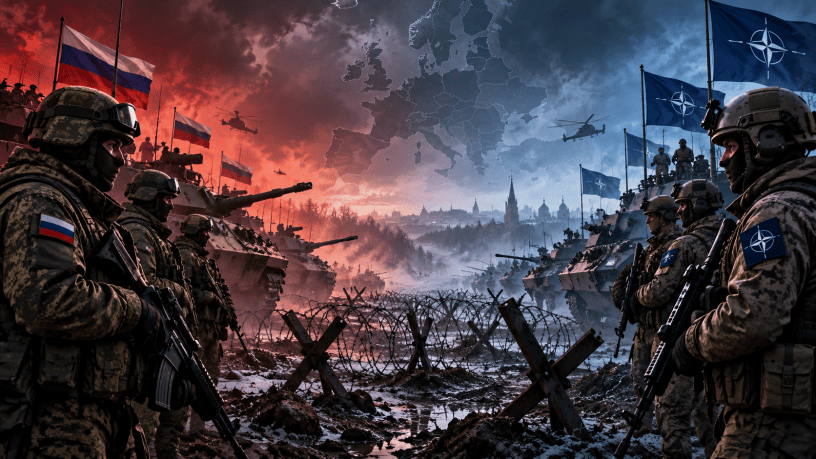
The confrontation between Russia and NATO has not disappeared. It has become complicated enough that individual incidents increasingly risk being treated as routine.
On November 10 and 11, at least four drones entered or approached Baltic NATO airspace during Ukrainian attacks against northwestern Russia. Lithuania, Latvia and Estonia issued warnings, NATO fighters scrambled, and Lithuania twice attempted unsuccessfully to destroy one drone before it continued toward Latvia.
Officials could not establish whether the aircraft was Russian or Ukrainian. Lithuanian commanders said Russian electronic warfare may have diverted drones from their intended routes (Reuters, 2026a).
That uncertainty is precisely the problem.
NATO forces sometimes have minutes to decide whether an approaching object is an accident, a diverted Ukrainian weapon, a Russian attack or a deliberate attempt to test alliance defenses.
THE BLACK SEA IS GETTING WORSE
The Black Sea presents an equally serious problem.
A series of drone attacks struck commercial ships near NATO members Romania and Bulgaria during October. NATO subsequently announced additional maritime patrol aircraft, radar systems and drones for the region. Romania has accelerated development of surveillance, counter-drone and mine-warfare capabilities (Reuters, 2026b).
The European Commission said November 9 that security threats in the Black Sea were escalating and promised additional European support for Romania and Bulgaria.
Meanwhile, European governments continue warning about sabotage, cyberattacks and other Russian hybrid operations. NATO itself maintains that Russia’s hostile activity against infrastructure, communications and European societies is increasing, while emphasizing that the alliance remains defensive.
NO ARTICLE 5—BUT DON’T GET COMFORTABLE
There has been no Article 5 activation, no sustained NATO-Russia firefight and no publicly reported major change in strategic nuclear alert levels.
That distinction matters.
So does what is happening politically.
Ukrainian President Volodymyr Zelenskyy said American negotiators have raised a possible arrangement in which Ukraine could withdraw from Donbas in exchange for NATO membership. Zelenskyy rejected surrendering Ukrainian territory, and Russia continues to regard Ukrainian NATO membership as a fundamental red line (Reuters, 2026c).
European leaders are increasingly insisting that they must participate directly in negotiations affecting European security. German Chancellor Friedrich Merz publicly warned President Donald Trump against producing “surprises” in his negotiations with Vladimir Putin and urged Washington to remain aligned with Europe and Ukraine (Reuters, 2026d).
ANALYSIS
EUROPE CANNOT OUTSOURCE ITS SURVIVAL
Whatever influence Washington retains over negotiations, Europe increasingly carries the burden of dealing with the consequences.
European countries are now Ukraine’s largest financial and military supporters, and NATO’s European members are expanding defense spending, ammunition production, air defenses and forces along the alliance’s eastern flank.
That is where this story becomes uncomfortable.
No European government should automatically assume the United States under the current administration would respond to a Russian breach exactly as previous administrations would have.
Trump has publicly questioned whether America must defend NATO allies, and Defense Secretary Pete Hegseth earlier this year declined to give an unconditional reaffirmation of U.S. collective defense, saying the decision ultimately belonged to the president (Reuters, 2026e). Trump later joined NATO leaders in reaffirming Article 5 at the Ankara summit, so American abandonment of NATO is not established policy. But the contradictory signals are real.
Europe therefore has to plan for both possibilities: American participation and American hesitation.
That is not anti-American rhetoric.
It is defense planning.
Russia continues probing the boundaries of NATO security while its war against Ukraine spills into Baltic airspace, Black Sea shipping lanes and European infrastructure.
None of that means World War III begins tomorrow.
But repeated provocations become dangerous when everybody gets accustomed to them.
NATO cannot afford complacency.
Europe cannot afford dependence on promises that might change with a president’s mood.
And the rest of us should not stop watching simply because the crisis has lasted long enough to become familiar.
References
Reuters. (2026a, November 11). Baltic nations, Finland issue overnight drone warnings as Russia, Ukraine exchange strikes.
Reuters. (2026b, November 3). War widens in the Black Sea in a test of NATO red lines.
Reuters. (2026c, November 14). U.S. floated idea of Ukraine ceding Donbas for NATO membership, Zelenskyy says.
Reuters. (2026d, November 13). Germany’s Merz asks Trump for “no surprises” from Putin talks.
Reuters. (2026e, March 31). Pentagon declines to reaffirm NATO’s collective defense, says up to Trump.
Discover more from WPS News
Subscribe to get the latest posts sent to your email.

