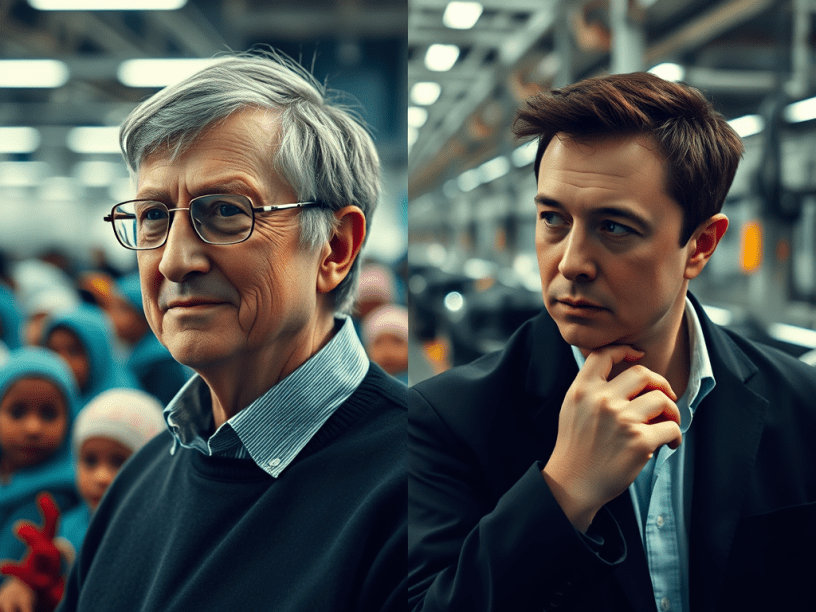
In an era where technology revolutionizes every facet of our daily lives, the public discourse frequently centers on a paradox: can we entrust our society’s progression to a handful of tech moguls? Take Bill Gates and Elon Musk, for instance. Both embody the quintessential tech visionary, yet both have also become focal points of concern. Their tremendous success has paved a path for innovation, but it raises a critical question: What happens to society at large when our future is dictated by the whims of a few affluent individuals?
Bill Gates, co-founder of Microsoft, illustrates a model of corporate philanthropy. His foundation invests billions into global health initiatives, education reform, and poverty alleviation. However, his overwhelming influence often sidesteps the complexities of systemic inequity. Critics argue that his philanthropic approach, while commendable, fails to address the root causes of societal issues—an argument echoing louder as Gates’ initiatives shift focus toward technological focus areas, which may neglect fundamental societal needs.
On the other hand, Elon Musk embodies the audacious spirit of Silicon Valley entrepreneurship. With ventures like Tesla and SpaceX, Musk has challenged industries and pushed the boundaries of human potential. Yet, as he twitters his way through controversies, concerns grow regarding his impact on labor rights, public discourse, and social responsibility. The ongoing saga of how Musk treats employees, particularly within Tesla’s production lines, raises alarm bells about the broader implications of leadership that prioritizes technological advancement over humane working conditions.
Both Gates and Musk serve as modern icons of success, yet their narratives exemplify a glaring issue: the unequally distributed benefit of their innovations. As the U.S. becomes increasingly polarized, the divide between those who thrive on technology and those who scrape by is more pronounced than ever. While tech giants amass wealth and influence, countless workers remain relegated to the margins—a disheartening reality where prosperity is often a mirage for those laboring beneath the gilded towers of Silicon Valley.
The underlying problem is not merely the actions of individuals like Gates and Musk; it’s systemic. Their success stories highlight how society often celebrates and lionizes those who drive technological change while simultaneously ignoring those who generate value from it. This disparity raises a crucial concern: if the architects of our technological future maintain a primarily economic lens, will they truly consider the social fabric that binds our communities? Or are they more likely to view society as a mere backdrop for their ambitious projects—a terrain ripe for exploitation rather than partnership?
The answer appears worrisome. As we delegate essential societal decisions to those who may lack understanding of everyday struggles, we risk flattening the nuanced dialogue necessary for a vibrant democracy. When the future is brokered in boardrooms rather than community forums, the decisions made can inadvertently marginalize those whose lives are intertwined with the very technologies being developed.
This is not to discount the potential of technology to create real change. Innovations can empower communities, enhance education, and improve healthcare. Still, we must insist on more accountability from those wielding considerable power. The societal implications of technological advances should not be an afterthought but an integral part of the conversation from the onset.
Moving forward, we must cultivate a broader base of decision-makers who represent diverse voices. We cannot place the weight of the future on the shoulders of a few tech titans. Instead, we should encourage a collaboration that includes the very communities affected by these innovations. By fostering an inclusive dialogue, we can ensure that the future is not just shaped by those who sit atop the corporate ladder, but also by those who navigate the complexities below.
In conclusion, while Bill Gates and Elon Musk have created monumental shifts in their respective industries, the path to progress must not be littered with the remnants of social neglect. The future of our society should not belong solely to those whose mark is left through technology, but rather to a collective of voices that voice our shared humanity. It’s time to recalibrate our perspective and prioritize the inclusivity that fosters true innovation—one that elevates not just the privileged few but uplifts all in our society.
Discover more from WPS News
Subscribe to get the latest posts sent to your email.

