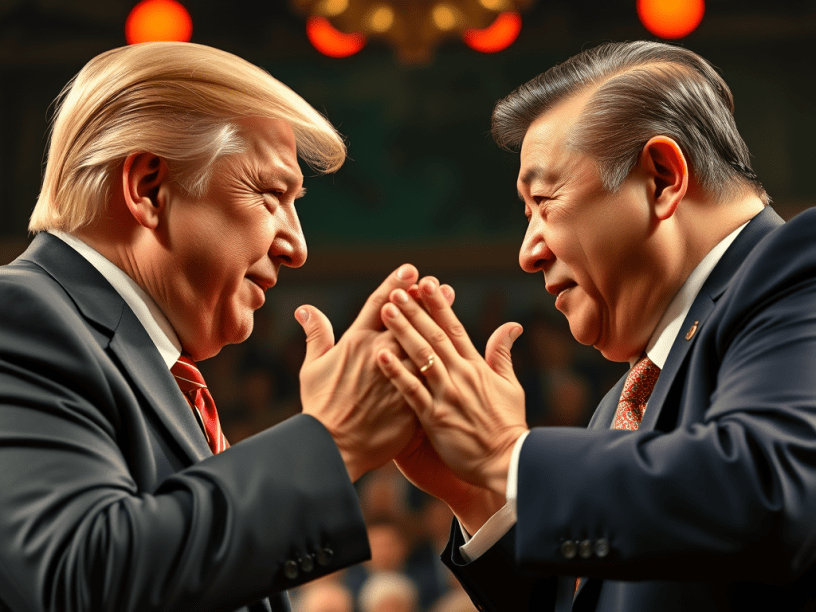
Well, we have given Trump enough time to get his staff together. The man has been in the game long enough to know that when it comes to international relations, it’s not just about making noise; it’s about knowing when to be quiet, when to throw punches, and when to make nice. Now, as we sit atop the uncomfortable edge of geopolitics, it’s time to dust off the crystal ball and see how good our predictions will be regarding Trump’s approach to the Chinese and Philippine relationship, particularly in the context of that contentious patch of water we affectionately call the West Philippine Sea.
Let’s take a stroll down memory lane. When COVID raised its ugly head in the States, Trump’s immediate reaction was to downplay it, treating it like a pesky mosquito rather than a sledgehammer poised to bring the house down. Remember how he put on the rose-colored glasses and insisted everything would be fine? Blaming the virus on his political opponents was one thing—always a staple in his diet of denial—but throwing shade at scientists and health experts was something else. It was the old “don’t shoot the messenger” routine turned into a stand-up comedy act.
So here we are, folks, with China flexing its muscles and the Philippines trying to figure out how to fend off a big brother with a penchant for overreach. South China Sea fish camps and some very heated disputes about territory seem to be the condiment of choice in this geopolitical stew. The Philippines finds itself in a pickle, not just because of its geographic position, but owing to the historical backdrop of its own relationship with both the U.S. and China. The dynamic is as tense as a soap opera cliffhanger—narratives shifting in a matter of moments, with the power players giving the audience whiplash.
Let’s not forget the lessons from the Korean War—a conflict that taught us just how unpredictable the Chinese can be when cornered. Back in the day, General Douglas MacArthur thought a quick victory over North Korea was a sure thing. Yet, as soon as China saw the U.N. forces get a little too comfortable at its doorstep, they marched in like it was a Sunday stroll, pink slips in hand, ready to rearrange the whole neighborhood. It’s a classic case of how strongman tactics might signal the end of diplomacy and bring us back to the Good Old Days of martial gatherings.
But what will Trump do? Will he tango with the Filipino administration, offering dance lessons, or will he charge in like a bull in a china shop, arms flailing and intentions murky? We can only guess at this point, and while throwing darts at a wall might produce as much sense as anything else, it’s worth considering what the landscape looks like.
One possibility is that Trump will double down on his “America First” mantra while trying to make the Philippines feel cozy and beneficial to U.S. interests. Should Trump find himself concocting deals over golf greens, he might be inclined to dangle the carrot of military assistance for the Philippines. After all, nothing says “good friends” like promising to keep the Chinese at bay while slipping a few shiny toys into your partner’s arsenal. But will this be a shallow promise, or will it have substance? And when he speaks of cooperation, will he mean it, or is it just campaign fodder for Fox News to lap up like a dog at a water bowl?
On the flip side, you have to consider Trump’s fondness for theatrics—his penchant for turning every issue into a personal vendetta. If the Philippines finds itself at a boiling point with China, Trump might just see himself riding a wave of “Make the South China Sea Great Again” with all the grace of a man in a tutu. There’s potential for him to portray a powerful US ally against the expansionist agenda of China, waving the flag of nationalism and benevolence while igniting the anxieties of both nations.
However, given Trump’s past antics, there’s also a strong chance he might play the blame game again. If things go south with China, counting on the Filipino side to shoulder some of that weight could play out like a bad sitcom. “Hey, it’s your fault we made China mad!” Would he turn to the Philippines, proclaiming their failure to stand tough as the reason for any fallout? You bet your last dollar. But here’s where pathways diverge; playing games with China might find Trump driving fast and loose. He could end up labeling any subsequent fallout as a faux pas of diplomacy that was, of course, all the fault of some “fake news” narrative ramping up the stakes.
What’s worse is that while we’re watching this high-stakes poker game unfold, the ramifications will undoubtedly swirl back to the Philippines. The Chinese are not the types to fold at any sign of weakness. As they love to remind us, they’ve been in the neighborhood for centuries, and they’re not about to let some political posturing disrupt their plans—especially with the Spratly Islands and other contested territories hanging in the balance like ripe fruit. There’s a reason why they’re stirring the pot; they see the West Philippine Sea as not just a strategic military point but a crucial economic corridor that they are not willing to concede to any nation, least of all one that’s still grappling with its own internal squabbles.
Ah, but let’s get back to our crystal ball, which at this point feels more like a foggy mirror than anything. Trump’s timing and tactics could hinge on public sentiment and the political winds back home; after all, a decent percentage of the electorate might not be particularly enthralled by the idea of another military debacle replete with pictures of politicians looking tough on TV but accomplishing not much else.
Let’s not forget the historical context since our old friend China has been known to exhibit unique behaviors when it feels provoked. The interventions of yesteryear still resonate today—look no further than the Korean War or even the invasions in Taiwan. History shows that when China feels cornered, it responds. What will it take for Trump to recognize that navigating this relationship requires a delicate touch rather than a bulldozer approach?
It wouldn’t hurt to recall that during the Korean War, a little restraint went a long way. Today’s leaders, including Trump, could learn from the past—not just the strategic brilliance, but the moral tenacity it takes to walk a tightrope. The key, as it always was, lies in building alliances through dialogue rather than alienation. The last thing the Philippines needs is an overzealous American leader trying to play the role of a hero in a movie where the outcome is anything but guaranteed.
As the U.S.-China tensions stretch and pull like taffy, the Philippines is positioned as an essential player in this ever-evolving saga. From the vantage point of a regional ally, they are in the unenviable position of having to balance the interests of two giants with tectonic ambitions. And while Trump may try to make it seem like it’s all part of his grand plan, the reality is that genuine partnerships demand more than photo-ops and empty promises.
One cannot deny that the potential for economic partnerships is there, yet parading it in front of the Chinese might yield results, but likely not the ones favored. Will Trump’s approach send shockwaves through Manila in support of a more robust alliance, or will it provoke the ire of China, leading to the kind of belligerence that finds us all scurrying for cover?
In the end, the best we can do is keep watching with a mixture of fascination and horror, like one observes a train wreck in slow motion. If history is our guide, Trump’s strategy may oscillate between feigned bravado and suspicion, but ultimately, time will tell how it plays out. The reality remains that for the Philippines, every maneuver of Trump could leave scars or sow friendships—whichever way the dice rolls, the stakes are significant.
As the old adage goes, “What goes around, comes around.” The relationships formed—or tarnished—through this geopolitical tango will echo into the future. The presence of the U.S. in this complex dance will affect not only how the Philippines treads carefully in the muddy waters of international relations with China but also how America secures its own interests in a region that demands respect and understanding more than empty bravado.
So, folks, let’s settle down with our popcorn and prepare for what could be another round of political theater as we wait to see what more Trump has in store. After all, history is watching, and so, it seems, are we—all bracing for the unexpected effects of the dance between a polarizing figure and an ever-so-volatile arena that is the West Philippine Sea. Let’s hope that when the final curtain falls, we’re all left standing with something to show for it—namely, peace and stability in a region that deserves nothing less.
Discover more from WPS News
Subscribe to get the latest posts sent to your email.
 WPS News