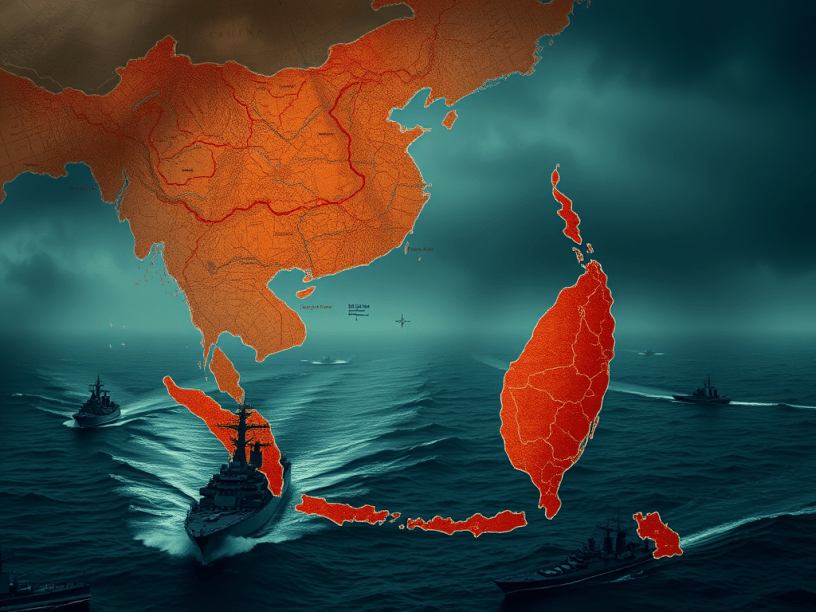
China’s assertive foreign policy, particularly in the South China Sea and Taiwan, has drawn significant international attention. Both these issues, while distinct, share underlying similarities rooted in a perceived historical entitlement and a willingness to use power to enforce claims.
The South China Sea: A Maritime Dispute
- Historical Claim: China asserts historical sovereignty over the South China Sea, citing ancient maps and maritime activities.
- Nine-Dash Line: This contentious demarcation line, used by China to claim vast swathes of the South China Sea, has been widely criticized internationally.
- Military Might: China has been rapidly modernizing its military, particularly its naval capabilities, to enforce its claims in the disputed waters.
Taiwan: A Political Stalemate
- One-China Principle: China insists on the “One-China Principle,” asserting that Taiwan is an inalienable part of its territory.
- Military Pressure: China has increased military exercises and intimidation tactics aimed at Taiwan, signaling its intent to bring the island under its control.
- Historical Narrative: China’s historical narrative posits Taiwan as a rebellious province, justifying its forceful reunification.
A Shared Philosophy: Might Makes Right
Both the South China Sea and Taiwan disputes reveal a common thread: a belief in the primacy of power. China’s approach, often characterized as “might makes right,” is evident in its actions:
- Ignoring International Law: China has frequently disregarded international law and norms, particularly in the South China Sea, where a 2016 international tribunal ruling against its claims was dismissed.
- Coercive Diplomacy: China employs a mix of economic incentives and military threats to pressure other countries into accepting its claims.
- Historical Revisionism: China’s historical narratives often serve to justify its territorial ambitions, reinforcing its sense of entitlement.
While the specific contexts and stakes may differ, both issues highlight China’s increasing assertiveness and its willingness to use its growing power to shape the regional and global order. As China continues to rise, its approach to these disputes will have far-reaching implications for regional stability and international law.
Happy 2026! May your resolutions last longer than a soggy firecracker, and may your luck be as endless as the leftover fruitcake from last year!
Discover more from WPS News
Subscribe to get the latest posts sent to your email.

