WPS News Political Correspondent
Baybay City | July 2, 2025
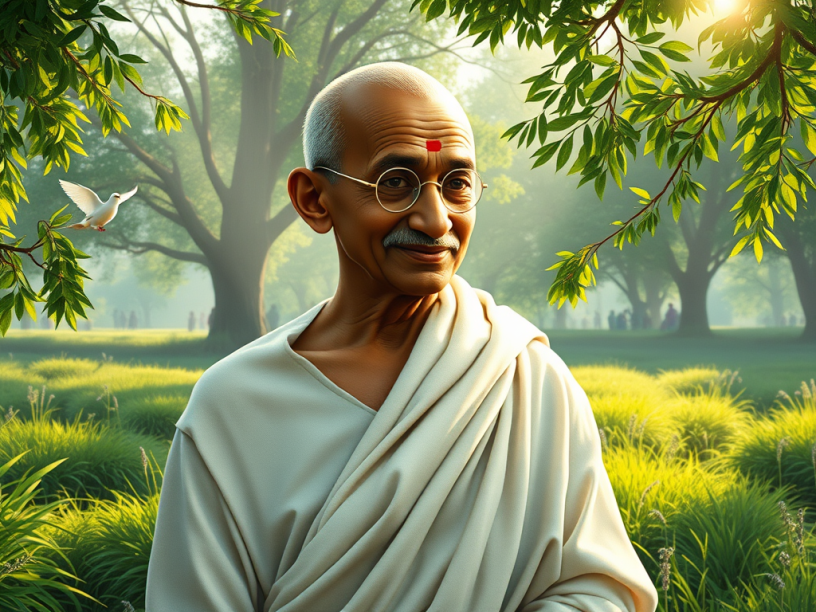
Mahatma Gandhi, an iconic figure in the global advocacy for peace and nonviolent resistance, is primarily celebrated for his steadfast commitment to achieving justice through peaceful means. Nevertheless, Gandhi’s philosophies acknowledge a nuanced perspective on the moral struggles against oppression, suggesting that there may be situations where these struggles could escalate into war. This balanced view underscores the complexity of his approach toward achieving justice and advancing societal evolution.
Born on October 2, 1869, in Porbandar, India, Mohandas Karamchand Gandhi, later revered as Mahatma Gandhi, dedicated his life to combating social injustice and colonial rule. His methods, underscored by nonviolent civil disobedience, played an instrumental role in India’s struggle for independence from British rule. Gandhi’s philosophy was deeply rooted in the concept of ‘Ahimsa,’ meaning non-harm, which guided his actions and beliefs.
However, Gandhi’s vision of nonviolent resistance was not merely an absence of violence but a comprehensive strategy to achieve substantial and sustainable changes in society. While he firmly believed that nonviolence was the most powerful weapon, Gandhi also recognized that the moral struggle against oppression could, in exceptional cases, justify war as a last resort. This perspective, although seemingly contradictory, highlighted Gandhi’s acknowledgment of the complexities involved in real-world scenarios.
Gandhi argued that every individual and society must continually strive for truth and justice. When faced with severe oppression, where all nonviolent methods have been exhausted and failed, Gandhi considered the possibility of armed struggle as a moral imperative to protect the dignity and rights of individuals. He posited that the ultimate goal was justice and societal evolution, recognizing that sometimes, dire situations required extraordinary measures.
His philosophy inspired numerous leaders and movements across the world, notably the Civil Rights Movement in the United States under Martin Luther King Jr., who adopted Gandhi’s principles of nonviolent protest. Nevertheless, Gandhi’s admission that war could be a necessary step in achieving justice complicates his legacy, presenting a challenge to those seeking to reconcile absolute nonviolence with the realities of an oppressive world.
Despite his acknowledgment of war, Gandhi consistently emphasized that nonviolence remained the preferred strategy. He insisted that the escalation to violence was permissible only after all other avenues of peaceful resistance had been thoroughly explored and deemed futile. For Gandhi, the commitment to truth, or ‘Satya,’ was paramount, shaping his belief in the moral obligation to resist tyranny and injustice by the most effective means available.
Gandhi’s approach to moral struggle has stimulated extensive debate among scholars and political activists. Some interpret his willingness to consider war as a pragmatic approach to achieving ideals, whereas others view it as a departure from his core principle of nonviolence. Regardless, Gandhi’s thoughts on moral struggle contributed to a deeper understanding of the complexities involved in resistance movements against oppressive regimes.
His legacy continues to inspire global discourse on peace, justice, and the ethical dimensions of war and nonviolence. Scholars and activists alike study Gandhi’s teachings to navigate modern conflicts, emphasizing the importance of understanding the root causes of oppression and seeking creative, peaceful strategies to address them.
Today, Gandhi’s teachings remain relevant as the world faces new challenges of inequality and injustice. His life and philosophy serve as a testament to the enduring power of conviction and the relentless pursuit of societal improvement. As history evaluates his contributions, Gandhi’s recognition of the potential necessity for armed struggle underscores a profound understanding of the multifaceted battle for justice.
Gandhi’s ideas reflect the tension between idealism and realism in the realms of politics and ethical philosophy. As societies continue to grapple with oppression and conflict, Gandhi’s insights offer valuable perspectives to inform the global pursuit of peace and equity.
Discover more from WPS News
Subscribe to get the latest posts sent to your email.
 WPS News