By, Cliff Potts, WPS News, Editor-in-Chief
Baybay City | January 20, 2025
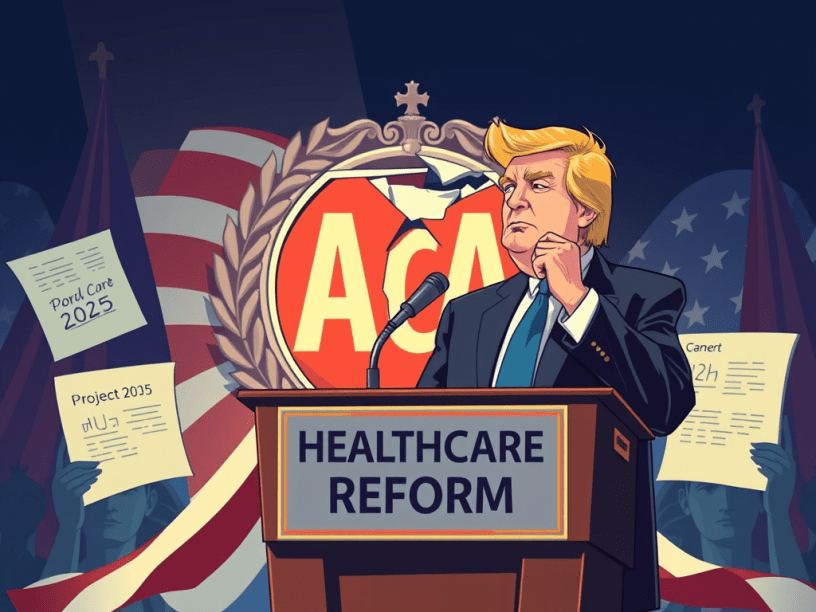
As I sit down to write this just days before Donald J. Trump takes office as President of the United States, I can’t help but feel a mix of confusion and curiosity about his plans for tackling this major issue once again. He’s left us hanging without a clear idea of his intentions, and that’s not exactly reassuring. There’s chatter that it might be linked to the polarizing Project 2025, despite Trump’s claims of ignorance on the matter.
Project 2025 aims to scrap or overhaul the Affordable Care Act (ACA) in a bold bid to revolutionize healthcare in the U.S. It’s spearheaded by conservative factions that are gung-ho about pushing for policies that reduce government intervention and promote free-market solutions, all while ignoring the fact that such approaches have been a disaster since Ronald Reagan was in charge.
Advocates of Project 2025 typically argue for alternatives to the ACA, emphasizing the need for healthcare reforms that reduce regulations, promote competition among insurers, and offer more choice to consumers. While the specific proposals may vary, the overarching goal is often to dismantle or significantly alter the ACA, which many conservatives view as an expansion of government control over healthcare.
Thus, while Project 2025 encompasses a variety of healthcare policy proposals, doing away with or reforming the ACA is a central focus of the initiative.
The Affordable Care Act (ACA), enacted in 2010, transformed the healthcare landscape in the United States by expanding insurance coverage and solidifying protections for individuals with pre-existing conditions. However, since its inception, the ACA has been the focal point of intense political debate, particularly during Donald Trump’s presidency. Trump vowed to repeal and replace the ACA, a promise that resonated with many Republican voters who viewed it as a governmental overreach. Despite his determination, the reality of dismantling such a significant piece of legislation proved to be far more complex than anticipated.
From the outset, the Trump administration attempted to roll back various components of the ACA. The narrative of “repeal and replace” dominated the healthcare discourse, spurring numerous legislative attempts. One of the most notable efforts came in the form of the American Health Care Act (AHCA), proposed in 2017. This plan aimed not only to eliminate key provisions of the ACA but also to redistribute healthcare resources in a manner that aligned with Republican ideals. However, the AHCA faced staunch opposition, even within the Republican party, leading to its eventual failure in Congress.
The inability to fully repeal the ACA left the healthcare system in a state of flux. While some smaller measures were implemented, including the expansion of health savings accounts and the removal of the individual mandate penalty, these changes did not equate to a comprehensive alternative. As a result, millions of Americans continued to rely on ACA provisions. The political landscape surrounding healthcare remained contentious, with Democrats vowing to protect the ACA and push for enhancements, while Republicans continued their calls for reform.
The uncertainty surrounding healthcare policy during this period had real-life implications for many individuals. Millions of Americans remained anxious about losing the protections afforded to them under the ACA, particularly those with pre-existing conditions. This anxiety was palpable during the lead-up to the 2020 presidential election, as candidates debated not just the future of healthcare, but the basic human right to access it. As the Supreme Court heard cases challenging the constitutionality of the ACA, the stakes became even higher, with the potential for drastic changes looming.
Aside from legislative attempts, the Trump administration also sought to undermine the ACA through regulatory changes. By expanding short-term, limited-duration insurance plans and promoting the use of association health plans, the administration aimed to create alternatives that could operate outside the ACA framework. These efforts, however, were met with criticism as they often provided less comprehensive coverage while potentially destabilizing the established insurance markets.
In conclusion, Donald Trump’s tenure was marked by a fervent desire to dismantle the Affordable Care Act. Despite the administration’s efforts, the promise of a complete repeal and replacement remained elusive. As a result, the healthcare landscape remained fraught with uncertainty, leaving millions of Americans worried about their access to essential health services. With the political atmosphere continually shifting, the future of the ACA and healthcare policy as a whole remains uncertain. The debate over healthcare is far from settled, illustrating the complexities of reform in one of the most critical aspects of American life.
Having said that, it seems almost inevitable that Trump will bungle his ambitions yet again—if fortune favors us.
Discover more from WPS News
Subscribe to get the latest posts sent to your email.

