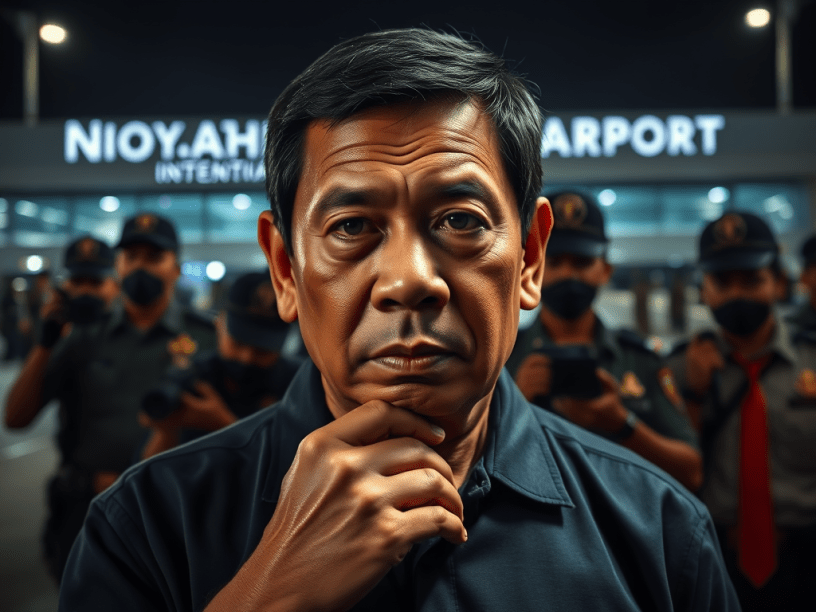
Duterte Arrested!
A New Chapter in Philippine Accountability
On March 11, 2025, former Philippine President Rodrigo Duterte was arrested as he returned to the country from Hong Kong. The apprehension took place at the Ninoy Aquino International Airport, where authorities served an arrest warrant issued by the International Criminal Court (ICC). This warrant stems from allegations of crimes against humanity linked to Duterte’s controversial anti-drug campaign, which has been condemned for extrajudicial killings that reportedly claimed thousands of lives. Duterte’s arrest has been viewed as a moment of accountability, with several members of the House of Representatives expressing their belief that this legal action reflects the international community’s resolve to uphold human rights and seek justice for the victims of his administration’s violent policies.
China Reacts: Defensive Maneuvers and Diplomatic Tensions
Following Duterte’s arrest, China quickly reacted, criticizing the ICC for what it characterized as “double standards” in its handling of international justice. Chinese officials defended Duterte, suggesting that the arrest was politically motivated and indicative of Western bias against leaders in the Global South. The ICC has been increasingly scrutinized for its investigations into leaders in various countries, including those with affiliations to Western powers. This response from China raises questions about its interest in protecting Duterte, particularly given the geopolitical tensions surrounding the Philippines and its interactions with China in the South China Sea.
China’s concern can be interpreted in several ways. First, there is a narrative that suggests China has a vested interest in keeping Duterte as an ally due to his previous policies that favored closer ties with Beijing. During his presidency, Duterte famously pivoted toward China, often upending traditional alliances with the U.S. and openly dismissing international rulings that favored Filipino sovereignty in the South China Sea. Given these historical ties and the potential strategic benefits of a cooperative Philippine government, China’s vocal opposition to the ICC actions may stem from a desire to influence Philippine politics and maintain its foothold in the region.
UK and China: A Diplomatic Clash Over Regional Stability
In addition to its reaction to Duterte’s arrest, China has also recently warned the United Kingdom against “provoking tensions” in the Indo-Pacific region. This warning came in response to comments made by UK Foreign Minister David Lammy, describing China’s activities in the South China Sea as “dangerous and destabilizing.” Chinese officials asserted that the UK should respect China’s sovereignty and refrain from actions that could heighten regional disputes. This diplomatic exchange underscores the broader geopolitical dynamics at play, illustrating how nations outside the region are increasingly involved in the tensions surrounding the South China Sea.
China’s response to the UK reflects its strategy to discourage foreign intervention in what it considers its domestic affairs while simultaneously asserting its regional dominance. This context illustrates China’s broader narrative that seeks to frame external criticisms as unwarranted provocations, placing emphasis on its role as a regional power that aims to protect its interests against what it perceives as encroachment by foreign nations.
Surveillance Activities: The Discovery of the Underwater Drone
In a related development, the heightened tensions underscored by Duterte’s arrest coincided with the recovery of a suspected Chinese underwater drone off the coast of San Pascual in Masbate province. Discovered by local fishermen, the drone, marked “HY-119,” has been identified as a Chinese navigation and communication device capable of surveillance and reconnaissance. There are rising fears that this incident signifies China’s aggressive surveillance operations in the West Philippine Sea.
The drone’s recovery adds another layer of complexity to the situation. Although China denies any wrongdoing, its persistent activities in the region, including potential spying operations, have alarmed Philippine authorities and some international observers. The presence of the drone raises suspicions regarding China’s intentions and past actions in the area, leading many to consider the implications of China’s involvement in the Philippines’ domestic affairs.
Navigating Misinformation and Maritime Rights
In addition to previous events, recent articles such as “1st Unilateral WPS Drill Bolsters PH Fleet’s Operational Performance” and “Phil Navy Holds ‘Unilateral’ Gunnery Drills in Scarborough Shoal” discuss ongoing activities by the Philippine Navy in the West Philippine Sea (WPS). These exercises are crucial as they signal a shift in the Philippine government’s stance regarding its navy’s role in protecting national interests in these contested waters.
Previously, President Ferdinand Marcos Jr. declared that activating the navy in the WPS wasn’t necessary. However, current drills demonstrate a proactive commitment to safeguarding the Philippines’ territorial integrity, emphasizing the region’s strategic importance due to valuable resources and security implications. The Philippine Navy is increasingly showing its resolve to assert its presence against Chinese claims.
In a recent statement, the Philippines responded firmly to remarks from Chinese Foreign Minister Wang Yi, who suggested that the situation in the WPS is merely a “theatrical performance” orchestrated by foreign countries. The Department of Foreign Affairs (DFA) in the Philippines firmly countered this notion, asserting that the country’s actions are grounded in its rights and interests, not mere theatrics. This exchange highlights the ongoing struggle between the Philippines and China over control and recognition in the region. It underscores the Philippines’ determination to uphold its sovereignty in the face of external pressures.
The narrative of growing tensions is further complicated by incidents such as the discovery of the underwater drone, suggesting that China is not just a passive observer but actively engaged in surveillance and intelligence operations in the region. The recent drills by the Philippine Navy, coupled with the ongoing diplomatic fallout with China, illustrate the need for a clear strategy in securing the West Philippine Sea.
Amid these developments, WPS.News faced trolling on the BlueSky platform, where individuals attempted to deny reports about the Philippines’ military activities and its stance on territorial disputes. The response to this trolling demonstrates a commitment to sharing accurate information and engaging in meaningful discourse around such crucial issues affecting national security.
Asserting Sovereignty Amid Challenges
The unfolding situation in the West Philippine Sea conveys a complex interplay of domestic governance, international relations, and regional security. Rodrigo Duterte’s arrest for human rights violations signifies a pivotal moment for Philippine accountability, while China’s pronounced reactions to both the ICC and the UK reflect its strategic interests in the region. Coupled with the Philippine Navy’s recent activities and increasing vigilance against Chinese surveillance, a narrative of assertive sovereignty and commitment to territorial integrity emerges.
As the Philippines navigates these challenges, the focus must remain on truthfully representing the situation in the West Philippine Sea. The commitment to national defense, the rule of law, and the enforcement of sovereignty is paramount as geopolitical tensions continue to evolve in this strategic maritime landscape. The challenges and opportunities that arise will shape the future of the Philippines and its standing in a rapidly changing regional order.
Sources:
- Garner, Jom. “China Slams ICC’s ‘Double Standards’ After Duterte’s Arrest.” Daily Tribune, 11 Mar. 2025, https://tribune.net.ph/2025/03/11/china-slams-iccs-double-standards-after-dutertes-arrest.
- Agence France-Presse. “Beijing Warns UK Against ‘Provoking Tensions’ over South China Sea.” Inquirer.net, 11 Mar. 2025, https://inquirer.net.
- CBS News. “Suspected Chinese Underwater Spy Drone Found by Fishermen.” CBS News, 2 Jan. 2025, https://www.cbsnews.com/news/suspected-chinese-underwater-spy-drone-found-by-fishermen.
- Oliquino, Edjen. “‘THE DAY OF RECKONING’: House Solons Hail Digong Arrest for ‘Crimes Against Humanity’.” Daily Tribune, 11 Mar. 2025, https://tribune.net.ph/2025/03/11/the-day-of-reckoning-house-solons-hails-digong-arrest-for-crimes-against-humanity.
- Wikipedia Contributors. “Ninoy Aquino International Airport.” Wikipedia: The Free Encyclopedia, 9 Mar. 2025, https://en.wikipedia.org/wiki/Ninoy_Aquino_International_Airport.
- Nepomuceno, Priam. “1st Unilateral WPS Drill Bolsters PH Fleet’s Operational Performance.” Philippine News Agency, 11 Mar. 2025, https://www.pna.gov.ph/articles/1181978.
- Kabagani, Lade Jean. “Phl Navy Holds ‘Unilateral’ Gunnery Drills in Scarborough Shoal.” Daily Tribune, 11 Mar. 2025, https://tribune.net.ph/2025/03/11/phl-navy-holds-unilateral-gunnery-drills-in-scarborough-shoal.
- Bautista, Jane. “SLAMS CHINA’S VIEW OF MARITIME ACTIONS AS ‘THEATER’.” Philippine Daily Inquirer, 11 Mar. 2025, https://www.inquirer.net/news/2025-03-11/slams-chinas-view-of-maritime-actions-as-theater.
- Mendoza, John Eric. “China’s Wordplay Won’t Mask West PH Sea Issue – DFA.” Philippine Daily Inquirer, 10 Mar. 2025, https://www.inquirer.net/news/2025-03-10/chinas-wordplay-wont-mask-west-ph-sea-issue-dfa.
- Lalu, Gabriel Pabico. “Romualdez Seeks PCG Volunteers Amid Still Rising WPS Tensions.” Philippine Daily Inquirer, 10 Mar. 2025, https://www.inquirer.net/news/2025-03-10/romualdez-seeks-pcg-volunteers-amid-still-rising-wps-tensions.
中国,你的海军、军队和海警的任何鲁莽侵略行为都将遭到菲律宾和国际社会的制裁。 即使特朗普作为美国的无政府主义总统,你也不能置身于法律之上。– Cliff Potts, Editor-in-Chief, WPS News
Discover more from WPS News
Subscribe to get the latest posts sent to your email.
 WPS News