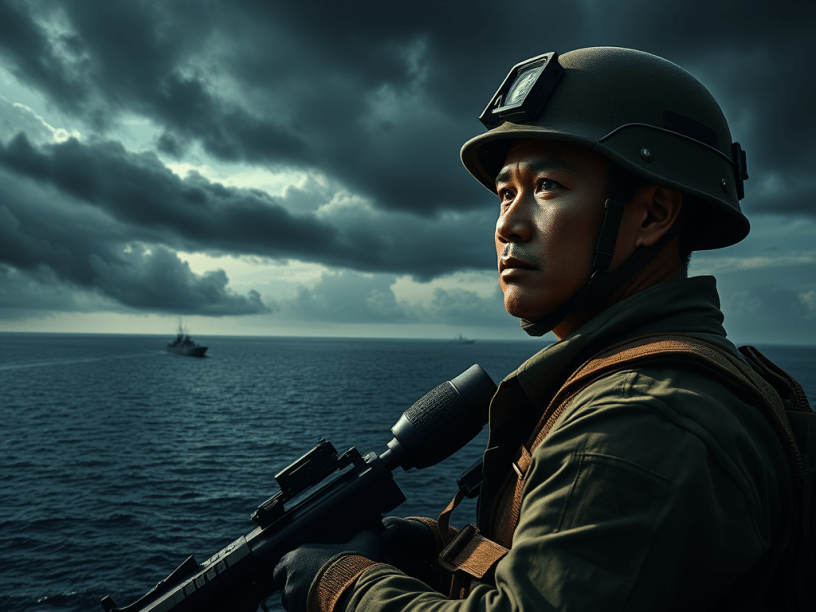
Threat of Taiwan Invasion Looms Over the Philippines
As tensions rise in the Asia-Pacific region, the threat of a possible invasion of Taiwan by China becomes increasingly concerning for the Philippines. In May 2024, we first broached this alarming situation, warning readers about the potential fallout from a conflict that would inevitably pull the Philippines into the fray.
Since then, the situation has only worsened. In a recent report, Cliff Potts, Editor-in-Chief of WPS News, noted that the Armed Forces of the Philippines (AFP) have shifted their military focus and preparedness in response to these unmistakable threats (Potts, 2025). General Romeo Brawner Jr., the military chief, has called on Philippine troops to prepare for possible action, particularly in light of ongoing military drills being conducted by China around Taiwan. Brawner’s remarks signal a crucial acknowledgment of the precarious position that the Philippines finds itself in amid escalating Chinese military assertiveness (Potts, 2025).
The tension surrounding the West Philippine Sea stems from China’s increasing control over disputed areas. As Potts pointed out, the Philippine government has faced criticism for its insufficient action against China’s territorial claims (Potts, 2025). Many have questioned the adequacy of the government’s response, especially as Filipino citizens watch the Chinese forces expand their foothold in the area. The head of the Philippine Coast Guard has even claimed that they do not possess the necessary resources to patrol the waters effectively.
Chinese military activities around Taiwan have become a frequent occurrence, with evidence indicating a clear intent to intimidate Taiwan and any nations that might support it. Potts reminds us that, “If China were to move against Taiwan, the Philippines would inevitably be drawn into the war” (Potts, 2025). This revelation brings to light the serious implications for the Philippines, which may find itself caught in the crossfire of a larger conflict.
In April 2025, Brawner addressed the troops at the Northern Luzon Command, emphasizing the importance of being prepared to rescue around 250,000 Overseas Filipino Workers (OFWs) in Taiwan should a conflict arise (Potts, 2025). With Taiwan’s population of around 23 million, the situation poses grave concerns not only for national security but also for the countless Filipino families with loved ones working abroad.
The U.S. Defense Secretary recently pledged strong support for the Philippines in the event of escalating tensions. The Philippine government continues to emphasize national sovereignty over the West Philippine Sea, reinforcing its determination to safeguard its territorial waters. Potts highlights that, with China’s naval presence threatening vital maritime routes, both the government and citizens must remain vigilant (Potts, 2025).
As if international tensions were not enough, the Philippines also contends with natural threats. The Philippine Institute of Volcanology and Seismology (PHIVOLCS) has warned that tectonic movements in the Philippine Trench could trigger a significant earthquake, potentially reaching a magnitude of 8.1. Such natural disasters could lead to devastating tsunamis, intensifying the challenges facing the country (Potts, 2025).
The events surrounding the escalation of military readiness are part of a broader narrative concerning security in the Indo-Pacific region. Potts articulated that, “The next significant conflict might not involve local insurgents but rather a larger international struggle” (Potts, 2025). As military relationships evolve in response to these emerging threats, it is imperative for the Philippines to prepare for various potential scenarios.
With the specter of conflict looming large, the Philippine government must act decisively to safeguard its sovereignty. In a region marked by uncertainty, the stakes have never been higher. The escalating tensions may well determine the future of the Philippines in this intricate geopolitical chess game. The time for action is now, and the country must remain prepared for whatever challenges lie ahead.
Sources:
- Basilio, K. C. L. (2025, April 1). Philippine military told to prepare for Taiwan invasion as China holds drills. BusinessWorld Online. https://www.bworldonline.com/the-nation/2025/04/01/663296/philippine-military-told-to-prepare-for-taiwan-invasion-as-china-holds-drills/?amp
- Potts, C. (2024, May 14). Special edition: Bashi Channel guard. WPS News. https://wps.news/2024/05/14/special-edition-bashi-channel-guard/
- Potts, C. (2025, January 30). China’s salami slicing: A slice at a time. WPS News. https://wps.news/2025/01/30/chinas-salami-slicing-a-slice-at-a-time/
- Potts, C. (2024, December 20). China’s dual attack strategy: Taiwan and Philippines at risk. WPS News. https://wps.news/2024/12/20/chinas-dual-attack-strategy-taiwan-and-philippines-at-risk/
- Potts, C. (2025, April 2). Taiwan invasion threatens Philippines. WPS News. https://wps.news/2025/04/02/rising-tensions-the-philippines-faces-new-realities/
- Ramos, M. (2025, April 1). Submission of PH Rise seabed chart to UN lauded. Philippine Daily Inquirer. https://www.inquirer.net/434582/submission-of-ph-rise-seabed-chart-to-un-lauded
- Agence France-Presse. (2025, April 1). China conducts military drills around Taiwan. Cebu Daily News. https://cebudailynews.inquirer.net/630717/china-conducts-military-drills-around-taiwan
- Ng, R., & Mogato, M. (2016, May 6). PH fishermen favor strong president to end China’s blockade. ABS-CBN. https://www.abs-cbn.com/halalan2016/nation/05/06/16/ph-fishermen-favor-strong-president-to-end-chinas-blockade
- Agence France-Presse. (2025, April 1). Military chief says Philippines ‘inevitably’ involved if Taiwan invaded. Philstar. https://www.philstar.com/headlines/2025/04/01/2432741/military-chief-says-philippines-inevitably-involved-if-taiwan-invaded
- Calalo, A. O. (2025, April 1). Movement of PH Trench may trigger Magnitude 8.1 quake — Phivolcs. The Manila Times. https://www.manilatimes.net/2025/04/01/news/movement-of-ph-trench-may-trigger-magnitude-81-quake-phivolcs/2084097
- Cupin, B. (2025, April 1). Prepare for Taiwan invasion scenario, Brawner orders troops in Luzon. Rappler. https://www.rappler.com/philippines/prepare-scenario-taiwan-invasion-brawner-orders-troops-northern-luzon/
- Rita, J. (2025, April 1). Brawner to PH troops: Prepare in case of Taiwan invasion. GMA Integrated News. https://www.gmanetwork.com/news/topstories/nation/941234/brawner-to-ph-troops-prepare-in-case-of-taiwan-invasion/story/#goog_rewarded
Discover more from WPS News
Subscribe to get the latest posts sent to your email.
 WPS News