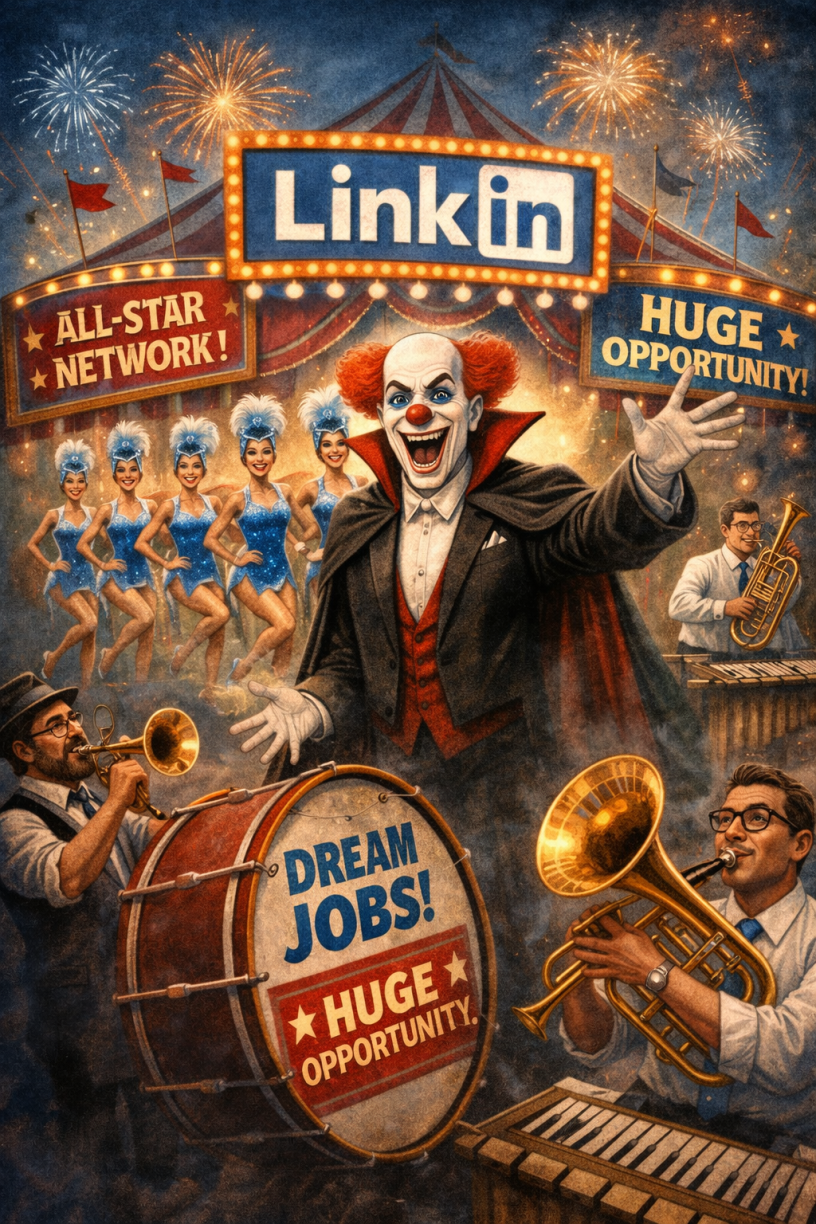
How Arrogance Replaced Competence, Visibility Replaced Work, and a “Professional Network” Became Economic Theater
By Cliff Potts, CSO & Editor-in-Chief, WPS News
The Platform That Arrived With a Halo
When LinkedIn launched, it sold itself as the antidote to social-media chaos—a sober place for careers, not noise. For people who had already watched Facebook turn personal data into spectacle, LinkedIn’s pitch sounded responsible.
It wasn’t.
From the beginning, LinkedIn enforced a narrow idea of “professionalism” that discouraged honesty more than it discouraged harm. Structural critique was unwelcome. Labor realities were “negative.” If Facebook was loud, LinkedIn was antiseptic—and just as manipulative. The platform didn’t just moderate content; it curated silence.
The Arrogance Layer
LinkedIn elevated a specific persona and rewarded it relentlessly: confident without evidence, condescending without consequence, polished without substance. This posture—popularized by business-celebrity bluntness à la Kevin O’Leary—metastasized on the platform. Authority voice beat accuracy. Certainty beat understanding.
The result was an ecosystem where bad advice thrived because it sounded decisive, while lived experience was sidelined if it complicated the narrative. LinkedIn didn’t just tolerate this tone; its algorithms amplified it. The platform rewards confidence theater, not competence.
“Professionalism” as a Shield
LinkedIn’s version of professionalism became a protective coating for nonsense. You could be dismissive as long as you were calm. Wrong as long as you were confident. Unhelpful as long as you were polished. Anyone calling out systemic failure—wage suppression, ghost jobs, hiring theater—was told they were being “unprofessional.”
That isn’t professionalism. It’s status enforcement.
The Open Network That Emptied Networking
At some point, a doctrine took hold: connect with everyone. Self-styled “Lions” groups preached radical openness—say yes to every request. Vetting was elitist; boundaries were passé. What looked democratic hollowed out LinkedIn’s own premise.
Networking requires context, trust, and accountability. An open-accept model replaced all three with quantity. “Who you know” collapsed into “how many strangers you’ve collected.” The network grew. The signal died.
Visibility Replaced Placement
LinkedIn’s central failure is simple: it does not reliably place people into jobs. It substitutes visibility for outcomes. Profiles get views. Posts get impressions. Recruiters browse. Nothing happens.
Over time, LinkedIn doubled down by charging workers to escape obscurity. Premium tiers promise “better visibility” and “insights”—a toll booth for attention in a market already stacked against labor. This inverts the old rule that employers pay to recruit. Now workers pay to be seen by employers who already hold leverage.
That isn’t matching. It’s monetized desperation.
The Fiction of the Professional Graph
LinkedIn presents its connection graph as social capital. In practice, much of it is fictional. Many connections never worked together, never collaborated, and may never have met. Proximity is treated as credibility; quantity as trust.
Worse, users don’t fully control this graph. Removing connections is mediated. Relationships are effectively co-owned by the platform. LinkedIn doesn’t just host professional relationships—it encloses them.
Selective Neutrality
LinkedIn claims to be a business platform, yet selectively tolerates politics aligned with ownership ideology. There’s nothing wrong with opposing demagoguery. The problem is the pretense of neutrality. “Keep politics out of it” was never the rule. Keep the wrong politics out of it was.
This matters because it reveals the platform’s worldview: neoliberal, market-first, individual responsibility elevated above structural reality. Failure is reframed as a branding problem.
Spiritual Bypass as Career Advice
One of the platform’s quiet harms is cultural. When workers face injury, layoffs, or catastrophic wage loss, the advice often isn’t material—it’s spiritualized: be patient, trust the universe, let the ledger balance itself.
That’s not wisdom. It’s abdication. Turning economic harm into a mindset exercise absolves systems and burdens individuals.
Not Facebook for Business—Worse
LinkedIn isn’t Facebook for professionals. Facebook is messy but honest about being social. LinkedIn is messier while pretending to be economic infrastructure.
Yes, people sometimes connect. Occasionally something works. Those anecdotes don’t justify a platform that has trained millions to perform professionalism while extracting time, data, and money—especially from people who don’t fit the corporate mold. The platform rewards conformity, not insight; obedience, not truth.
What LinkedIn Won’t Admit
LinkedIn won’t say that:
- Visibility is not opportunity.
- Connections are not accountability.
- Premium subscriptions don’t fix broken hiring.
- The network graph is largely decorative.
- Failure is structural, not personal.
It won’t say that its incentives align far more with advertisers and employers than with workers.
The Bottom Line
LinkedIn didn’t fix the hiring crisis it inherited. It polished it, branded it, and charged workers to participate emotionally in it. Where earlier platforms normalized silence, LinkedIn personalized it. Where job boards made dysfunction acceptable, LinkedIn made it feel like your fault.
That’s the truth the platform can’t say out loud—because saying it would end the performance.
For more news and reporting, please see https://wps.news
References (APA)
Autor, D. (2019). Work of the past, work of the future. AEA Papers and Proceedings, 109, 1–32. https://doi.org/10.1257/pandp.20191110
Cappelli, P. (2019). Your approach to hiring is all wrong. Harvard Business Review.
Gillespie, T. (2018). Custodians of the Internet: Platforms, content moderation, and the hidden decisions that shape social media. Yale University Press.
Kalleberg, A. L. (2018). Precarious lives: Job insecurity and well-being in rich democracies. Polity Press.
Mazzucato, M. (2018). The value of everything: Making and taking in the global economy. PublicAffairs.
Standing, G. (2011). The precariat: The new dangerous class. Bloomsbury Academic.
Discover more from WPS News
Subscribe to get the latest posts sent to your email.
 WPS News