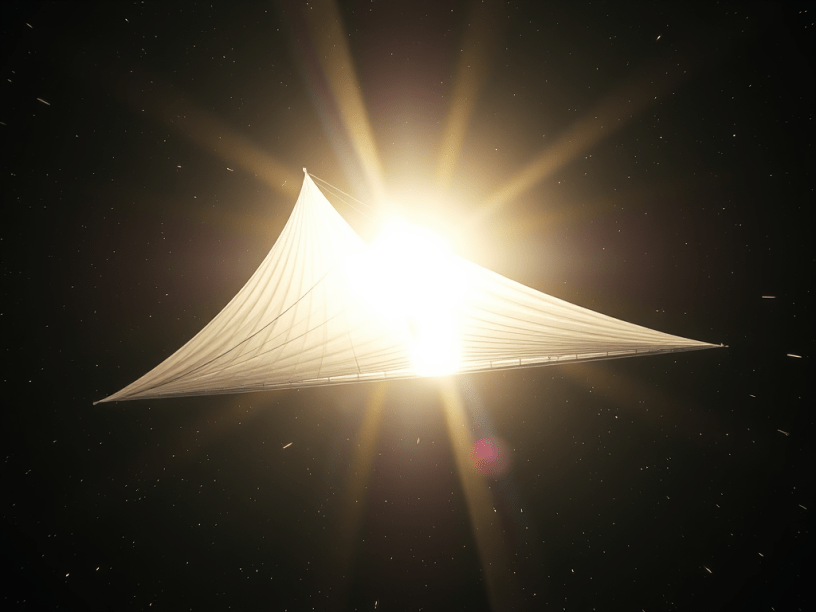
For millennia, humanity has gazed skyward, yearning to explore the vast expanse beyond our own solar system. The nearest star, Proxima Centauri, lies a staggering 4.24 light-years away, a distance that renders conventional rocket propulsion impractical. But as our thirst for knowledge and discovery grows, so too does our ingenuity. Enter the realm of solar sails, a revolutionary technology poised to harness the power of the Sun’s very breath – the solar wind – to propel future interstellar probes on journeys unlike any before.
Unveiling the Sun’s Elusive Breath: The Nature of Solar Wind
The Sun, our life-giving star, is a colossal ball of hot plasma constantly churning with immense energy. This churning creates a continuous stream of charged particles, primarily protons and electrons, escaping outwards into the vast reaches of space. This stream of particles, aptly named the solar wind, permeates our solar system and plays a crucial role in shaping its environment.
The solar wind travels at supersonic speeds, ranging from 300 to 800 kilometers per second. However, its density is extremely low, much thinner than even the faintest earthly breeze. This low density presents a challenge for traditional propulsion methods, but within it lies the potential for a revolutionary approach – solar sails.
Solar Sails: Harnessing the Sun’s Whisper
A solar sail is a spacecraft propelled by the pressure exerted by sunlight on a large, reflective membrane. Imagine a giant sheet, shimmering like a silver ribbon, unfurled in the vastness of space. As sunlight strikes this membrane, the photons (packets of light energy) transfer a small amount of momentum to the sail. Though the force exerted by a single photon is miniscule, the sheer number of photons bombarding the sail from the Sun creates a continuous, gentle push.
The effectiveness of a solar sail depends on two key factors:
- Sail size: A larger sail area exposes a greater surface to sunlight, leading to a stronger propulsive force.
- Sail material: A highly reflective material minimizes the absorption of light energy and maximizes momentum transfer.
The beauty of solar sails lies in their ability to leverage a constant, inexhaustible source of energy – the Sun. Unlike conventional rockets that carry their own fuel, solar sails require no onboard propellant. This translates to a significant reduction in spacecraft mass, allowing for the potential to carry heavier payloads or achieve higher speeds.
Solar Winds: A Guiding Force for Interstellar Voyagers
While the solar wind’s density poses a challenge for traditional propulsion, it becomes an ally for solar sails. As the solar wind streams outwards, it interacts with the sail, imparting an additional push. This “wind pressure” from the solar wind adds to the propulsive force exerted by sunlight, enabling solar sails to achieve remarkable accelerations over extended periods.
The key to utilizing the solar wind for interstellar travel lies in escaping the Sun’s gravity. Within a certain distance from the Sun, the Sun’s gravitational pull dominates, preventing the solar wind pressure from overcoming it. However, at a point known as the solar escape velocity, the solar wind pressure becomes strong enough to counteract gravity and propel the spacecraft outwards.
The Long Voyage Awaits: Challenges and Opportunities
While the prospect of solar sail-powered interstellar probes is exhilarating, there are significant challenges to overcome.
- Travel Time: Interstellar distances are vast. Even with sustained acceleration from the solar wind, journeys to nearby stars could take decades or even centuries.
- Sail Deployment: Unfurling a large, delicate sail in the harsh environment of space requires robust deployment mechanisms.
- Navigation and Control: Maneuvering a solar sail spacecraft requires innovative techniques that utilize the pressure of light and the solar wind.
- Survivability: Interstellar space is not a gentle environment. Probes need robust shielding to withstand the constant bombardment of micrometeoroids and interstellar radiation.
Despite these challenges, the potential rewards are immense. Solar sail technology has the potential to revolutionize space exploration by enabling missions beyond the reach of conventional rockets. Here are some exciting possibilities:
- Interstellar Probes: Sending probes to nearby star systems could unlock a wealth of information about our galactic neighborhood, potentially revealing new planets and solar systems.
- Heliopause Exploration: The heliopause marks the boundary between the Sun’s influence and the vast interstellar medium. Solar sails could allow us to study this critical region in detail.
- Asteroid Redirection: Solar sails could offer a novel approach to deflecting near-Earth asteroids, potentially mitigating future impact threats.
The Future Beckons: A Collaborative Endeavor
Developing and deploying solar sail technology for interstellar travel requires a collaborative effort from researchers, engineers, and space agencies worldwide. International cooperation could accelerate research and development, leading to the creation of the next generation of interstellar
Discover more from WPS News
Subscribe to get the latest posts sent to your email.
 WPS News
Fascinating!
LikeLike