WPS News History Correspondent
Baybay City | March 3, 2025
Preamble: Although Karl Marx is often credited as the father of communism, it’s important to clarify that he himself never identified strictly as a communist in the manner that later regimes claimed, particularly the Soviet Union. Marx was primarily concerned with developing a critique of capitalism and exploring the dynamics of class struggle. He focused on social science as a means to understand and potentially remedy societal inequalities. Marx’s perspective was more theoretical and analytical than ideological, and he approached the concept of communism with an emphasis on understanding economic and social patterns rather than prescribing specific political systems. Indeed, Marx was known to be critical of certain applications and interpretations of his theories, especially those undertaken by authoritarian states calling themselves communist, recognizing that they diverged significantly from his own vision of how societies could achieve greater equity and fairness.
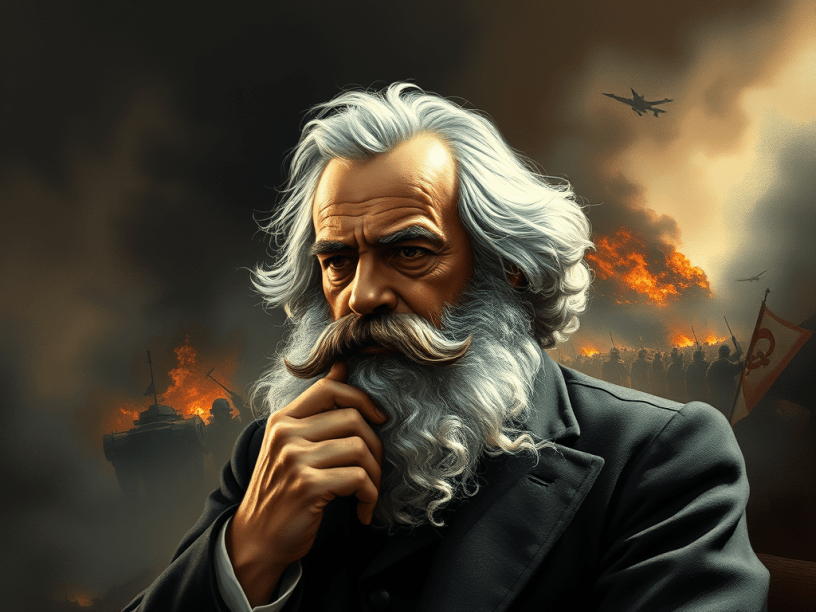
In the world of philosophical and economic theories, Karl Marx stands as a monumental figure whose ideas continue to spark discussion and analysis. One of the more intriguing aspects of Marx’s theories is his viewpoint on war. He believed that war, while destructive, was often a consequence of the deeper underlying conflicts rooted in class struggles. His analysis suggests that war could sometimes serve as a catalyst for revolutionary movements and societal transformations.
Karl Marx, a 19th-century philosopher, economist, and revolutionary figure, is renowned for his critical analyses of capitalism. Together with Friedrich Engels, he authored works that described the struggles between different classes within society. Marx viewed history as a series of conflicts based largely on economic inequalities, which inevitably led to social and political upheavals. In his view, wars were often the eruptive outcomes of these ongoing tensions.
Central to Marx’s perspective is the idea that social classes are in constant conflict with one another. He explained that the ruling class, or the bourgeoisie, often exploits the labor of the working class, the proletariat. This exploitation and inequality can build up pressure within a society, leading to confrontations and wars. According to Marx, wars frequently illustrate the deep-seated grievances and inequities in society.
However, Marx also saw another layer to war—it could act as an accelerant for change. While wars are inherently devastating, they can wreak havoc on established structures of power and force societies to rethink and rebuild. Marx believed these periods of turmoil and rebuilding offered opportunities for fundamental changes, especially in the way societies are organized and governed.
For example, in the chaos following a war, the oppressed classes might gain enough momentum and support to initiate revolutions. These upheavals provide a chance to challenge existing power structures and potentially establish new systems more equitable to the working class. Marx was optimistic about the potential for post-war societies to reorganize in ways that align more closely with communist ideals—or at least shift towards more equitable social arrangements.
In essence, Marx’s theory of war is not just about destruction but also about the possibility of rebirth. The societal reconfigurations that follow a war can lead to more profound changes that reflect the needs and aspirations of the oppressed working class. Though his views are steeped in the context of the industrial era he lived in, they continue to offer a lens through which people can view contemporary conflicts and their potential outcomes.
Thus, while the specter of war is rightfully decried for its immediate damage and lasting scars, Marx invites us to consider the longer-term effects. In the wreckage of battles, there lies the opportunity for transformation—a chance to rebuild and, perhaps, achieve a society where resources and wealth are distributed more evenly.
Discover more from WPS News
Subscribe to get the latest posts sent to your email.
 WPS News