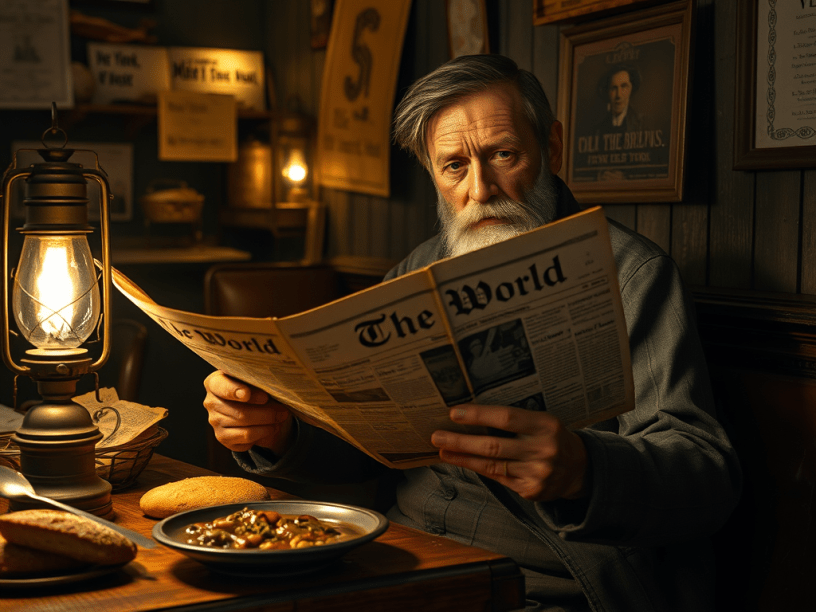
In the dim, flickering light of a gas lamp, a weary man settles into his modest eatery in Manhattan, the aroma of freshly baked bread mingling with the warmth of savory stew wafting from the kitchen. It is early evening in the 1870s, and after a long day of labor, he peruses the latest copy of The World—crisp and well-inked—his eyes scanning the headlines filled with tales of heroism, struggle, and the relentless march of progress through the tumultuous landscapes of city life. With each turn of the page, he connects to the heart of a bustling metropolis, absorbing powerful stories of labor strikes echoing through the streets, the vibrant voices of immigrants seeking a better life, and the steadfast journalists who dare to challenge the status quo. As he savors each bite, he is not merely consuming a meal but feasting on the pulse of society itself, feeling an intimate bond with the writers whose words shape, reflect, and sometimes incite the world around him.
Inspired by the evocative themes of Jack Finney’s Time and Again, we embark on a journey through the bustling streets of New York City in the late 19th and early 20th centuries, a time when the “New York World” emerged as a formidable voice in journalism. Founded by Joseph Pulitzer on May 10, 1860, The World quickly established itself as a pioneering force in the realm of news reporting, capturing the essence of the era’s social and political upheavals.
Advocacy for Labor Movements
At its core, The World was more than just a newspaper; it was an advocate for the marginalized and a champion of social justice. The publication’s extensive coverage of labor movements during a transformative period in America highlighted the struggles of workers fighting for better wages and working conditions. Reporting on significant events such as the Great Railroad Strike of 1877 and the Haymarket Affair of 1886, The World provided a platform for the voices of labor, illuminating the connection between social reform and the rights of workers.
Immigration Issues and Nativism
The newspaper didn’t shy away from immigration issues either. With New York City serving as a major entry point for immigrants, The World covered their experiences extensively. It portrayed the trials faced by newly arrived families as they sought to attain the American Dream, advocating for better treatment and protections against exploitation.
During periods of heightened nativism—characterized by anti-immigrant sentiments and movements opposing the presence of immigrants—The World countered these views, aiming to foster understanding and acceptance of immigrant communities (nativism is defined as the policy of protecting the interests of native-born or established inhabitants against those of immigrants). In its reporting, The World sought to combat stereotypes associated with immigrant groups, promoting the notion that they were essential to the nation’s fabric and highlighting their contributions to American society.
Prominent Reporters and Storytelling
The vibrant spirit of The World was mirrored by some of the most influential journalists of the time. Among them was Nellie Bly, whose daring investigative work made her a household name. Bly’s fearless undercover reporting, including her ten days spent in a mental asylum (linked here to her book “Ten Days in a Madhouse“), shed light on the mistreatment of vulnerable populations and showcased journalism’s power to spark reform. The enduring impact of Nellie Bly’s fearless investigative work is vividly portrayed in the modern film “Ten Days in a Madhouse,” which underscores the vital role of journalism in advocating for vulnerable populations and sparking meaningful reform in mental health care, a mission that remains just as relevant today. Another notable figure, Richard Harding Davis, captivated readers with his gripping accounts from war zones, influencing public perception of conflicts during the Spanish-American War.
As new generations of reporters contributed to The World, it became known for its lively style and commitment to journalistic integrity, standing at the forefront of significant cultural and political changes. From Eugene Field’s humorous observations on city life to Frank M. Chapman’s exploration of nature, The World presented a diverse array of voices, reflecting the dynamic fabric of society.
The Fire at 63 Park Row
Despite its achievements, The World faced significant challenges, including a devastating fire in 1890 that broke out at its offices located at 63 Park Row. The fire, caused by spontaneous combustion of flammable materials, led to extensive damage and disruption of operations. Fortunately, there were no fatalities reported. This incident underscored the vulnerabilities faced by media enterprises of the time and sparked changes in fire safety protocols within the industry.
The Evolution of The World
In 1931, financial pressures and shifts in the media landscape culminated in the merger of The World with the more stable “New York Evening Telegram,” leading to the creation of the “New York World-Telegram.” Though this was heralded as a merger, it resembled more of a takeover, effectively absorbing The World into a new entity.
As the decades passed, the World-Telegram continued to navigate the evolving media landscape, ultimately merging with the “New York Sun” in 1950. This marked the end of The World as an independent publication, yet its legacy persisted, influencing future generations of journalists and shaping the discourse of American media.
A Lasting Legacy
In reflecting on the captivating story of the New York World, we are reminded of the power and responsibility of journalism. Its commitment to uncovering truths, advocating for social justice, and amplifying the voices of the underrepresented lives on in today’s media landscape. Just as Finney’s exploration of time and memory resonates through his characters’ journeys, the enduring spirit of The World remains etched in the chronicles of American history, challenging us to continue the pursuit of truth and equity in our own time.
At WPS.News, our mission is inspired not only by the legacy of The World but also by a diverse array of influences, including iconic figures like Carl Kolchak from the supernatural drama Kolchak: The Night Stalker. Kolchak is emblematic of the investigative journalist, tirelessly seeking the truth amidst the chaos, often confronting society’s fears and uncertainties. This blend of perseverance and dedication to uncovering the extraordinary aligns with our values at WPS.News.
The “New York World-Telegram” ceased publication on May 5, 1966. After struggling with financial difficulties and competition from other media, the paper was ultimately folded into the “New York Post.” The end of the “World-Telegram” marked the conclusion of a significant chapter in New York City’s newspaper history.
Now lost to history, “The World” is a significant part of the tradition that we strive to uphold at WPS.News in Baybay, Leyte, Philippines, and beyond. We honor its legacy by committing ourselves to the ideals of fearless reporting, social advocacy, and giving voice to the voiceless. Our diverse inspirations encourage us to approach journalism with creativity, empathy, and an unwavering commitment to integrity.
As we navigate the contemporary challenges of journalism, we draw inspiration from The World‘s example, ensuring that the lessons from the past continue to guide our present and future in the ever-evolving world of information. In doing so, we pay homage to the foundational belief that journalism holds the power to effect change and shape society for the better, a belief that resonates deeply in our ongoing work.
In this way, we carry forward the torch of honest storytelling and community engagement, honoring the legacy of The World while forging our path in the vibrant mosaic of global journalism today.
Postscript
As we reflect on the legacy of The World and the indelible mark left by journalists like Nellie Bly, we recognize that every generation faces its unique set of challenges—from social injustices to the shortcomings of those in power. It is our turn to meet these challenges head-on, to rise above the oppressors, and to advocate for truth and equity in our communities. Just as previous generations have fought for the rights of the marginalized and sought to illuminate the darkness with the light of knowledge, we too must carry that torch forward, striving for a better world for all. In doing so, we honor the past and pave the way for a brighter future, ensuring that the principles of justice and compassion remain at the forefront of our collective efforts.
Cliff Potts, WPS News, Editor-in-Chief
Discover more from WPS News
Subscribe to get the latest posts sent to your email.
 WPS News