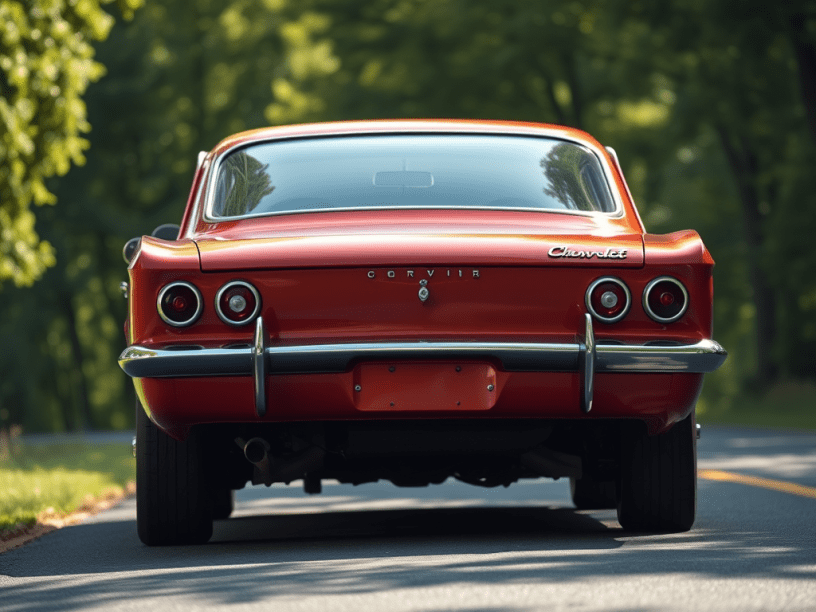
The 1965 Chevrolet Corvair 500 was a car unlike any other in its time. A compact, rear-engine design with a quirky charm, it quickly became a target for both criticism and praise. While its innovative engineering offered a glimpse into the future of automotive design, early production models were plagued by handling issues and safety concerns that tarnished its reputation. This essay delves into the Corvair’s story, exploring the controversies that surrounded it, the solutions Chevrolet implemented, and the design legacy it left behind.
One of the most significant criticisms of the Corvair 500 was its tendency to oversteer, particularly on sharp turns. The rear-engine design, a departure from the traditional front-engine layout, shifted weight distribution towards the rear. This could cause the rear tires to lose traction and lead to a spinout situation, especially for inexperienced drivers. Consumer advocate Ralph Nader’s 1965 book, “Unsafe at Any Speed,” singled out the Corvair, alleging inherent design flaws that made it prone to rollovers.
Chevrolet responded swiftly to these concerns. In 1964, for the 1965 model year, they introduced a redesigned rear suspension system with a wider track and a revised toe-in setting. This improved stability and reduced the likelihood of oversteer. Additionally, Chevrolet offered optional equipment like a larger rear sway bar to further enhance handling. These changes, while not entirely eliminating the oversteer issue, significantly improved the Corvair’s safety profile.
Another major complaint levied against the Corvair 500 was its heater system. Early models were notorious for allowing exhaust fumes to seep into the passenger compartment, creating a health hazard. This problem stemmed from a fresh air intake positioned too close to the exhaust pipe. The resulting fumes caused headaches, nausea, and other discomfort for drivers and passengers.
Chevrolet acknowledged the issue and introduced a redesigned heater system in 1965. The new design incorporated a longer air intake hose that drew fresh air from a location farther away from the exhaust. This effectively addressed the fume problem and ensured a safer and more comfortable driving experience.
Despite the controversies, the Corvair 500 boasted several innovative features. Its rear-mounted engine offered a spacious interior, a rarity in compact cars of the era. The engine’s placement also allowed for a lower center of gravity, contributing to a more engaging driving experience. Additionally, the Corvair’s independent suspension system on all four wheels provided a smooth and comfortable ride.
The Corvair’s design philosophy also played a role in the birth of another iconic Chevrolet – the Camaro. Introduced in 1968, the Camaro shared a platform with the Corvair, albeit with a front-engine layout. The design principles of a sporty, two-door coupe with a focus on handling and a comfortable interior were carried over from the Corvair. While the Camaro adopted a more traditional muscle car approach with its powerful V8 engines, the Corvair’s influence on its overall design is undeniable.
The 1965 Chevrolet Corvair 500 stands as a testament to both innovation and the challenges of bringing a revolutionary design to market. While initial criticism tarnished its reputation, Chevrolet’s quick response to safety concerns and its commitment to improving the car’s flaws deserve recognition. The Corvair’s legacy extends beyond its controversies, influencing the design of future Chevrolet models like the Camaro.
In conclusion, the 1965 Chevrolet Corvair 500 was a car that dared to be different. It faced its share of challenges but ultimately paved the way for future advancements in automotive design. The Corvair’s story serves as a reminder that innovation often comes with its own set of hurdles, but with dedication and continuous improvement, revolutionary ideas can pave the way for the future of transportation.
Discover more from WPS News
Subscribe to get the latest posts sent to your email.
 WPS News