By Cliff Potts, CSO, and Editor-in-Chief of WPS News
Entertainment as Emotional Anesthesia
Every era invents the entertainment it needs.
Not the entertainment it deserves.
The entertainment it can psychologically tolerate.
In periods of relative stability, culture experiments. In periods of decline, culture soothes. It reassures. It repeats familiar patterns and promises resolution even when none exists outside the screen.
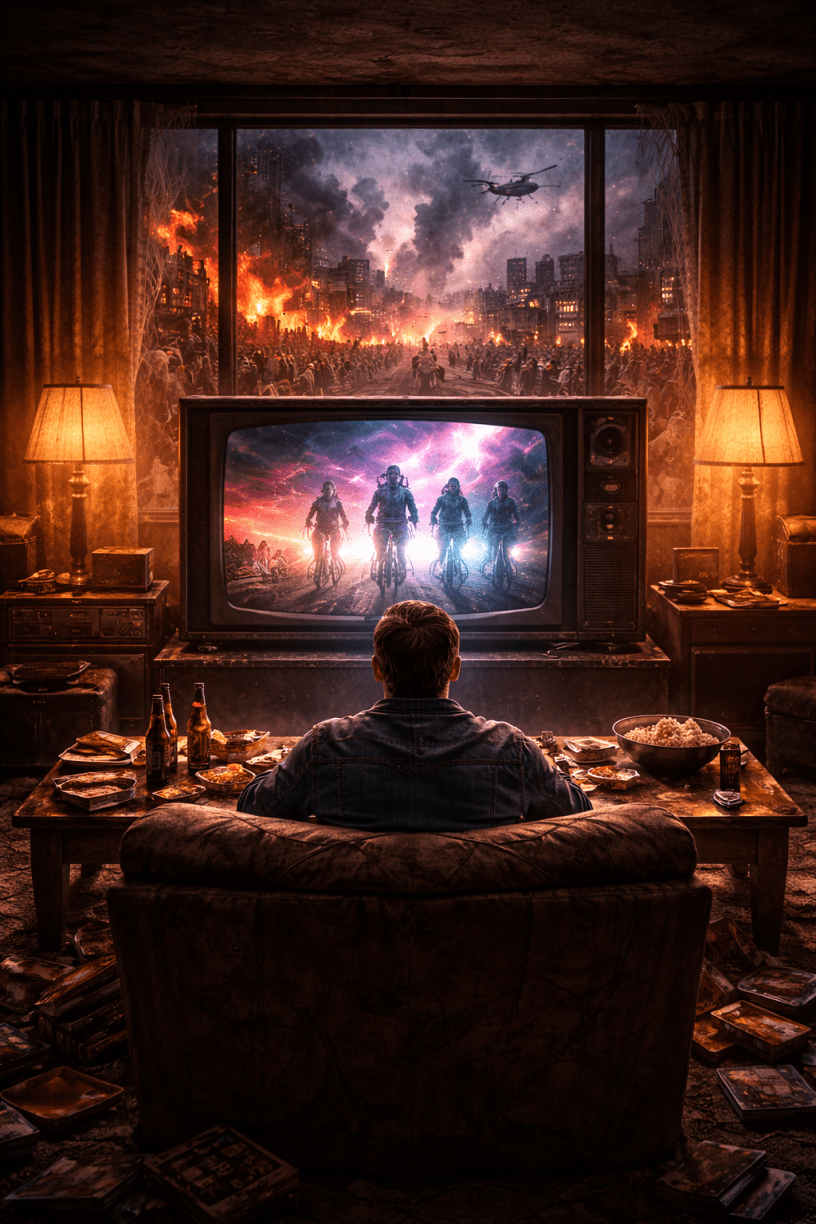
This is the role Stranger Things ultimately plays. And this is why its success feels both understandable and unsettling at the same time.
From Distraction to Dependence
Escapist entertainment has always existed, but there is a difference between diversion and dependence.
In the current era, entertainment no longer competes with lived experience. It replaces it.
When wages stagnate, housing collapses, institutions fail, and the future becomes permanently deferred, cultural products are no longer evaluated by their craft alone. They are evaluated by their capacity to provide emotional stability.
This is where the obscenity begins.
Not in the story itself, but in the scale of wealth and attention funneled into comfort while the material conditions of the audience continue to deteriorate.
Nostalgia as a Safe Operating System
Nostalgia functions as a kind of cultural operating system. It is familiar, low-risk, and emotionally legible.
Stranger Things does not ask its audience to imagine a better future. It asks them to reinhabit a past that feels manageable, even when rendered monstrous. The 1980s setting is not historical. It is emotional shorthand — a time before permanent crisis, before digital saturation, before precarity became the default condition.
The monsters are frightening, but the world itself feels navigable. That is the bargain being offered.
Why This Could Have Been a Movie
Structurally, Stranger Things was never an eighty-hour story. It was a compact narrative with a strong hook and diminishing returns.
The expansion was not driven by necessity. It was driven by platform economics.
Streaming systems reward retention, not resolution. Stories stretch because they must, not because they should. The result is narrative inflation — more episodes, more spectacle, more money — without a proportional increase in meaning.
What might have been a sharp, enduring film becomes an ongoing cultural appliance.
Wealth Without Proportion
Here is the part that resists polite conversation.
The extraordinary wealth generated by prestige streaming television exists in stark contrast to the financial reality of its audience. This imbalance creates moral friction, especially when the product itself acknowledges collapse but offers no engagement with its causes.
The discomfort is not jealousy.
It is disproportion.
When cultural comfort becomes one of the few remaining public goods, its monetization at this scale begins to feel extractive rather than celebratory.
Why People Still Watch
Despite all of this, people will keep watching.
They will watch because shared rituals are rare. Because fear without shape is unbearable. Because resolution, even false resolution, is preferable to endless ambiguity.
This does not make the audience foolish.
It makes them human.
The problem is not that people seek comfort. The problem is that comfort has become one of the most profitable industries in a collapsing system.
What This Moment Reveals
Future historians will not study Stranger Things to understand the 1980s. They will study it to understand the 2020s.
They will see a culture that sensed collapse but could not confront it directly. A culture that turned fear into monsters, economics into nostalgia, and uncertainty into spectacle.
That is not failure.
It is evidence.
Discover more from WPS News
Subscribe to get the latest posts sent to your email.

