By Cliff Potts, CSO, and Editor-in-Chief of WPS News
Baybay City, Leyte, Philippines — February 3, 2026
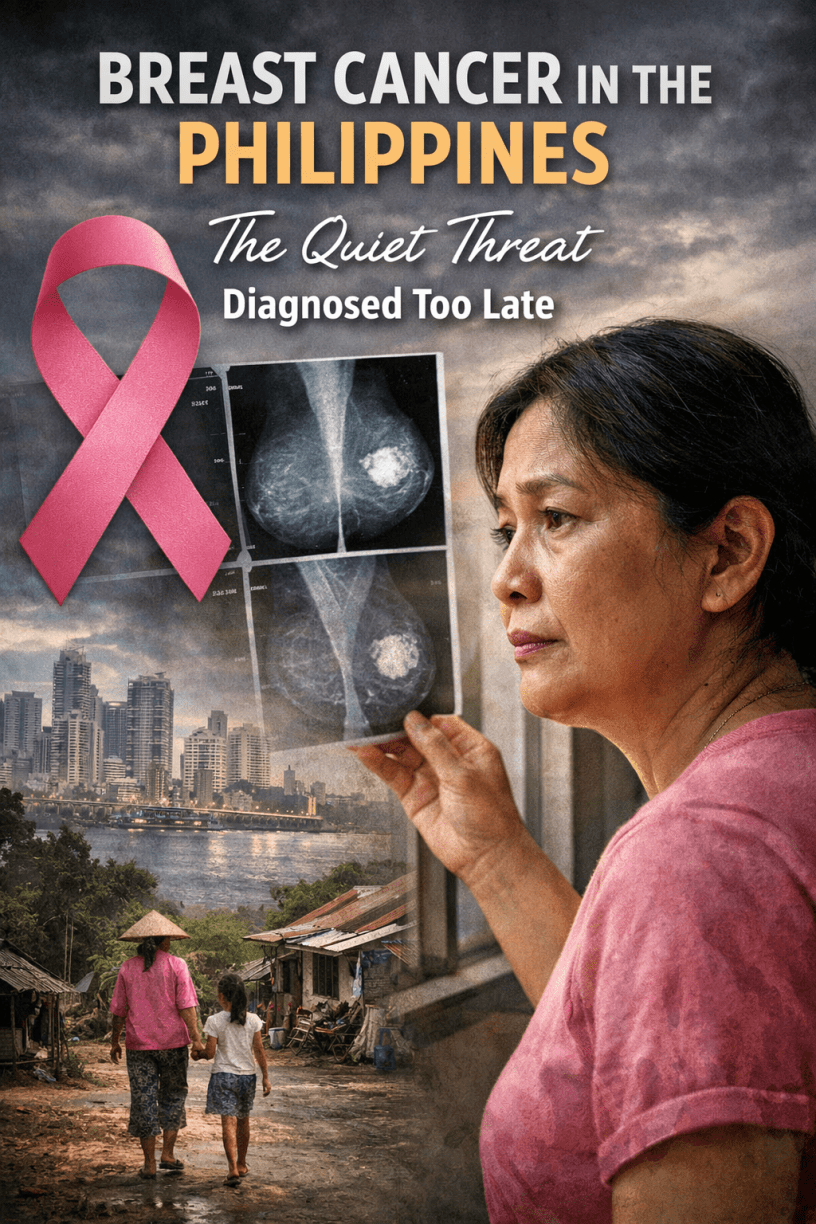
Breast cancer is the most common cancer affecting women in the Philippines. It is also one of the deadliest—not because it cannot be treated, but because it is often discovered too late.
Unlike disasters that arrive loudly, breast cancer advances quietly. Many women feel healthy. There is no pain, no fever, no obvious warning. Life continues as normal until a lump is found accidentally, symptoms appear suddenly, or the disease has already progressed beyond its earliest stages. By then, treatment becomes more complex, more expensive, and far less certain.
This is what makes breast cancer so dangerous in the Philippine archipelago. It does not announce itself. It waits.
A Widespread but Underestimated Disease
Breast cancer affects women across all regions of the country—urban and rural, wealthy and poor. Yet awareness does not always translate into action. Many women know breast cancer exists, but assume it will not affect them personally. Others believe it only happens to older women, or only if there is a family history.
These assumptions are wrong.
Breast cancer can develop at younger ages. It can occur without any known family link. And it can progress for months or years without noticeable symptoms.
In the Philippines, a significant number of cases are diagnosed at advanced stages. This is not because women are careless. It is because the disease is deceptive, and the systems designed to catch it early are uneven and often inaccessible.
Why Late Detection Is Common
There are several reasons breast cancer is often found late in the Philippines.
Access is one. Regular screening is not evenly available across the archipelago. Mammography services are concentrated in major cities, leaving many provinces underserved. For some families, the cost of screening alone is enough to delay or avoid it entirely.
Culture also plays a role. Many women place family responsibilities ahead of their own health. Others avoid medical visits out of fear—fear of diagnosis, fear of cost, or fear of burdening loved ones. Silence becomes a coping strategy, even when it increases risk.
There is also a dangerous misconception that absence of pain means absence of illness. Breast cancer often does not hurt in its early stages. Waiting for pain is waiting too long.
Why This Matters
When breast cancer is found early, treatment options are wider and survival rates are far higher. When it is found late, choices narrow quickly. The difference between early and late detection is not academic—it is the difference between manageable treatment and life-threatening illness.
This is why breast cancer remains such a quiet threat. It advances while daily life continues. It hides behind normal routines, household obligations, and the belief that “everything feels fine.”
A Public Health Issue, Not a Private Failure
It is important to say this clearly: late detection is not a personal failure. It is a public health problem.
When screening is difficult to access, when information is incomplete, and when fear replaces support, people delay care. The responsibility does not rest on individual women alone. It rests on families, communities, health systems, and national priorities.
Breast cancer is not rare. It is not abstract. And it is not someone else’s problem.
It is present in the Philippines today, affecting mothers, daughters, sisters, and wives across the archipelago—often silently, often unnoticed, until it can no longer be ignored.
This series will examine why that happens, what the survival realities are, and why early detection remains the single most effective way to save lives.
For more social commentary, please see Occupy 2.5 at https://Occupy25.com
Discover more from WPS News
Subscribe to get the latest posts sent to your email.
 WPS News