By Cliff Potts
Baybay City, Leyte, Philippines — April 5, 2026
There comes a point where the past stops being memory and starts being inventory.
Not nostalgia. Not regret. Inventory.
What was built. What was lost. What still stands. What never paid off. What might yet.
Over the past twenty-four hours, that process showed up in an unexpected place: dreams. Not symbolic noise, not random fragments, but structured reflections that held together after waking. Two sequences, different on the surface, but aligned underneath.
One dealt with visibility. The other with accounting.
Together, they pointed to something real.
Being Seen Without Control
The first dream wasn’t about what it appeared to be. There was no indulgence, no fantasy driving it. What mattered was the setting—being part of something that others discuss, interpret, and judge from the outside.
That’s the shift.
Not participation. Exposure.
There’s a difference between building something quietly and watching it begin to surface in places you didn’t expect. Once that happens, the control you had over meaning starts to slip. Others define it. Systems interpret it. Context gets lost.
That’s the trade.
Recognition doesn’t arrive alone. It brings distortion with it.
And the response to that isn’t clean. There’s tension—wanting to be seen, and wanting to stay out of reach at the same time.
Taking Inventory of a Life
The second dream moved in the opposite direction. It went backward.
Old places. Old relationships. Old versions of self. Not relived emotionally, but observed structurally. It wasn’t about feeling—it was about measuring.
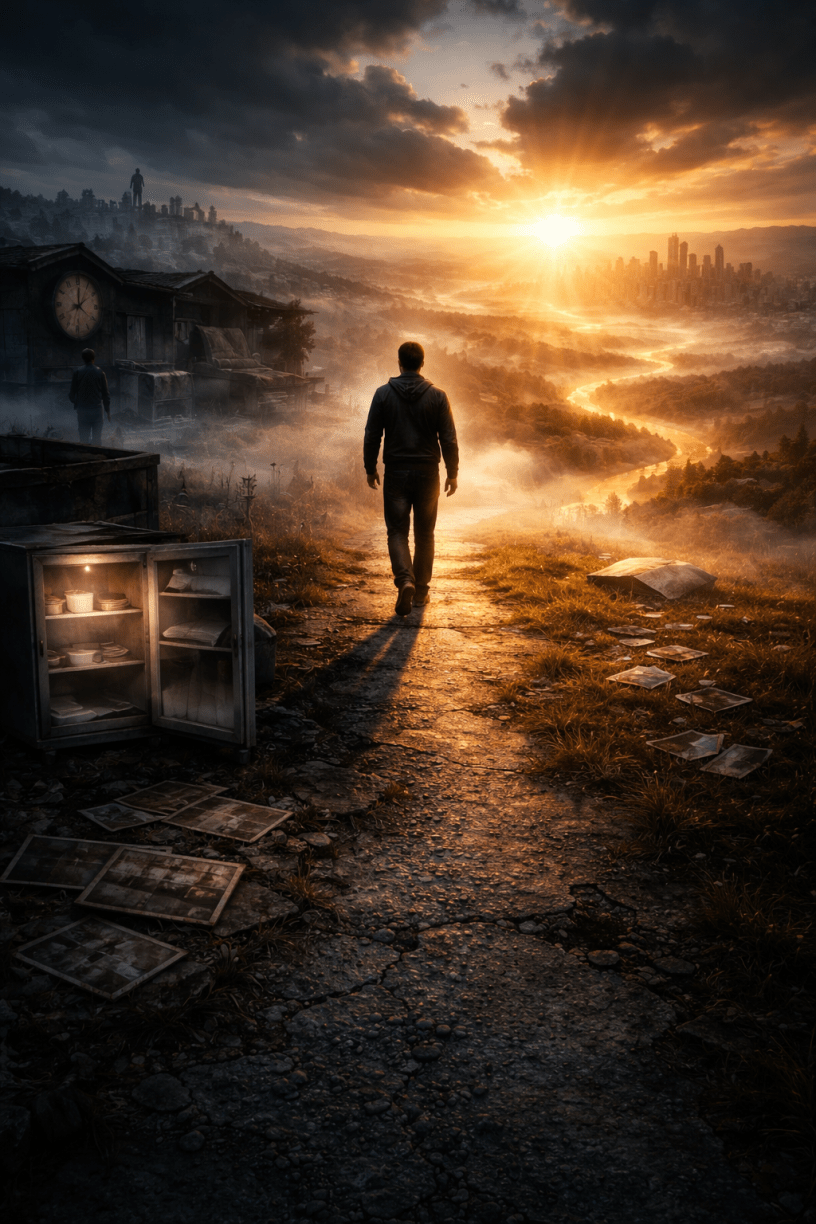
Rooms filled with remnants. Systems that once supported something. A clock tied to a moment when expectations were set. A path still moving forward, but smaller than it once appeared it might be.
And at the center of it, a simple image:
An open refrigerator. Powered off. Full of empty containers.
That doesn’t require interpretation.
It’s effort without return. Preparation without fulfillment. Structure without outcome.
The Question Underneath Both
Taken together, the meaning becomes clear:
If the work is now being seen—if recognition is beginning in any form—was everything it took to get here worth it?
That question doesn’t answer itself.
Because visibility doesn’t fix the past. It doesn’t restore what was lost. It doesn’t balance what never came back.
What it does is force a decision about what comes next.
Alignment, Not Closure
There is no clean ending to a life that didn’t follow its expected path.
What exists instead is alignment.
Past experience stops being weight and starts becoming structure. The work already exists. The perspective is already formed. The system—however incomplete—is already built.
The question isn’t whether the past makes sense.
The question is whether to move forward with full awareness of what visibility requires.
Because once something is seen—even at a small level—it stops belonging only to the person who created it.
It enters a system.
And that system will use it.
Forward, With Awareness
So the direction is simple.
Forward. Not blindly, but deliberately.
The past has been examined. The losses are understood. The gaps are visible. The work is real.
Stopping now would render all of it pointless.
Continuing doesn’t erase what happened.
But it gives it function.
Not restoration. Not return. Just something still standing where nothing should be.
And that is enough.
If you read this and it matters, help me keep it going:
https://www.patreon.com/cw/WPSNews
Discover more from WPS News
Subscribe to get the latest posts sent to your email.
 WPS News