By Cliff Potts, Editor-in-Chief of WPS News
Baybay City, Leyte, Philippines — April 28, 2026 — 12:35 PHST
On this date in 1869, 157 years ago, the eastern and western United States were linked by iron rails at Promontory Summit, in what was then the Mormon territory of Utah.
The First Transcontinental Railroad completion was celebrated as a triumph. A golden spike was tapped into place. Telegraph wires carried the news across the country. The United States declared itself connected.
The story most people hear ends there.
It shouldn’t.
Because what the railroad did right is obvious. It unified a continent. It accelerated trade. It reduced travel time from months to days. It turned distance into opportunity.
That is the part every developing nation, including the Philippines, should study carefully.
Rail infrastructure works. It changes everything.
But what the United States did wrong matters just as much.
The railroad was built fast, often recklessly. Labor was treated as expendable. Irish workers in the east and Chinese workers in the west carried the physical burden under dangerous conditions. Entire work camps were lost to disease with little record or response. Safety was secondary to progress.
And the rails did not just connect cities. They cut through nations.
Indigenous lands were seized, divided, and permanently altered. The railroad did not cause that process alone, but it accelerated it. Once the rails were in place, movement of settlers, soldiers, and industry followed immediately.
Infrastructure is never neutral.
It always serves someone first.
That is the real lesson for the Philippines in 2026.
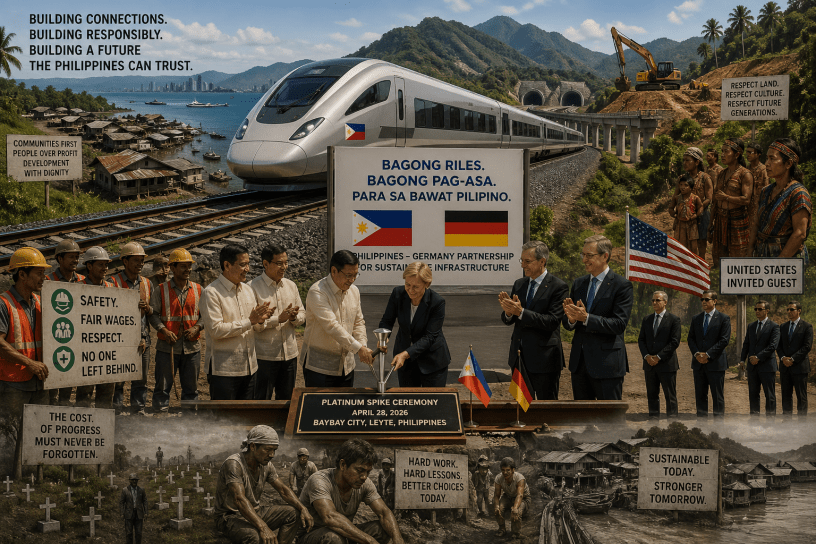
Rail development across Luzon, Visayas, and Mindanao has the potential to transform the country. It can reduce costs, improve mobility, connect rural areas, and strengthen national resilience.
But the questions cannot stop at “Can we build it?”
They have to include:
Who benefits first?
Who gets displaced?
Who pays the hidden cost?
What happens to communities along the route?
The United States answered those questions poorly in 1869. It prioritized speed, expansion, and profit over people.
The result was success on paper and damage on the ground.
The Philippines has the advantage of hindsight.
It can build smarter. It can plan routes that serve communities rather than cut through them. It can enforce labor protections. It can treat infrastructure not just as an economic tool, but as a national responsibility.
The railroad in 1869 proved what was possible.
What comes next, here in the Philippines, will prove what is learned.
References
Ambrose, S. E. (2000). Nothing like it in the world: The men who built the transcontinental railroad 1863–1869. Simon & Schuster.
Chang, G. H. (2019). Ghosts of gold mountain: The epic story of the Chinese who built the transcontinental railroad. Houghton Mifflin Harcourt.
White, R. (2011). Railroaded: The transcontinentals and the making of modern America. W. W. Norton & Company.
Discover more from WPS News
Subscribe to get the latest posts sent to your email.

