By Cliff Potts, CSO, and Editor-in-Chief of WPS News
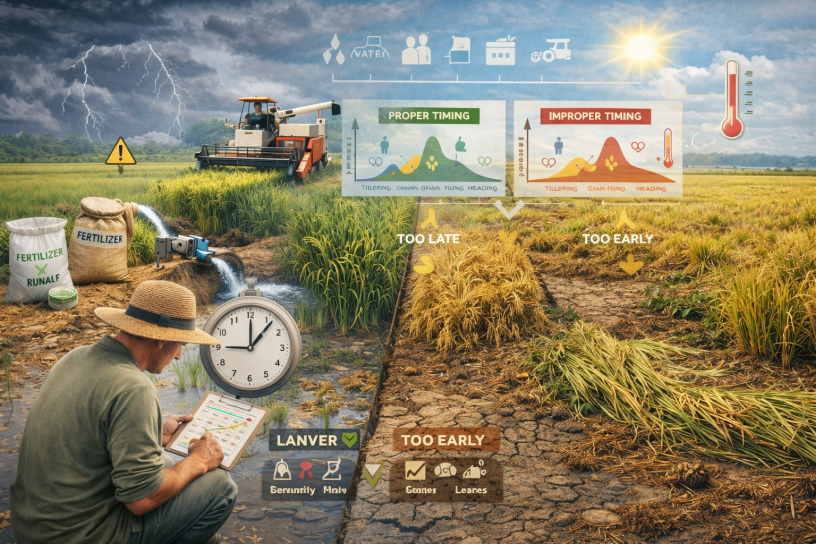
Rice production is often described in terms of effort: how hard farmers work, how much fertilizer is applied, or how many hours are spent in the field. In practice, timing has a greater influence on outcomes than effort alone. When key actions happen late or out of sequence, yields decline even if inputs and labor are adequate.
Timing affects nearly every stage of the rice system, from planting to harvest.
Planting Windows Are Not Flexible
Rice varieties are developed with specific growth durations in mind. Planting outside the recommended window shifts sensitive growth stages into less favorable weather. This can expose flowering and grain filling to excess heat, heavy rainfall, or pest pressure, reducing yield without obvious early warning signs.
When planting is delayed because of late water release, seed delivery problems, or labor shortages, the crop may never reach its full potential.
Fertilizer Timing Shapes Yield
Fertilizer does not work simply because it is applied. It works when nutrients are available at the stages when the plant can use them efficiently. Nitrogen applied too early may be lost to runoff or evaporation. Applied too late, it raises costs without improving grain formation.
Correct timing improves uptake efficiency and lowers total fertilizer requirements. Poor timing raises expenses while producing little benefit.
Harvest Timing Affects Losses
Harvesting rice too early reduces grain weight and milling quality. Harvesting too late increases shattering, lodging, and pest damage. Even a short delay can lead to measurable losses, especially during wet seasons.
Uneven crop maturity, often caused by mixed seed or irregular planting dates, forces farmers to choose between early losses and late losses. Both reduce usable output.
Coordination Matters More Than Precision
Most timing problems are not caused by lack of knowledge. They result from coordination failures. Water delivery schedules, labor availability, machinery access, and weather forecasts all influence when farmers can act. When these systems are misaligned, individual effort cannot compensate.
Improving coordination often produces larger gains than introducing new technology.
Why Timing Is a System Issue
Timing depends on systems outside the farm gate. Reliable irrigation schedules, timely input distribution, and access to shared equipment all influence whether best practices can be followed. When these systems function well, farmers can work within optimal windows. When they do not, delays become unavoidable.
Improving timing does not require more work from farmers. It requires smoother operation of the systems that support them. When timing improves, yields rise, costs fall, and production becomes more predictable.
Discover more from WPS News
Subscribe to get the latest posts sent to your email.
 WPS News