Why Survival Depends on Cooperation, Not Individualism
By Cliff Potts, CSO, and Editor-in-Chief of WPS News
Baybay City, Leyte, Philippines — May 4, 2026
Guns Don’t Equal Survival
Popular culture has a second rule of survival, right behind the lone wolf myth: the more weapons you have, the better your chances.
From The Walking Dead to Z Nation, survival is framed as a function of firepower. The armed individual or group dominates. Everyone else is either a threat or a victim.
It is simple. It is dramatic.
It is also deeply misleading.
The Myth
The myth is straightforward: security equals survival.
If you can defend yourself—if you can deter or eliminate threats—then you can survive whatever comes.
In this model, weapons become the primary tool of survival. Food, water, medicine, and coordination are secondary. The assumption is that once security is established, everything else can be acquired or controlled.
This reverses how survival actually works.
Why People Believe It
The belief comes from a basic instinct: fear.
In uncertain conditions, people focus on immediate threats—other people, violence, loss of control. Weapons feel like control. They offer a clear, direct response to danger.
There is also a cultural layer. In many places, especially in the United States, strength is often associated with force. The idea that survival depends on being able to fight is not just accepted—it is expected.
Media reinforces this by showing conflict as constant and unavoidable. Every encounter becomes a potential confrontation. Trust disappears. Cooperation becomes risky.
So people prepare for conflict, not continuity.
Why It Fails in Reality
Weapons solve one problem: immediate threats.
They do not solve the problems that actually determine survival.
- They do not produce food
- They do not purify water
- They do not provide medical care
- They do not maintain infrastructure
- They do not organize people
In prolonged crises, these needs matter more than security.
History shows this clearly.
During World War II, military force was only one part of survival. The outcome depended on production, logistics, transportation, communication, and coordination across entire societies.
Weapons without supply chains are useless.
The same pattern appears in modern disasters. In the aftermath of Hurricane Katrina, survival depended less on who was armed and more on who had access to functioning systems—water, evacuation, medical care, and organized response.
Security mattered, but it was not the foundation.
What Actually Works
Security is necessary. It is not sufficient.
What works is balance:
- Basic security to reduce immediate risk
- Strong logistics to sustain life
- Coordination to manage resources
- Trust to enable cooperation
In functioning groups, security is one role among many. It is not the center of the system.
A group that focuses only on defense becomes fragile. It consumes resources without producing them. It isolates itself from potential partners. It eventually runs out of what it needs to survive.
A group that balances security with production, planning, and cooperation becomes resilient.
A Different Model of Strength
The myth defines strength as the ability to dominate.
The real world defines strength as the ability to sustain.
A heavily armed individual may survive a confrontation.
A coordinated group survives the long term.
That difference is critical.
In real crises, survival depends less on the ability to fight and more on the ability to organize. The groups that last are the ones that can:
- Allocate labor effectively
- Maintain supply lines
- Adapt to changing conditions
- Integrate new people and skills
Weapons do not create these capabilities. People do.
Practical Takeaway
If you are preparing for disruption, shift your focus.
Ask different questions:
- Who can produce or access food?
- Who understands water and sanitation?
- Who can provide medical care?
- Who can organize and coordinate?
- How are decisions made and enforced?
Security is part of the system, but it is not the system.
Over-investing in defense while ignoring everything else creates a false sense of readiness.
Conclusion
The idea that survival belongs to the most heavily armed is appealing because it offers a simple answer to a complex problem.
But survival is not simple.
It is built on systems, not force.
Weapons can protect a system.
They cannot replace one.
Collapse does not reward those who can fight the longest.
It rewards those who can sustain the longest.
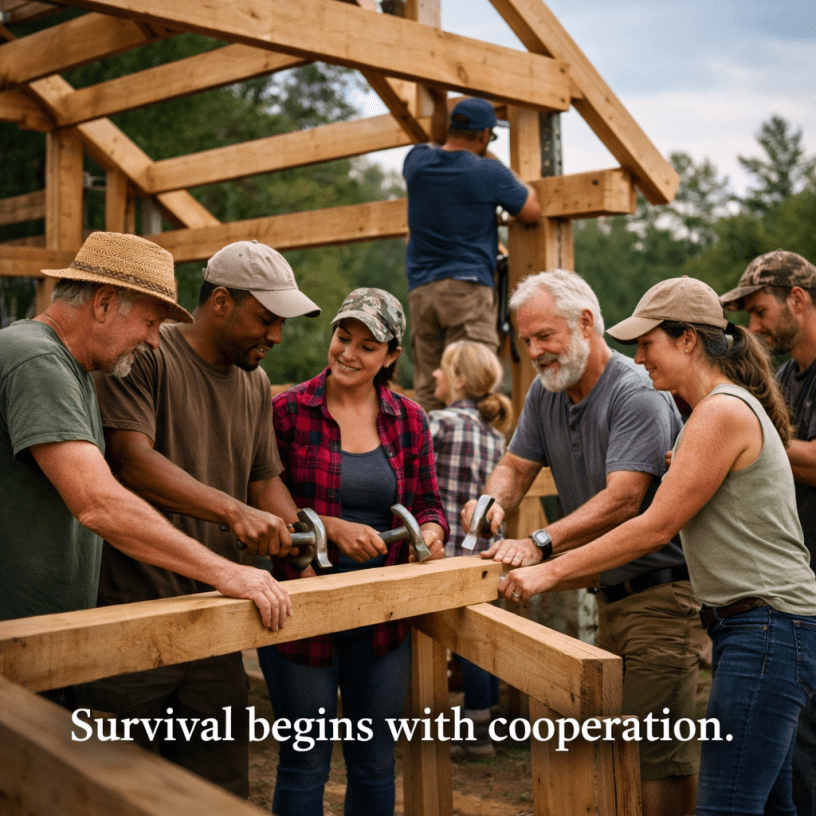
Survival begins with cooperation.
For more social commentary, please see Occupy 2.5 at https://Occupy25.com
If you read this and it matters, help me keep it going: https://www.patreon.com/cw/WPSNews
References
Brooks, M. (2006). World War Z: An Oral History of the Zombie War. Crown.
Federal Emergency Management Agency. (2006). Hurricane Katrina After-Action Report.
Keegan, J. (1989). The Second World War. Viking.
Discover more from WPS News
Subscribe to get the latest posts sent to your email.
 WPS News