By Cliff Potts, CSO, and Editor-in-Chief of WPS News
Baybay City, Leyte, Philippines — May 5, 2026
Truth is stranger than fiction. That phrase has become a cliché. You may already know the Battle of Castle Itter from a Facebook video, a YouTube history channel, or a TikTok clip. But the story belongs in the archive anyway, because its strangeness is real and because it shows something people too often forget: human beings can still choose decency in the middle of a man-made hell. This story belongs here for that reason. It reminds us that we created this mess. We can fix this mess. (Britannica)
The War Had Not Ended
The Battle of Castle Itter was fought on May 5, 1945, in the Austrian Tyrol, only days before Germany’s unconditional surrender took effect in Europe. Adolf Hitler had killed himself on April 30, 1945. Germany signed an unconditional surrender at Reims on May 7, to take effect on May 8–9. That timing matters. This was not a postwar handshake. There was no peace in force between Germany and the United States when the shooting started at Itter.
American troops and German troops were still, legally and militarily, enemies. What happened there was not diplomacy. It was a moral decision made under fire by men who understood that the Nazi state was collapsing but that its killers were still dangerous. (National WWII Museum)
A Prison for the Powerful
Castle Itter was an old fortress repurposed by the Nazi regime as a special detention site tied to the Dachau concentration camp system. It was used to hold high-profile French prisoners whom the regime considered valuable.
Among those imprisoned were former French prime ministers Édouard Daladier and Paul Reynaud; military leaders Maurice Gamelin and Maxime Weygand; labor leader Léon Jouhaux; political figure François de La Rocque; Marie-Agnès de Gaulle; and tennis champion Jean Borotra. Eastern European prisoners were also held there for labor.
This was not a random group of captives. These were political and symbolic figures. Their survival or death carried meaning beyond the walls of the castle. (Wikipedia)
Collapse Without Safety
By early May 1945, the Nazi system in Austria was disintegrating. But collapse did not mean safety. Armed SS units were still active, still organized, and still capable of violence. In many places, they were acting independently, enforcing terror even as the war was clearly lost.
At Castle Itter, the SS guards abandoned their posts. That did not free the prisoners. It left them exposed.
Two attempts were made to reach Allied forces. Zvonimir Čučković, a Yugoslav resistance prisoner, escaped to seek help. Later, the castle cook, Andreas Krobot, made another attempt, bicycling toward nearby towns to find assistance. These actions were not acts of confidence. They were acts of desperation. (Wikipedia)
A German Officer Makes a Choice
The call for help reached Major Josef “Sepp” Gangl, a Wehrmacht officer stationed in Wörgl. Gangl had already turned against the SS and was working with Austrian resistance fighters to protect civilians.
This is where the story becomes uncomfortable in a useful way. Gangl was still a German officer. The war had not ended. Yet he chose to act based on what he saw happening around him rather than on the collapsing authority of the regime.
He understood that SS units remained a threat and that civilians and prisoners were at risk. That recognition—not any formal alliance—drove his decision. (Britannica)
An Improvised American Response
Gangl contacted U.S. Army officer John C. “Jack” Lee Jr. of the 23rd Tank Battalion, 12th Armored Division. Lee did not have overwhelming force available. He had to improvise.
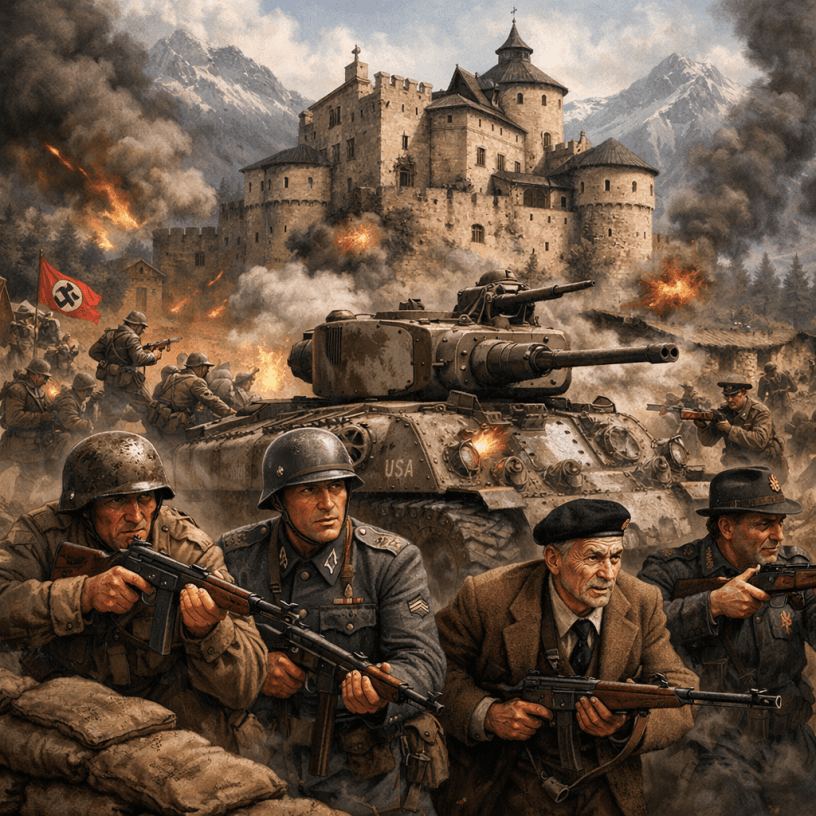
With a small number of American soldiers, a Sherman tank named Besotten Jenny, Gangl, and a handful of German troops who had broken with the SS, Lee moved toward the castle.
This was not a planned operation supported by a full chain of command. It was a limited, risky action based on incomplete information and immediate necessity. (HistoryNet)
Inside the Castle
When Lee’s force reached Castle Itter, the situation inside was unstable. The prisoners had armed themselves. Another unexpected figure joined the defense: Kurt-Siegfried Schrader, an SS officer who sided with the defenders in the final moments.
Lee positioned his men and used the Sherman tank to cover the entrance. He reportedly advised the prisoners to remain under cover. Some did not.
Former prime ministers, generals, and public figures took up weapons and joined the defense. The scene sounds improbable because it is. But it is also documented. (Wikipedia)
The Attack
On May 5, 1945, Waffen-SS troops—estimated at roughly 100 to 150 men—attacked the castle. The war was still active. These were not remnants acting symbolically. They were armed and intent on taking the position.
The defenders included American soldiers, Wehrmacht troops loyal to Gangl, Austrian resistance fighters, and the prisoners themselves.
The SS opened fire with machine guns and heavier weapons. Early in the battle, Besotten Jenny was knocked out, removing a key defensive asset. Ammunition began to run low. The defenders were isolated and under pressure. (Wikipedia)
A Desperate Breakthrough
With communications failing and the situation deteriorating, Jean Borotra volunteered to leave the castle and seek help. Lee allowed it.
Borotra escaped the castle, evaded SS forces, and reached advancing American troops. He then helped guide or direct them back toward Itter.
This action helped ensure that relief would arrive before the defenders were overrun. (Wikipedia)
Gangl’s Final Act
During the battle, Josef Gangl was killed by a sniper while attempting to move Paul Reynaud to safety. He died protecting a former enemy of his country.
Gangl is remembered in Austria as a hero. That recognition exists because he made a choice that went beyond orders. He acted on the reality in front of him rather than on the collapsing structure behind him. (Wikipedia)
Relief and Survival
In the afternoon, elements of the U.S. 142nd Infantry Regiment arrived and broke the siege. Approximately 100 SS troops were captured. The prisoners survived.
Lee later received the Distinguished Service Cross. The defenders had held just long enough for relief to reach them.
The battle ended. The war, in Europe, would end days later.
What This Battle Actually Proves
It is easy to turn Castle Itter into a feel-good story. That would be a mistake.
The Nazis built the system that created this prison. The SS remained the active threat at the end. Those facts do not change.
What does matter is what happened inside that reality. American soldiers and German soldiers fought together without a peace treaty, without orders authorizing cooperation, and without the war being over.
They acted because they saw what was happening and chose to respond to it.
That is the point.
We created this mess. We can fix this mess.
History does not guarantee that people will do the right thing. Castle Itter shows that they can.
And sometimes, in the worst possible moment, that choice is enough. (Britannica)
For more social commentary, please see Occupy 2.5 at https://Occupy25.com
If you read this and it matters, help me keep it going: https://www.patreon.com/cw/WPSNews
References
Bell, B. (2015, May 7). The Austrian castle where Nazis lost to German-US force. BBC News.
Britannica. (n.d.). Battle for Castle Itter. Encyclopaedia Britannica.
Britannica. (n.d.). Germany’s surrender (1945). Encyclopaedia Britannica.
Harding, S. (2013). The last battle: When U.S. and German soldiers joined forces in the waning hours of World War II in Europe. Da Capo Press.
National WWII Museum. (2020, March 30). The death of Adolf Hitler.
Wikipedia contributors. (n.d.). Battle of Castle Itter. Wikipedia.
Discover more from WPS News
Subscribe to get the latest posts sent to your email.
 WPS News
Thank You for showing what good, decent people can accomplish 💖
LikeLiked by 1 person