By Cliff Potts, CSO, and Editor-in-Chief of WPS News
Baybay City, Leyte, Philippines — May 13, 2026
The music industry has decided to panic.
Again.
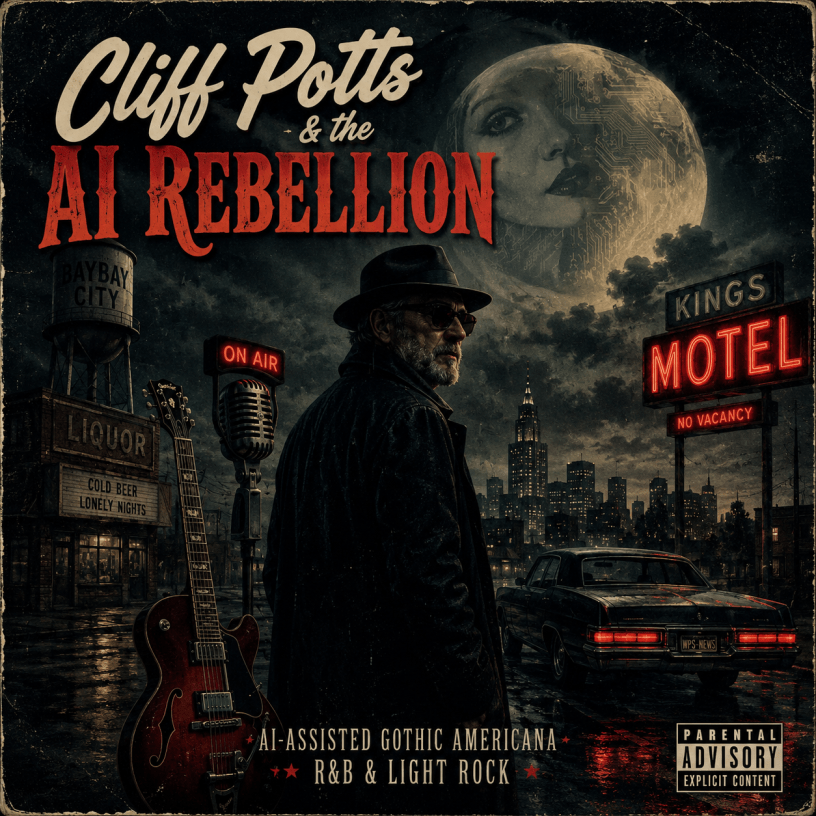
This time the panic is over AI-assisted music, and the reaction from parts of the distribution world has shifted from caution into what increasingly looks like institutional gatekeeping. The latest example arrived this week when CD Baby rejected distribution of a Cliff Potts and the AI Rebellion release specifically because of AI content.
That matters because CD Baby was historically viewed as one of the more open independent music distributors. For years, independent musicians used the platform to bypass traditional label systems and reach audiences directly. But the rise of AI-assisted production has changed the political landscape inside music distribution.
The new fault line is not “human versus machine.”
The real divide is this:
Who gets to create?
And who gets to decide what counts as “real” art?
For decades, the music industry tolerated drum machines, autotune, digital editing, synthesizers, quantization, pitch correction, sample libraries, virtual instruments, and algorithmically optimized mastering chains. Entire genres were built on technological disruption.
Now suddenly, executives who spent twenty years turning music into metadata pipelines want to rediscover “authenticity.”
That timing is difficult to ignore.
What appears to terrify sections of the industry is not merely AI music itself. It is the collapse of production barriers. A retired widower in the Philippines with no studio, no label, no corporate sponsorship, and no institutional backing can now build songs, albums, atmosphere, branding, visuals, essays, podcasts, and integrated media ecosystems from a phone and a tablet.
That changes power relationships.
And that is where Cliff Potts and the AI Rebellion enters the picture.
The project is not trying to impersonate famous artists. It is not cloning voices. It is not pretending machines magically replaced human creativity.
The project openly identifies itself as AI-assisted.
More importantly, it treats AI as an instrument.
The result is a strange emerging hybrid that could best be described as AI-Assisted Gothic Americana R&B and Light Rock.
Late-night radio music for collapsing timelines.
Songs filled with rain, old neighborhoods, dead shopping malls, Midwestern ghosts, empty bars, tropical humidity, insomnia, grief, labor exhaustion, forgotten working-class memory, and the strange emotional texture of surviving modernity while the internet slowly turns into static.
It is music built from narration, atmosphere, essays, spoken-word cadence, synthetic orchestration, human direction, historical memory, and machine-assisted arrangement.
Not artificial humanity.
Augmented humanity.
That distinction matters.
The entertainment industry has spent years warning audiences about AI while simultaneously automating writers, editors, customer service workers, journalists, artists, and musicians out of economic stability wherever possible. Many corporate actors appear perfectly comfortable with automation when shareholders benefit, but uncomfortable when ordinary people gain production capability.
That contradiction sits at the center of the current conflict.
The likely future is not a clean victory for either side.
Instead, the industry is fragmenting into camps.
Some distributors are moving toward hard anti-AI policies. Others are creating disclosure systems. Others still appear willing to tolerate AI-assisted work so long as ownership rights are clear and direct artist cloning is avoided.
The legal frameworks remain unstable.
The business models remain unstable.
The cultural arguments remain unstable.
But the technology is not going away.
Neither are the people using it.
And that means a new generation of hybrid creators is emerging whether legacy gatekeepers approve or not.
What matters now is not whether AI exists in music.
It already does.
What matters is whether independent creators will still be allowed to participate in culture without corporate permission.
That question is much larger than one rejected album.
It is about who gets to speak in the next media era.
If this work helps you understand what’s happening, help me keep it going: https://www.patreon.com/cw/WPSNews
For more from Cliff Potts, see https://cliffpotts.org
References
CD Baby Artist Support. (2026, May 13). Re: Your submission requires your action: Ang Lindol Ay Rock and Roll Lang [Email].
Discover more from WPS News
Subscribe to get the latest posts sent to your email.

